Alex Hassell
The Mystery of The Invisible DogAlex Hassell is a tenant whose daily cat-feeding routine makes him a familiar presence in the courtyard and an unlikely-seeming but plausible suspect in the theft of the Carpathian Hound. His role in the mystery is shaped by that contrast: he is known for caring for strays, yet he lives within the small neighborhood circle whose routines and access help the investigators narrow the case.
Identity and Routine
Fenton Prentice describes Hassell as a man with private means and no job, able to come and go as he pleases. Prentice believes he walks through the city looking for stray cats and takes sick or injured ones to a veterinarian. Hassell also keeps a Siamese cat in his apartment. The label “cat man” condenses the reputation he has acquired among his neighbors, but it rests on regular acts of care rather than a profession.
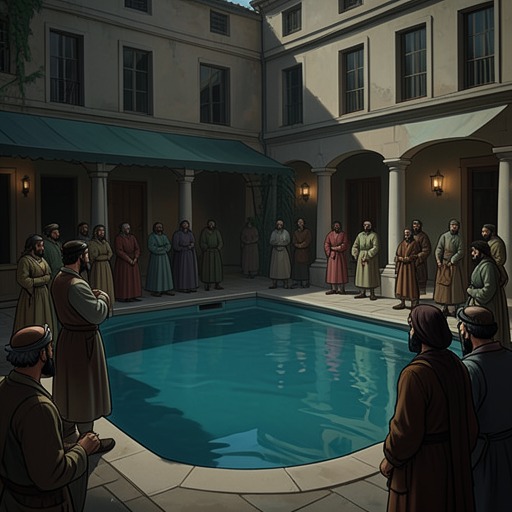
That routine has a precise hour and place. Every evening at five, stray cats gather at Hassell’s door to be fed. When the investigators see him in the courtyard, a grey cat runs in ahead of him. Hassell crosses to a rear apartment door, briefly leaves the cat outside, then returns with a plate of food and crouches on the flagstones as it eats. The scene makes his reputation visible in action: feeding is not merely something others say he does, but a repeated practice that shapes the courtyard’s daily life.
A Link in the Neighborhood’s Information Chain
Hassell also occupies a place in the flow of neighborhood gossip. When Sonny Elmquist asks how the boys knew about the phantom priest, he explains that Mrs O’Reilly told Mrs Bortz, Mrs Bortz told Hassell, and Hassell told him. The chain shows Hassell passing along news rather than originating it; his connections give him access to what neighbors have heard, while the story of the supposed apparition reaches Elmquist through several intermediaries.
The investigators observe the courtyard for hours without seeing anything happen beyond Mrs Bortz taking garbage to the bins. Hassell is not reported among the people who appear during that stretch. Later, when Elmquist comes out to look into the pool, the investigators also see John Murphy leave his apartment. The watch establishes the courtyard as a shared space in which tenants’ movements can be observed, but it does not by itself implicate Hassell in the theft.
Suspicion and the Pool
When Jupiter announces that the stolen Hound is in the building, Hassell objects that there is no dog there and adds that his cats would know if one were present. His response is rooted in his everyday frame of reference: he expects a dog to be a living animal that might disturb the cats. Prentice then clarifies that the Hound is a crystal sculpture, making the apparent contradiction between Hassell’s confidence and the object’s presence a matter of what the word “dog” means.
Hassell is nevertheless among the final suspects. Jupiter reasons that the burglar must have been a neighborhood resident familiar with the church keys and with the tenants’ habits, including when the pool would be safe to use. After excluding Miss Chalmers and Mrs Bortz, he narrows the field to tenants; after considering the alibis of Sonny Elmquist and Harley Johnson, he identifies Hassell and Murphy as the remaining possibilities. Both men were away from home during the burglary, and both had heard Mrs Bortz announce that she planned to drain the pool.
The decisive distinction in the supplied account is not a hidden object or an accusation against Hassell, but a remembered reaction: Mrs Bortz’s announcement startled Murphy, who later drove away. Hassell’s access and neighborhood knowledge make him a credible candidate, yet the clue Jupiter singles out points instead toward Murphy. The sculpture itself had been lowered into the pool on a gilt cord, invisible against the blue-and-gold tiles, which explains how the Hound could remain concealed without Hassell—or anyone else—needing to see it there.