Bob Andrews
The Mystery of The Invisible DogBob Andrews is the bookish researcher and record keeper of the Three Investigators, and his role in the mystery is to carry an unsettling observation beyond the group and test it against specialized knowledge. When a shadow-person appears in Fenton Prentice’s apartment despite Sonny Elmquist being known to be asleep in his own, Bob takes the puzzle to an expert; the apparent supernatural contradiction becomes a question that can be investigated.
Identity and Role
Bob is one of the three young detectives introduced as residents of Rocky Beach, California, on the outskirts of Los Angeles. He is characterized by a bookish disposition, responsibility for the group’s records, and a particular talent for research. These traits give him a distinct place alongside Jupiter Jones, the group’s keen-minded leader, and Pete Crenshaw, its quick and athletic member: Bob contributes by gathering, organizing, and pursuing information.
That division of strengths is not merely introductory description. The investigation gives Bob a practical research task when the shadow-person’s appearances raise a question about what Elmquist could be doing. Rather than treating the puzzling account as an answer in itself, Bob seeks someone who can help explain it.
Introduction and Teamwork
At the meeting with Prentice, Jupiter Jones formally identifies himself and introduces Bob and Pete as his companions. Bob is thus presented as part of a working investigative trio, not as an independent visitor. Prentice has been expecting the boys, and Jupiter handles their introduction while Bob’s contribution to the case develops through the follow-up inquiry.
The contrast between these roles is useful to the group’s method. Jupiter leads the encounter and frames the case; Bob later carries information to people whose knowledge may clarify it. The story gives Bob a quieter function than the leader’s, but the movement of evidence depends on that function: an observation made in the investigation must be communicated accurately before it can be assessed from another perspective.
Research and the Shadow-Person
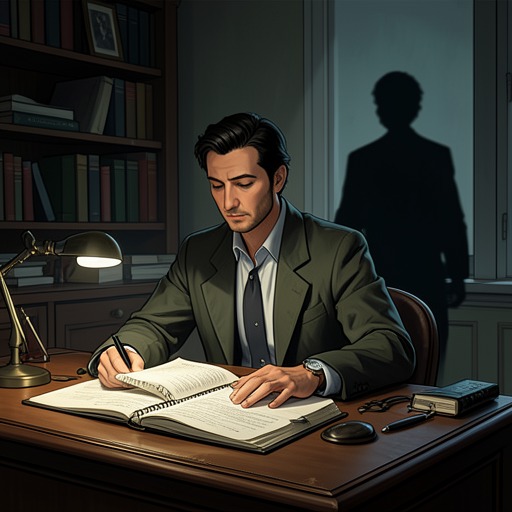
Bob telephones Dr Barrister and then takes a cab to Ruxton University. Twenty minutes later, he is in the professor’s office, where he explains that a shadow-person has visited Prentice’s apartment while Elmquist was, as far as the investigators could know, asleep in his own apartment. Bob’s account places the two apparently incompatible facts together and makes their contradiction the subject of expert discussion.
Professor Eugenia Lantine recognizes the description as that of a wanderer. She explains that a true wanderer leaves his body while asleep and moves about. Bob accepts the proposed label provisionally but asks how Elmquist does it, turning the professor’s identification into a further question rather than treating it as a complete explanation. His part in the scene is therefore both communicative and inquisitive: he brings the evidence, then presses for an account of the mechanism it suggests.
Narrative Significance
Bob’s visit to Ruxton University shows how the investigation moves between firsthand mystery and research. The shadow-person is frightening because it seems to violate ordinary limits; Bob’s trip reframes the sighting as a claim that can be examined with the help of a specialist. The professor’s response does not erase the unsettling nature of the appearances, but it gives the investigators a concept with which to interpret them.
The episode also makes Bob’s established strengths consequential. His research-mindedness is expressed not through a dramatic confrontation but through the precise relay of a strange circumstance: Elmquist appears elsewhere while believed to be asleep at home. In a case that mingles a haunting with criminal deception, Bob helps the investigators distinguish an uncanny-looking event from the separate questions that must still be solved.