Carpathian Hound burglary
The Mystery of The Invisible DogThe Carpathian Hound burglary was John Murphy’s theft of a crystal sculpture from 329 Lucan Court, followed by a hurried escape, a disguise in St Jude’s Church, and a concealment that left the stolen object beneath the pool in plain sight. What first looked like an ordinary break-in became a connected sequence of opportunistic decisions: Murphy used knowledge of the neighborhood and its residents to take the Hound, keep it hidden, and buy time before anyone searched the water.
Target and Opportunity
The target was the home of Charles Niedland, whose brother Edward had died. Edward had kept a small collection there, including works of his own and pieces by other artists. Charles had moved the collection to a safer place after Edward’s death and was returning borrowed works after his brother’s gallery show ended. The Carpathian Hound was at the house only because Charles had brought it there for Fenton Prentice, intending to deliver the sculpture and spend time sorting Edward’s books.
Charles arrived while Prentice was expecting The Three Investigators, whom he had told about his plans earlier that day. Charles left the Hound at the house and went out to eat; when he returned, he saw an intruder through the window and called the police from a neighbor’s phone. The sculpture’s presence was therefore a matter of timing rather than a planned display: it had arrived at the house shortly before the burglary, in the course of Charles’s effort to return it to Prentice.
The initial account described a conventional method of entry. Charles said the burglar had used a glass cutter to make a hole in the kitchen window and reached in to open the latch. He characterized the method as ordinary, and believed the police might have frightened the intruder away before anything else was taken. Later, Jupiter Jones reconstructed the theft as the work of someone familiar with the immediate neighborhood, the church’s keys, and the residents’ routines—not an unknown opportunist without local knowledge.
Break-In and Escape
The alarm and police response turned the burglary into a flight through nearby shared spaces. After a sound that might have been a backfire or a shot, Pete Crenshaw looked over the balcony railing. The courtyard below appeared empty, but shouting came from behind the building, followed by a slamming gate and pounding footsteps on a staircase out of sight. A running man in a dark windbreaker and black ski hood then crossed the courtyard, passed the pool, and left through the front gate onto the street. Pete ran downstairs, where a policeman appeared at the rear of the courtyard.
The route matters because the house, the apartment courtyard, the pool, and the church belonged to the same small neighborhood world. The Investigators later went from Prentice’s building through its rear passage—a route past a laundry and storeroom, up steps, and into an alley—to reach 329 Lucan Court, directly behind the apartment house. Murphy’s escape and the investigators’ subsequent inquiry both depended on the close arrangement of buildings, back entrances, and shared outdoor spaces.
By the time the boys visited Charles the next morning, the theft had been established but its full course had not. Prentice, sitting on a daybed with his chin in his hands, told them that he had been robbed the previous night. Charles suggested the police had interrupted the burglar after he took the Hound and before he could take anything else. The apparent simplicity of the crime concealed the more elaborate problem: the sculpture had disappeared, but its hiding place was not an obvious room or getaway route.
Church Disguise and Violence
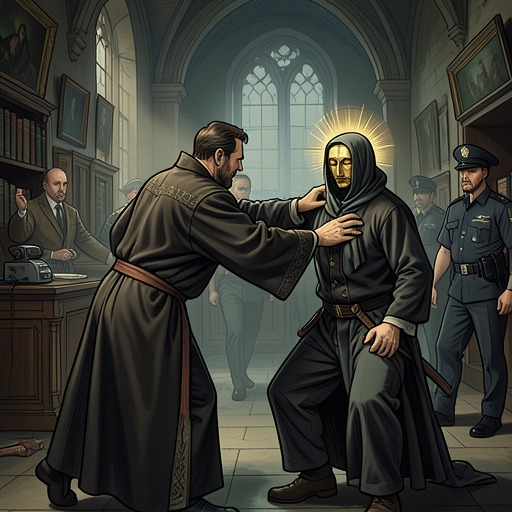
Jupiter’s later reconstruction placed Murphy’s escape inside St Jude’s Church. With police searching the neighborhood, Murphy ducked into the church. When it seemed likely that the building would be searched, he put on a cape and bishop’s mitre and posed as a statue of St Patrick. The disguise worked at close range: the policemen searching the church came so near that they could have touched him without recognizing that the supposed statue was a man.
The disguise also created a new danger. The caretaker came down from the choir loft, then later returned after the search. Jupiter reasoned that the caretaker might notice a statue that did not belong in the church. The caretaker remembered only that he had stumbled, but he had suffered a serious concussion and was being treated for shock. Jupiter proposed that Murphy may have struck him because he feared being seen. Pete’s fuller account identified the weapon: Murphy hit Earl with his gun, hid the crystal dog, and then slipped out of the church.
Murphy discarded the black mask and dark jacket in a rubbish bin near the park before strolling home. These changes of appearance and route helped him turn a conspicuous flight from an active police search into an apparently ordinary return to his residence. The disguise did not explain the whole case, however. When Alfred Hitchcock later suggested that Murphy had returned for the dog the following night disguised as the phantom priest, Jupiter rejected that identification: Murphy had told them that he, too, saw the phantom priest. The priest’s appearance therefore could not simply be treated as proof that Murphy had retrieved the sculpture in that guise.
The Hound Beneath the Water
The theft’s most effective concealment was the pool itself. Murphy did not need to enter the water. He lowered the Hound on a length of gilt cord until the sculpture touched the bottom, then let go. Against the pool’s random blue-and-gold tile pattern, the gold cord was difficult to see. The method hid a valuable object in a place used by residents, while leaving it inaccessible to casual discovery from the poolside.
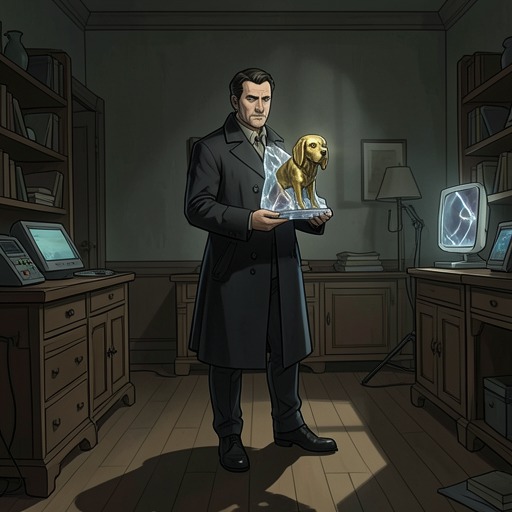
The Hound was a distinctive object, about six inches tall from its glass base to the tips of its ears. It represented a heavily muscled dog with a massive square head, gold-rimmed round eyes, and gold froth on its crystal jowls; a human skull lay between its feet. When Jupiter brought it up, the long gilt cord still dangled from it. He explained that Murphy had lowered it into the pool rather than entering the water himself, making the cord’s near-invisibility against the tiles the key to the hiding place.
The pool was not a secure hiding place indefinitely. Mrs Bortz, the building’s manager, remarked that Gwen Chalmers was the only person who used it in that weather and that she could have the pool drained and cleaned while Gwen was away. Murphy heard Mrs Bortz announce the planned cleaning, and Jupiter later recalled that the announcement had startled him. Murphy’s response was to create a diversion: he wired a noisy, smoky explosive device to Mrs Bortz’s car, intending to upset her enough to postpone the cleaning for a day or two. The device was not truly deadly, but its commotion served the practical purpose of protecting the concealed Hound from discovery while Murphy still needed time.
Identification and Significance
Jupiter’s identification of Murphy rested on elimination and access. He concluded that the burglar had to be someone in the neighborhood who knew about the keys kept in the parish house closet. Once Gwen Chalmers and Mrs Bortz were excluded, the remaining suspect had to be a fellow tenant: someone with knowledge of their habits and of the pool as a place that would be safe when they were away. Sonny Elmquist was asleep during the burglary, a fact Bob Andrews checked through his investigation at Ruxton University. Harley Johnson had a readily checked alibi. That left Alex Hassell and Murphy.
Both Hassell and Murphy had been away from home at the time of the burglary, and both had heard Mrs Bortz announce that she intended to drain the pool. The announcement’s effect on Murphy, followed by his later drive away from the building, gave the investigators a sharper line of suspicion. Jupiter concluded that Murphy went to a friend who manufactured chemicals to obtain the explosive used on Mrs Bortz’s car. Its function was not simply to frighten her: it was meant to keep the pool from being drained long enough for the Hound to remain hidden.
The final reconstruction also tied Murphy’s motive to information he acquired from Sonny Elmquist. After waking from his wandering, Sonny encountered Murphy in the courtyard and mentioned the Hound without understanding what it was. Murphy recognized the Niedland name and guessed the object’s significance. He then went to Lucan Court wearing a ski mask and carrying a gun, intending to hold up Niedland. The burglary thus began as an attempt to seize the sculpture, but the police response forced Murphy to improvise: he fled, impersonated a church statue, injured the caretaker, and concealed the object before returning home.
The episode’s tension comes from the contrast between the Hound’s striking, almost theatrical appearance and its modest hiding place at the bottom of an everyday swimming pool. Murphy repeatedly exploited what residents knew and did not notice: who used the pool, when it might be cleaned, how an unfamiliar figure could pass as a statue, and how the nearby buildings connected. The theft was solved not by treating the neighborhood as a backdrop, but by tracing how its routines and passages gave a local burglar both opportunity and cover.