Charles Niedland
The Mystery of The Invisible DogCharles Niedland is Edward Niedland’s brother and Fenton Prentice’s friend. In the investigation of the burglary at 329 Lucan Court, he provides the connection between the violated house and the missing Carpathian Hound: Edward was a sculptor, and the Hound was a glass-and-crystal work made for Prentice. Charles’s role is practical rather than theatrical, but his account establishes what the stolen object was and why it mattered to its intended owner.
Introduction and Characterization
During the police search for a fugitive in a black ski mask, Charles stands at the kerb speaking excitedly with a police lieutenant. He then hurries to the apartment-house steps and calls for Prentice. The account describes him as chunky, with thick grey hair. Prentice listens intently when Charles takes him by the arm to tell him what has happened, seemingly absorbed enough to forget that the investigators are present.
When the investigators meet him again, Charles appears haggard. He opens the door to 329 Lucan Court and invites them inside. The brief shift from his animated approach during the search to his worn appearance at the house gives the burglary a personal presence: the victim is not merely an address or an object of investigation, but Charles’s brother.
Family and Friendship
Charles identifies the house on Lucan Court as his brother’s home and tells Prentice that it has been broken into. Prentice responds with sympathy, saying the news must be especially painful for Charles. Their exchange presents Charles and Prentice as friends bound by concern for one another as well as by the missing artwork. Charles, in turn, urges Prentice not to let the news upset him too much and to get some rest, promising to speak with him in the morning.
The scene also shows Charles carrying difficult news between the two men. He approaches Prentice during the police commotion, and Prentice’s attention settles on what Charles has to report. The later meeting at the burglarized house gives that concern a concrete setting: the investigators follow the route behind Prentice’s apartment building to the residence Charles identifies as his brother’s.
Edward’s Work and the Carpathian Hound
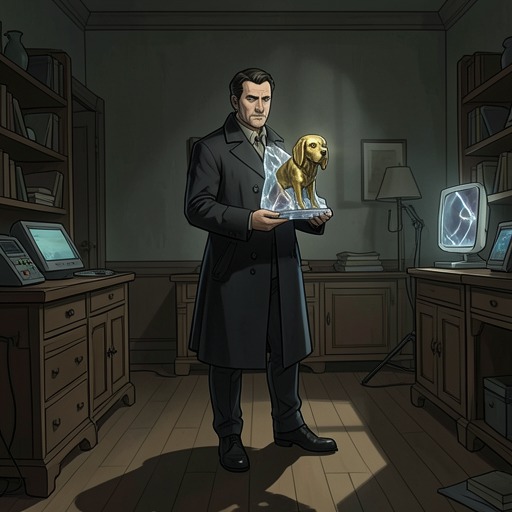
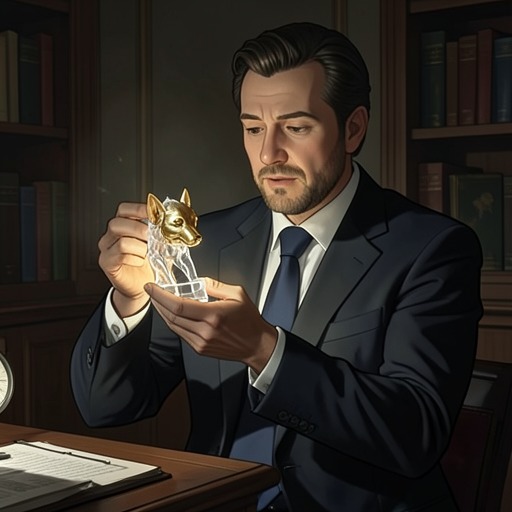
Charles corrects the investigators’ assumption that Edward was a painter. Edward sketched while working out designs, he explains, but his art was sculpture, made in glass and crystal, sometimes combining crystal with metals. This distinction matters to the case: the missing Hound is not a painting but a substantial sculptural object whose material and maker help define what the investigators are searching for.
Prentice adds that Edward made the Carpathian Hound especially for him. It had been finished a month earlier but had not yet been delivered, because Edward wanted to include it in a show of newer work at the Mailer Gallery. Prentice had agreed to the exhibition, and the work was therefore still missing when the burglary came to light. Charles’s account of his brother’s artistic practice supplies the context for understanding the Hound as both a unique work and a personal gift intended for Prentice.
Place in the Investigation
The investigators find 329 Lucan Court directly behind Prentice’s apartment house, confirming the location Prentice had reported. The square, one-storey frame residence is also a working studio: its living room has a skylight, drawing tables and an easel, with photographs, sketches and books filling the space. Its sparse furnishings and art-making equipment give physical form to Charles’s explanation of Edward’s vocation.
Charles’s contribution is to make the burglary legible in human and material terms. He identifies the victim as his brother, welcomes the investigators into the house, and clarifies the nature and intended destination of the missing sculpture. Through him, the case’s central object is connected to Edward’s craft, Prentice’s friendship with the artist, and an exhibition for which the Hound had been temporarily retained.