Closed-circuit television surveillance equipment
The Mystery of The Invisible DogThe Closed-circuit television surveillance equipment is a refurbished camera-and-monitor set that Jupiter Jones uses to watch the courtyard outside Fenton Prentice’s apartment without revealing the investigators’ presence. It turns an ordinary potted plant into a hidden observation post and brings activity in the courtyard onto a screen indoors. The device helps the boys keep watch on Sonny Elmquist, but its restricted view also marks a boundary: seeing the courtyard is not the same as understanding everything concealed within it.
Identity and Acquisition
The equipment consists of a small camera and a television receiver or monitor, formerly used in a department store for security surveillance. The store had suffered a fire, damaging both its cameras and monitors. Uncle Titus Jones bought the equipment for almost nothing, and Jupiter repaired this set. He describes the repairs as uncomplicated, presenting the device not as a new invention but as useful salvaged technology made serviceable again.
That history matters to the way the equipment functions in the investigation. Its original purpose was to let security personnel watch for shoplifters; Jupiter adapts the same principle to observe a residential courtyard. The change is practical rather than technical: the investigators need a view of a particular space, and a repaired commercial system supplies one. The camera and screen are valuable because they can be placed apart, allowing the observers to remain inside while the lens looks out.
Installation and Operation
Fenton Prentice’s apartment has no windows opening onto the balcony, so the investigators cannot watch the courtyard from indoors without help. They could sit openly on the balcony or beside the pool, but Jupiter does not want Sonny Elmquist—or anyone else—to know that they are watching. A large potted rubber tree outside Prentice’s door offers a way to conceal the camera while keeping the boys out of sight.
At 5:20, before the courtyard lights come on, Jupiter has Bob Andrews and Pete Crenshaw stand at the balcony’s edge to block the view from below. He places the small camera on a low metal tripod and inserts the tripod into the soil in the plant’s pot, then adjusts the lens to point down into the courtyard. The placement depends on both concealment and angle: the plant hides the device, while its position provides the view the investigators need.
The camera is transistorized and runs on batteries. Its signal reaches only a few feet, but that is enough because the monitor is nearby, inside Prentice’s apartment. Once the boys return indoors, Jupiter closes the apartment door, sets the monitor on a bookcase, plugs it in, and turns a dial. At first the screen flickers faintly, and Pete cannot make anything out. Jupiter waits for the courtyard lights; a few minutes later, the image becomes clear. The setup therefore depends not only on the camera but on timing, the lighting of the courtyard, and the short distance between transmitter and receiver.
What the Camera Reveals
The live image gives the investigators a view of people moving through the courtyard and its rear passageway. They see Sonny Elmquist leave his apartment, disappear into the passage, return with a laundry bag, and go back inside. A young blonde woman then enters the foreground; Fenton Prentice identifies her as Miss Chalmers. The screen turns separate movements in a shared space into observations the boys can compare without appearing there themselves.
The watch is patient rather than immediately dramatic. For several hours, little happens. Mrs Bortz carries garbage to the trash cans, and the boys grow bored and sleepy. Then Jupiter notices Elmquist standing beside the pool and staring into the water. The camera makes this sustained attention visible to the investigators, giving them a reason to keep watching the courtyard instead of abandoning the stakeout.
The monitor also shows John Murphy come out of his apartment. He is smoking and carrying the ashtray he usually uses; after a half-greeting to Elmquist, he puts out his cigarette, leaves the ashtray on a table, and exits through the front gate. The boys hear a car start, and Pete looks out toward the street to report that Murphy is going somewhere quickly. The scene demonstrates the system’s particular advantage: it lets the investigators observe gestures and departures from inside, while other information—the car’s movement, for example—comes from listening and looking beyond the monitor.
Uses and Limits
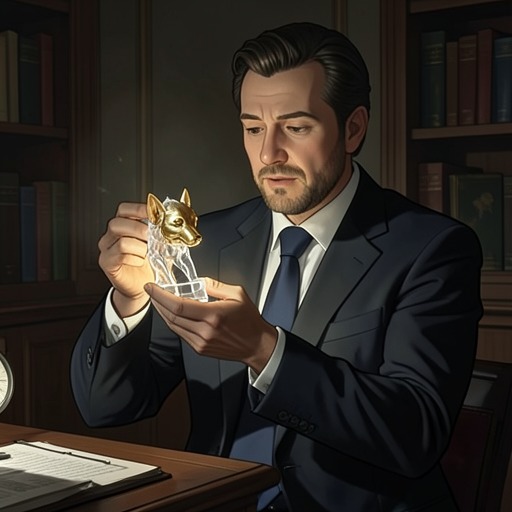
The equipment does not itself solve the mystery of the Carpathian Hound. Later, Jupiter retrieves the sculpture from the pool and explains that the burglar lowered it to the bottom on a length of gilt cord, which blended into the blue-and-gold tile pattern. The contrast is telling: the camera has made the courtyard’s visible activity available for scrutiny, including Elmquist’s attention to the water, but the Hound’s concealment depended on a detail that could disappear within the pool’s pattern. The object that extends the investigators’ sight cannot replace inference or direct examination.
As a piece of investigative equipment, the system joins ordinary materials and careful placement: a salvaged department-store set, a battery-powered camera, a potted rubber tree, a short-range signal, and a monitor on a bookcase. Its effectiveness comes from coordinating these parts so that the watchers remain hidden while the courtyard is illuminated on-screen. Its role is therefore both practical and revealing. It changes who can observe the shared space, but the image remains a partial account, requiring the investigators to interpret what appears and to pursue what the screen cannot settle.