Edward Niedland
The Mystery of The Invisible DogEdward Niedland is known through the accounts of his brother Charles and his friend and patron Fenton Prentice, but his work gives him a vivid presence in the investigation. A sculptor rather than a painter, he died of pneumonia two weeks before the burglary of his home; the theft of the still-undelivered Carpathian Hound turns the loss of his work into a second grief for those who knew him.
Identity and Artistic Practice
Charles Niedland describes Edward as a sculptor who worked in glass and crystal, sometimes combining crystal with metals. He sketched while developing designs, but those preliminary drawings did not make him a painter: his finished art took material form in sculpture. This distinction matters to the investigation because the stolen work is not a painting but a distinctive three-dimensional object.
Edward shaped glass and crystal while the material was so hot it was almost liquid. As it cooled, he reheated it, shaped it again, and repeated the process until he had the form he wanted. He then finished the sculpture by grinding, buffing, and polishing it with acid. Charles’s account presents the work as a prolonged negotiation with a changing material, rather than a single act of shaping.
Friendship with Prentice and the Carpathian Hound
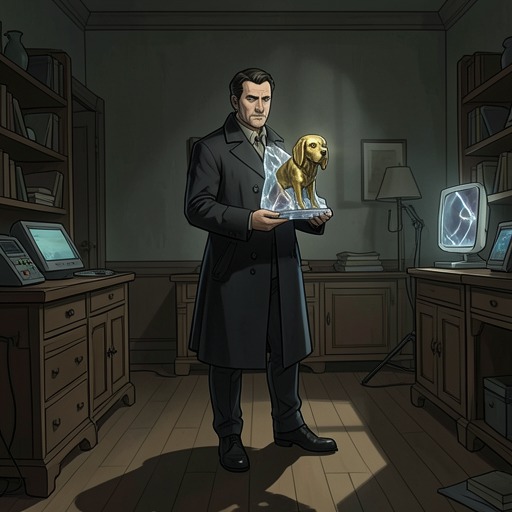
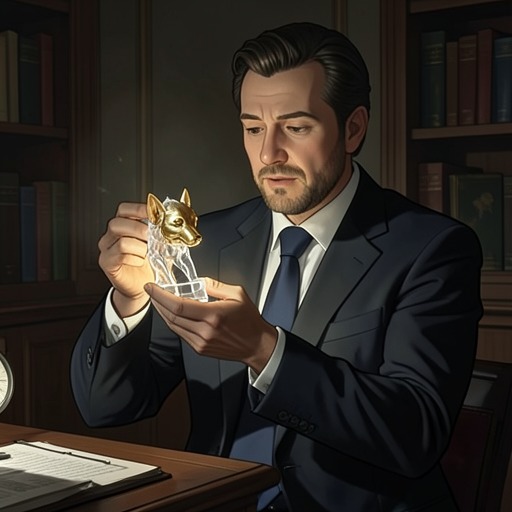
Prentice remembers Edward as his friend and protégé, as well as a very fine artist. The Carpathian Hound was made especially for him. Edward completed it a month before the investigation, but it had not yet been delivered: he planned to include it in a show of newer work at the Mailer Gallery, and Prentice had agreed to let him exhibit it first.
The sculpture was made of crystal and gold. Its dog’s eyes were rimmed with gold, and golden froth edged its jowls, details that recalled the legend’s ghost dog with glowing eyes. The material and finish connect Edward’s technical craft to the subject he represented: the Hound is both a carefully worked artwork and an image fashioned to evoke a supernatural creature.
Death, Theft, and Artistic Significance
Edward died of pneumonia two weeks before his home was broken into. Prentice calls his death a great loss, difficult for him to accept and difficult for Charles as well. The burglary therefore strikes at a household already marked by bereavement, while the disappearance of the Hound makes Edward’s absence tangible through the loss of a work he had only recently finished.
The sculpture’s value also gives the theft continuing stakes. Prentice fears that someone who knows Edward’s work and has no scruples might obtain it by consorting with thieves, despite Bob’s hope that such a distinctive piece would be difficult to sell. Edward is not present to pursue the artwork or explain its fate; instead, his skill, relationships, and unfinished delivery are reconstructed through other people’s testimony and through the object that bears his artistic signature.