Fenton Prentice’s haunting
The Mystery of The Invisible DogFenton Prentice’s haunting is the recurring, shadow-like presence in his apartment that makes ordinary intrusions seem supernatural and then unsettles that explanation again. Its importance lies in the gap between what can be accounted for—the discovery that Mrs Bortz entered and searched the apartment—and what remains unexplained: both Prentice and Jupiter Jones encounter a fleeting darkness that neither can confidently identify.
The first account
Prentice tells the Three Investigators that he is being haunted only after glancing over his shoulder as though someone might be listening. His account begins with evidence of entry when he has been away: his belongings are displaced, a desk drawer is partly open, and someone has read his letters. Those signs establish a real violation of his privacy, but they do not explain the presence he fears.
He insists that ordinary access seems impossible. Mrs Bortz, the building manager, has no key to his apartment, and Prentice says that he has installed a special lock and employs no servants. The windows, he argues, offer no plausible route: those facing the street are twenty feet above the sidewalk, while those in the bedroom and den overlook the church and are also high above ground. A ladder would be conspicuous. His reasoning narrows the possibilities without resolving them, leaving the apartment at once a private home and a space whose security he can no longer trust.
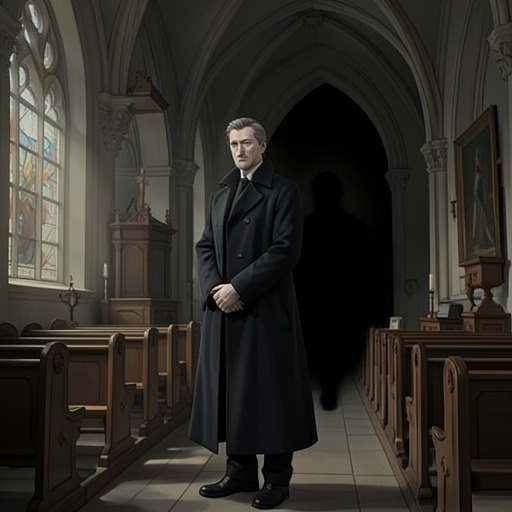
The presence is not, in Prentice’s description, consistently visible. Sometimes he feels it while reading; if he looks up, he may see something like a shadow. On one occasion he glimpses a tall, thin figure in the hall. He thinks he may have shouted, follows it into the den, and finds the room empty. The account is defined by a rapid sequence—sensation, glimpse, pursuit, absence—in which the fleeting sight cannot be held long enough to become proof.
Prentice expects the police to dismiss his description, which is why he has called the investigators instead. His fear is therefore doubled: he is troubled by the presence itself and by the prospect that reporting it will make him seem irrational. The distinction he draws between a person and something “not quite a person” captures the problem. He has an experience he regards as real, but no stable description that can make it readily credible to others.
An explanation that does not hold
The discovery that Mrs Bortz has been entering the apartment supplies a concrete explanation for at least part of Prentice’s original complaint. After the investigators expose her snooping, Prentice recognizes her as the person who has been going through his desk and papers and takes her key. The letters and disturbed belongings no longer require a supernatural cause. That resolution matters, but its scope is limited: it accounts for the intrusion, not necessarily for the shadow.
Prentice initially draws a broader conclusion. Relieved that a real human being has been entering his home, he decides that he must have imagined the shadowy presence. He even wonders whether Mrs O’Reilly’s ghost stories gave him ideas and shakes his head at his own supposed folly. The reversal is striking: the same man who had feared he would not be believed now readily doubts his own perception once one part of the mystery has been solved. Jupiter Jones, however, does not simply accept the case as closed; his attention turns to the mandala above Prentice’s desk.
That apparent resolution lasts only until Prentice calls again. He says that after the investigators trapped Mrs Bortz, he was sure he had imagined the shadow, but has now seen it once more in the den. He presents the alternatives starkly: either he is losing his mind or he is being haunted. The return of the experience breaks the easy equation between a discovered intruder and a fully explained mystery. Prentice asks the investigators to come into town and stay overnight because he cannot bear being alone, sitting in expectation of the next appearance.
A second witness
On their return, Jupiter goes directly to the den. A desk lamp illuminates richly bound books, Chinese porcelains, and the mandala above the desk. As he studies the design, frowning and pulling at his lip, he has the feeling that someone is silently watching him. The room’s ordinary objects remain clearly visible; what disrupts the scene is an impression that cannot be located among them.
Jupiter turns and senses a darker darkness pulsing in the far corner, then ebbing away. He rushes toward it and gropes along plain plaster walls. After switching on the overhead light, he finds no one there. His response gives the haunting a witness besides Prentice, but it still does not produce a visible figure or a physical trace. The episode repeats the pattern of the first account: apprehension, a brief manifestation, an immediate attempt to pursue or test it, and emptiness where the presence seemed to be.
Prentice takes Jupiter’s sighting as reassurance that he is not going mad. Jupiter confirms that he too has seen the shadow, including on the previous evening, but his agreement does not amount to an identification. Prentice says he could not be sure, though he thought the shape was Sonny Elmquist. Jupiter points to the difficulty: on both occasions when he saw the shadow, Elmquist appeared to be asleep in his own apartment. The apparent contradiction sharpens the mystery rather than solving it, and Jupiter asks what Prentice actually knows about Elmquist. Prentice can offer little beyond the fact that Elmquist has lived in the building for about six months.
Uncertainty as the haunting’s force
The presence remains indistinct across these encounters. Prentice describes a feeling, a shadow, and a tall, thin shape; Jupiter experiences a pulsing darkness in a corner. Neither account establishes that the figure is Elmquist, and the information available here does not explain how it appears or disappears. Even the shared sighting changes the status of the claim only partly: Prentice is no longer its sole witness, but the phenomenon remains difficult to describe and impossible to grasp.
The haunting also works through contrast. A special lock, high windows, and an exposed route for a ladder belong to practical questions of access; the shadow belongs to an experience that evades those tests. Mrs Bortz’s snooping demonstrates that an actual person did enter and read Prentice’s papers, yet her discovery cannot settle what Prentice and Jupiter see afterward. The apartment thus holds two kinds of disturbance at once: a solved breach of privacy and a recurring presence whose cause is still uncertain. Its most consequential effect is not a confirmed supernatural explanation but the return of doubt after the investigators appear to have put the matter to rest.