Jupiter Jones
The Mystery of The Invisible DogJupiter Jones, the plump young leader of the Three Investigators, combines a keen mind with insatiable curiosity. In a case crowded with apparent hauntings, disguises, and objects that seem to vanish, his defining strength is the ability to turn the idea of invisibility into a concrete question: what is hidden, where, and by what ordinary means? His deductions connect the burglar’s movements, the submerged Carpathian Hound, and a sack of ransom cash to the practical details that make each concealment possible.
Identity and Introduction
Jupiter is introduced as the group’s leader and principal thinker. Pete Crenshaw is quick and athletic, while Bob Andrews is bookish, handles the group’s records, and has a talent for research; Jupiter’s stated distinction is his sharp intelligence and restless curiosity. The contrast establishes him not as a solitary investigator but as the central reasoner within a team whose members bring different strengths.
When the boys meet Fenton Prentice, Jupiter gives his name in a precise, formal manner characteristic of him, then steps aside to introduce Pete and Bob. He correctly identifies Prentice as the man he has come to see. The exchange makes his formality part of his investigative presence: even an introduction is orderly, deliberate, and attentive to who is standing before him.
Following the Case Through Its Spaces
Jupiter’s investigation moves through the connected spaces of the neighborhood rather than treating each strange occurrence as isolated. When the boys cannot answer a question about where a man might be, they leave through the building’s back entrance. Their route passes a laundry and storeroom, climbs a few steps to an alley, and leads past dustbins and garages to the backs of buildings on the next street. From there they reach 329 Lucan Court, directly behind Prentice’s apartment house, where Charles Niedland opens the door.
That physical route matters to Jupiter’s reasoning. The burglary and the apparent church mystery belong to a shared local geography: the house on the next street, the church nearby, and the routes by which someone could slip from one place to another. Rather than accept the apparent supernatural explanation, he reconstructs what a person under pressure could have done within that ordinary landscape.
Reconstructing the Church Disguise
Jupiter explains that the burglar, pursued by police after breaking into a house on the next street, ducked into the church. When a search seemed imminent, the man put on a cape and mitre and posed as a statue; the officers searching for him came so close they could have touched him without recognizing him. The apparent phantom is thus explained as a human intruder concealed by costume and by the expectations of those looking for a fleeing burglar.
Jupiter extends the reconstruction beyond the disguise itself. The caretaker’s arrival from the choir loft startled the impostor, and the burglar may have become desperate when the caretaker returned after the police search, since a new statue would be conspicuous. Jupiter asks Father McGovern whether the caretaker could remember what happened when he hurt himself. His account links the disguise to the caretaker’s movements and possible injury, using a small human interruption to test how the concealment could have failed.
Making Invisibility Material
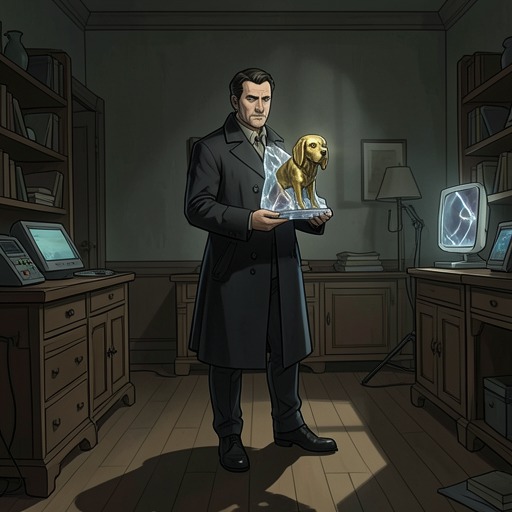
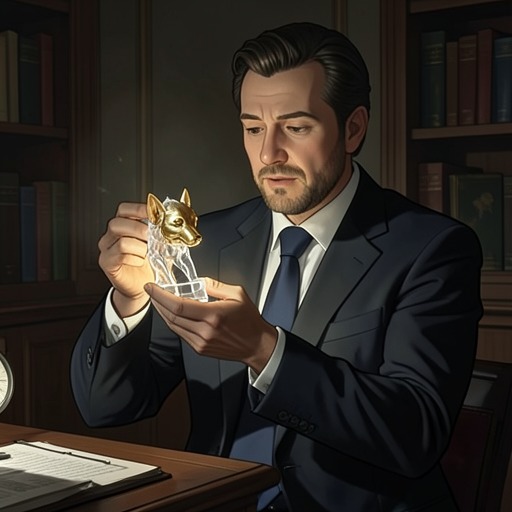
The Carpathian Hound provides Jupiter with another version of the same puzzle. When he surfaces from the pool, he is holding an object by a dangling string. Fenton Prentice recognizes the sculpture: a roughly six-inch figure of a muscular dog, with gold-rimmed eyes, gold flecks on its crystal jowls, a human skull between its feet, and a gilt cord tied around its middle.
Jupiter explains that the burglar did not need to enter the pool. He lowered the Hound on the cord until it touched the bottom, then let it go; against the random pattern of blue and gold tiles, the gold cord was difficult to see. The explanation transforms an apparently missing sculpture into a physical object hidden by its position and surroundings. Jupiter’s deduction depends on the specific cord, the pool’s tiled pattern, and the possibility of lowering the object from above—not on any supernatural disappearance.
The Sack and the Unfinished Deduction
Later, after Pete reports that John Murphy’s nephew is leaving the building, Jupiter concludes that the boys are alone. He stares at the cabinet where Prentice has concealed the ransom money and recognizes the significance of its container: cash inside a sack can be hidden in plain sight because the sack obscures what it holds. Bob recognizes the signs of Jupiter’s mental breakthrough, and Jupiter responds by offering to tell a story. The moment shows his characteristic shift from close observation to a larger explanatory idea, while keeping the reasoning rooted in an ordinary object and a specific hiding place.
As the police prepare to leave, Jupiter stops them. He says he knows where the burglar is and where the bogus ransom package is, and notes that the man will not try to hide because he has a perfect alibi. He identifies the Belvedere Medical Clinic, only a few blocks away, as the place where the burglar is or will shortly be. At this point the clinic is Jupiter’s prediction, not a confirmed arrest in the evidence presented here; the force of the moment lies in his confidence that the apparent alibi itself points toward the suspect’s location.