Jupiter’s attack and lock-in at St Jude’s Church
The Mystery of The Invisible DogJupiter Jones’s attack and lock-in at St Jude’s Church transform a search for a supposed apparition into a physical encounter with the burglary investigation. A candlelit figure in clerical dress gives the church its ghostly appearance, but Jupiter is then assaulted from elsewhere in the building and trapped behind a locked door. His later reconstruction separates the apparent phantom from the person who attacked him, a distinction that exposes the church as a place where disguise, access, and misdirection converge.
Investigation and Entry
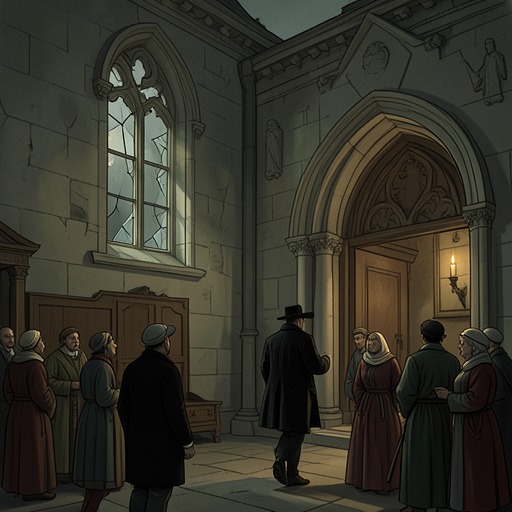
Jupiter’s visit began as a deliberate check on a mysterious light. He left Pete Crenshaw guarding the apartment door, found his jacket in the front closet, and went out alone. The courtyard lights were off and the pool was empty. From the street he saw a light flicker briefly in a church window, climbed the steps, and found a door that was not even latched. The ordinary, unsecured entrance drew him from observation into the dark interior.
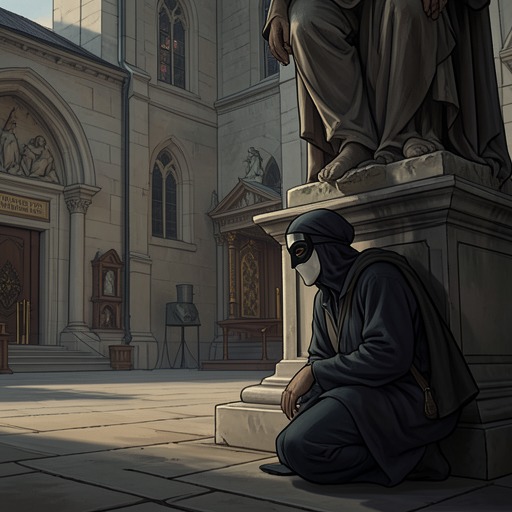
Inside, one candle burned near the front of the church, held by a person dressed in black. Jupiter could make out a very white face, abundant snow-white hair, shadowed eyes, and the white rim of a priest’s collar. The figure stared across the flame without speaking. Jupiter addressed him as a priest and explained that the light had drawn his attention, but the man answered only with a quick movement of his hand, snuffing the candle. In the sudden darkness, Jupiter felt fear and backed toward the door.
The Attack and Lock-In
A draft slammed the church door behind Jupiter. Before he could leave, someone shoved him; he caught his toe on a kneeling bench, stumbled between two pews, and was shoved again. The sequence matters: the candle-bearing figure had been at the front of the church, while the person who attacked Jupiter was positioned toward the back. Jupiter heard a door open and slam, followed by the turn of a lock. When he reached the handle and pulled, the door rattled but would not open. The apparent haunting had become a confinement by a person using the church’s darkness and exits to escape.
When Jupiter later explained what had happened, he rejected the idea that the figure he had seen was also the one who pushed him. The front-of-church figure had extinguished the candle, while the attacker was at the rear; Jupiter reasoned that the first person could not have crossed the church and escaped through the door in the time available. He therefore concluded that there had been two intruders that night. This distinction preserved a crucial uncertainty: the event established that the figures were separate, but Jupiter’s encounter alone did not identify the candle-bearer.
The Statue and the Church’s Access
The investigation soon supplied a practical explanation for how a burglar could have disappeared in the church. Jupiter noticed that a statue was missing from the place where he remembered seeing it: a figure dressed in a green cape and pointed cap, carrying a staff. A policeman also recalled the statue from the previous night, and Father McGovern identified its costume as St Patrick’s bishop’s mitre and staff. The church had held a Christmas pageant in which children performed a Nativity scene and presented famous church figures at the end. Father McGovern had taken the mitre, staff, and green cloak back to the costume house that day.
Jupiter reconstructed the burglar’s use of that pageant costume. With police searching the neighborhood after a house break-in, the burglar had ducked into the church and posed as the statue when officers came looking. The costume turned a conspicuous presence into part of the church’s scenery: the police could have stood close to the disguised man without recognizing him as a fugitive. The explanation recast the missing statue not as an incidental absence but as a temporary human disguise, made possible by the recent pageant and the familiar appearance of St Patrick.
The church’s keys offered another piece of the practical puzzle. Father McGovern said that he, Mrs O’Reilly, and Earl had keys, and that an extra set hung on a hook in the downstairs parish-house coat closet. Since the attacker had left and locked the door, the officers reasoned that a key had been used. The readily available spare set made church access a question of local knowledge rather than supernatural entry. Jupiter’s broader reasoning likewise placed the burglar among people familiar with the neighborhood, its occupants, and the pool’s relative safety when others were away.
Consequences and Later Reconstruction
The church episode fed into the recovery of the Carpathian Hound and the identification of John Murphy. Murphy’s later account, as reported by Jupiter, established that Murphy had also seen the phantom priest; that fact ruled out the simple explanation that Murphy had returned to the church disguised as the apparition. Pete Crenshaw’s reconstruction says Murphy struck Earl with his gun, hid the crystal dog, escaped after the police search, and later locked Jupiter inside after encountering the phantom. The account keeps the encounter’s two-presence structure intact: the priestly figure was not simply a costume Murphy resumed on his return.
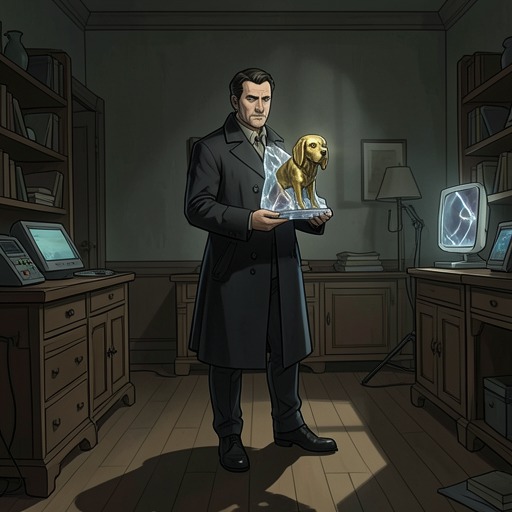
The hidden sculpture completed the connection between the church and the apartment-building pool. Jupiter explained that the burglar lowered the Carpathian Hound by a cord until it touched the pool bottom, then let it go; the gilt cord blended with the blue-and-gold tile pattern. Mrs Bortz’s announcement that she would drain and clean the pool had alarmed Murphy, who needed the concealment to last. The later recovery thus gave the church lock-in a consequence beyond Jupiter’s immediate danger: the assault and escape belonged to a chain of actions designed to hide the stolen object and delay its discovery.
Murphy’s hospital stay also proved to be part of the same deception. Jupiter concluded that Murphy had set the fire in his own apartment to create an excuse for being hospitalized, then used the nurses’ routines and the quiet Christmas period to come and go. His motive was tied to money he had borrowed from Harley Johnson’s account for stock-market speculation and lost; he needed the ransom to replace it before Harley came of age. Against that larger scheme, the church scene marks a sharp reversal: the locked door briefly gave the attacker control, but Jupiter’s attention to location, timing, costumes, and access turned the supposed ghost into evidence against a human burglar.