Paseo Place apartment courtyard pool
The Mystery of The Invisible DogThe Paseo Place apartment courtyard pool is the unlikely hiding place that turns the search for the Carpathian Hound into a problem of seeing what is already in plain sight. Its attractive, patterned floor conceals the gilt cord holding the sculpture, while its everyday use brings the investigators close enough to recognize how the trick works. The pool is not merely a backdrop to the mystery: its layout, water, and tiles make the concealment possible and the recovery legible.
Setting and Access
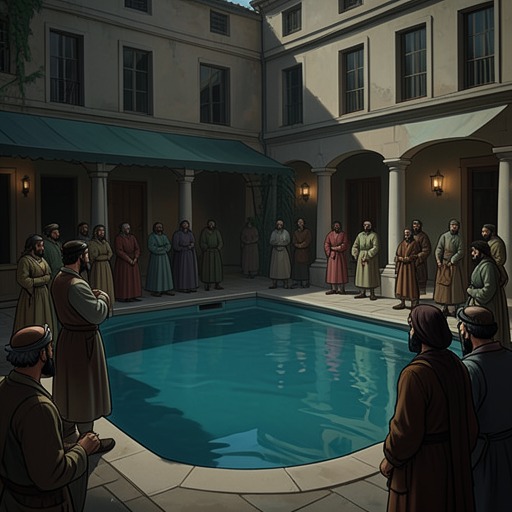
The pool occupies the centre of a flagstoned courtyard at the apartment building. Chairs and tables surround it, and shrubbery rims the court. A gate gives access to the courtyard; when Jupiter Jones opens it, floodlights come on around the pool and along the shrubs. A door beside the gate opens onto the same shared space, making the entrance both a point of arrival and a place where residents can meet or observe visitors.
The courtyard is connected to less public parts of the block as well. When the boys leave Fenton Prentice, they cross the courtyard and exit by a rear passage that runs past a laundry and a storeroom, then climbs a few steps to an alley of dustbins, garages, and the backs of buildings. From there they reach 329 Lucan Court, directly behind Prentice’s apartment house. This route places the pool within a compact network of entrances, service spaces, and neighbouring residences: the courtyard is open and communal, but it is only one link in a set of paths running behind the street-facing buildings.
A Shared Space Under Observation
The pool serves as a place where residents’ ordinary routines become visible to the investigators. After Jupiter suspects that someone in the building has watched the boys leave, they take chairs beside the water and wait. Their stakeout is not conducted in a hidden room or from a distant vantage point; it unfolds in the courtyard itself, among its tables and chairs. The pool therefore functions as a meeting ground where the investigators can watch who enters and how people use the space.
The boys’ attention to the water begins with its appearance. Pete Crenshaw calls the pool remarkable, and Bob Andrews crouches at its edge to inspect the clear water and the blue and gold tiles arranged in a random pattern across the bottom. He compares its decorative effect to the indoor pool at Hearst Castle in San Simeon, then puts a hand into the water and reports that it is heated. The observations establish both the pool’s polished, deliberately designed character and the details that will matter later: the water is clear, the floor is patterned, and the contrasting colours are scattered rather than arranged in a regular design.
The courtyard also makes routine behaviour part of the scene. A grey cat crosses it with a tawny-haired man in a white sweater and camel-coloured jacket. The man enters an apartment, returns with a plate of food, and crouches while the cat eats. This brief domestic episode places the mystery’s unusual object in a setting governed by ordinary habits: people cross the court, tend to a pet, and use the surrounding apartments while the pool remains at the centre of the shared space.
Concealment in Plain Sight
The discovery that the Hound is in the pool follows a change in the investigators’ reasoning. Jupiter connects the danger surrounding Gwen Chalmers and Mrs Bortz with the latter’s plan to have the pool drained and cleaned. That threatened maintenance gives the pool a new significance: it is not only a place where Gwen swims each night, but also a location where someone has a reason to prevent inspection. Jupiter compares the hidden sculpture to a glass knife in a water pitcher, an object that can escape notice because it is visible rather than concealed behind a barrier.
The hiding method depends on the pool’s particular floor. Jupiter explains that the burglar did not need to enter the water: the Carpathian Hound was lowered by a cord until it touched the bottom, and the cord was released. Its gold colour disappeared visually against the floor’s irregular blue-and-gold pattern. The deception is thus an arrangement of object, colour, and setting. The sculpture rests openly in the pool, but its support is difficult to distinguish from the tiles beneath it.
This solution also recasts the pool’s beauty as practical camouflage. The random tile arrangement first appears as decoration, then becomes the condition that makes the cord hard to see. The pool’s clear water does not reveal the Hound immediately; instead, the patterned bottom helps the gold blend into the surface below. The mystery’s emphasis on an object hidden in plain sight is made concrete by the courtyard’s design.
Recovery and Narrative Significance
Once Jupiter proposes retrieving the sculpture before the planned ransom, he sends Bob to watch the back gate and Pete to watch the street entrance. He then goes swimming. Fenton Prentice and Charles Niedland follow him to the pool, while Jupiter removes his clothes down to his shorts and carefully enters the shallow end. The search is a physical test of the deduction, not simply a verbal explanation: he wades toward the deep end, scans the tiles, ducks under when the water reaches his chin, and kicks forward just above the floor until he reaches for something.
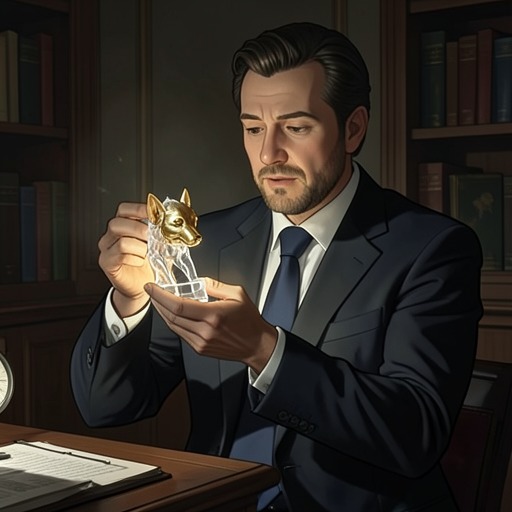
Jupiter surfaces holding the object, a string dangling from it, and offers it to Prentice. Prentice turns the sculpture over in his hands. The Carpathian Hound is a heavily muscled dog with a massive square head, wide round eyes rimmed with gold, and gold froth along its crystal jowls. It stands about six inches tall from its glass base to its ears; a human skull lies between its feet, and a long piece of gilt cord is tied around its middle. These details identify the recovered object and make the cord that enabled its concealment visible at last.
The pool’s role in the investigation reaches beyond furnishing a hiding place. Its position in the shared courtyard allows the boys to observe activity; its access points let them post lookouts; and its tiled bottom explains how the stolen sculpture could remain there unnoticed. The earlier explanation of a burglar escaping into St Jude’s Church by posing as a statue provides a telling parallel: in both cases, disguise works by making a person or object fit the visual expectations of a place. At the pool, the Hound is not removed from sight so much as made difficult to distinguish from its surroundings. Its recovery converts the courtyard from a routine residential setting into the decisive evidence of the theft’s method.