Prentice’s Mandala
The Mystery of The Invisible DogPrentice’s Mandala is both a conspicuous possession in Fenton Prentice’s collection and, in Sonny Elmquist’s account, a diagram intended for meditation rather than display. That difference gives the object its significance: Prentice values its design while admitting little knowledge of Eastern religions, whereas Sonny treats a mandala as a means of seeing past the world of desire. The work’s beauty is visible to both men; what it means, and what it is for, divides them.
Appearance and Provenance
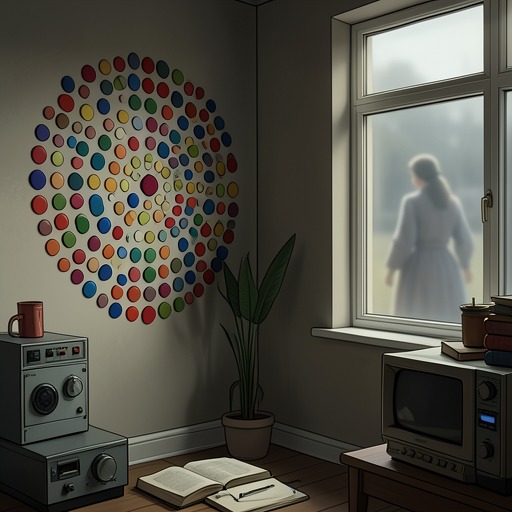
The mandala hangs framed on the wall of Prentice’s den, above his desk. Its design is intricate and brightly coloured: a circle decorated with scrollwork encloses a square, and figures described as deities or demons occupy the picture’s four corners. At the centre, overlapping triangles intersect around smaller circles containing tiny beings. The arrangement is not a simple repeated pattern. It draws the eye inward, from the decorated boundary toward a dense centre, and gives Prentice’s wall-hanging the complexity that distinguishes it from the diagram in Sonny’s book.
Prentice explains that the work belonged to a young artist he once knew, who had travelled to Tibet. It was made especially for that artist. After the artist died, Prentice acquired the mandala from his estate. The account establishes a chain of personal history behind the object, but not a religious connection between its maker and Prentice: Prentice says he admired it as a piece of design and knows little about Eastern religions. His ownership therefore preserves an artwork’s appearance and provenance without implying that he shares the knowledge or practice associated with it.
A Diagram, or a Display
Sonny supplies a different account of what a mandala does. To explain the form, he produces a little book containing a colourful diagram of overlapping triangles surrounded by a circle, which is edged by a square. He describes it as a diagram of the cosmos. Meditation on it, he says, makes life’s illusory things fade and allows the meditator to become one with the universe. His explanation makes the geometry functional: the design is not only something to look at but a focus for a practice meant to alter how the world is apprehended.
The drawing Sonny shows is explicitly simpler than Prentice’s Tibetan mandala. Prentice’s version includes the additional figures and intricate central pattern, while Sonny’s book gives him a basic visual comparison. The difference does not lead Sonny to claim that the objects are identical in every detail. Instead, it lets him recognize the category of Prentice’s possession, including its Tibetan origin, despite having seen only his own diagram. The mandala’s complexity is thus part of what makes it an artwork to Prentice and an instance of a spiritual form to Sonny.
Possession and Interpretation
Sonny connects the mandala to his broader criticism of desire. He argues that troubles begin with wanting things and uses Prentice’s collection as an example: in Sonny’s view, Prentice worries about his possessions and always wants more. He clarifies that he is not accusing Prentice of stealing or harming anyone to acquire them. His criticism is instead that Prentice cares too much about what he owns and fails to see that he is pursuing something unreal. The mandala becomes a particularly pointed example because Sonny believes its owner has the very kind of object that could help him look beyond attachment, yet treats it as another painting.
That judgment is Sonny’s, not an objective account of Prentice’s character or of the mandala’s power. Pete resists the harshness of the criticism, reminding Sonny that Prentice is a nice old man. The exchange sets personal kindness against Sonny’s spiritual diagnosis: Prentice may be decent, Pete implies, even if Sonny thinks his relationship to possessions is mistaken. Sonny, for his part, distinguishes attachment from criminal greed. The dispute gives the object a role beyond decoration, making it the concrete point at which two characters disagree about collecting, desire, and the value of material things.
Knowledge and the Haunting
When Jupiter Jones asks whether Sonny has ever been in Prentice’s apartment, Prentice denies it. He says that, apart from the building’s manager, no one there has ever been inside, and that he would be especially unlikely to admit Sonny. He disparages Sonny’s ideas and cleanliness, while affirming that he values his privacy. This denial sharpens the question of how Sonny knows that Prentice owns a mandala and that it is Tibetan. Sonny has a simpler diagram in a book; Prentice guesses that newspapers or his friends in the art world may have publicized his collection. The evidence offers possibilities, not a settled explanation for Sonny’s specific knowledge.
Elsewhere, Professor Eugenia Lantine considers the reports of Sonny appearing in Prentice’s apartment while, as Bob Andrews confirms, Sonny was known to be asleep in his own apartment. She calls him a wanderer. This discussion concerns the spectral visitor and does not establish that the mandala caused, enabled, or explained Sonny’s appearances. The distinction matters: Sonny gives the mandala a contemplative use, and his account resonates with the story’s interest in apparently unseen presence, but the object’s documented role remains interpretive rather than mechanical. It reveals the distance between ownership and understanding without being identified as an instrument of the haunting.