Professor Eugenia Lantine
The Mystery of The Invisible DogProfessor Eugenia Lantine is Ruxton University’s parapsychology department head, an investigator who separates a haunting assembled from inherited stories from the more unusual possibility of a person’s astral body leaving its sleeping body. Her account of the phantom priest at St Jude’s Church and her files on reported wanderers establish two different ways the seemingly supernatural can enter the story: as a reconstruction of local folklore, or as a phenomenon she regards as rare but documented.
Position and First Appearance
Professor Eugenia Lantine first appears through Dr Barrister’s introduction. After Bob explains the case, Dr Barrister says that he considers it a psychic occurrence outside his own expertise and takes Bob to meet his colleague. Professor Eugenia Lantine heads the university’s parapsychology department; Dr Barrister adds that some faculty members think her eccentric, while others fear she can read their minds. This is the university’s divided view of her, not a judgment she makes about herself.
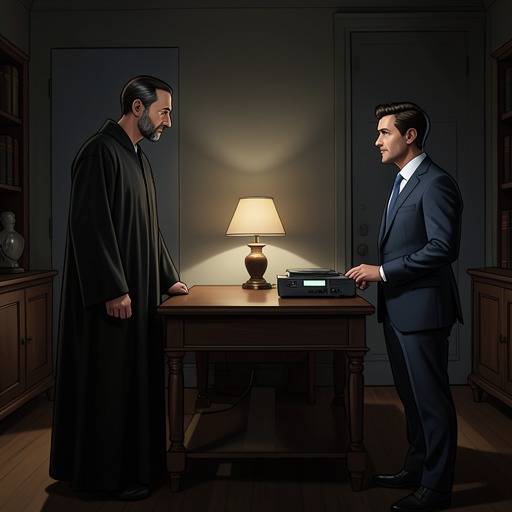
Her office is in a small, bare brick building behind the gymnasium. When Bob and Dr Barrister arrive, she is reading letters. She greets Dr Barrister with a broad smile and shows him a note from a man in Dubuque who claims his sister’s ghost is haunting him, although, as she points out, he has no sister. The letter offers an immediate example of her working material: a vivid supernatural claim that contains a contradiction worth investigating. Her response is amused, but the detail also frames her attention as analytical rather than credulous.
Investigating the Phantom Priest
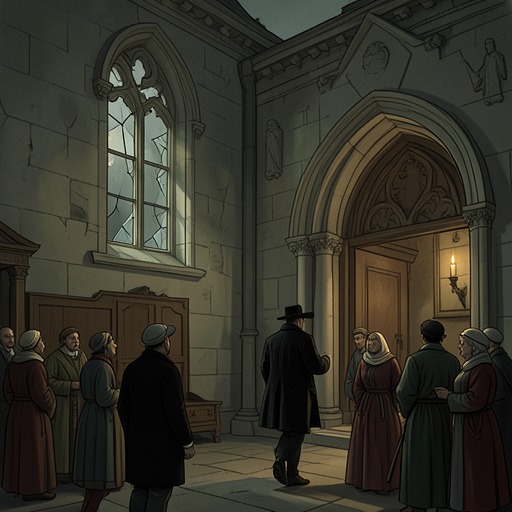
Professor Eugenia Lantine explains that the present pastor had previously contacted her about the alleged phantom priest. Father McGovern had never seen the figure, but his housekeeper was extremely nervous. The description Bob gives—a thin, white-haired man in clerical clothes—matches the former pastor, whose picture hangs in the parish-house parlour. Professor Eugenia Lantine thus identifies a visible likeness that could help explain how the apparition acquired its particular appearance.
Her investigation also traces the story beyond the church. The housekeeper came from Dungalway, a small town in Ireland, whose church was said to be haunted by the ghost of a priest lost at sea. Professor Eugenia Lantine spent several nights in St Jude’s Church and saw nothing. She also questioned residents of Paseo Place: several older people believed in the phantom priest, but none had seen him. The combination matters to her conclusion. A familiar image, a relevant childhood tradition, and belief without firsthand sightings point away from an independently witnessed ghost.
She concludes that Mrs O’Reilly made up the phantom priest without fully realizing it, reconstructing the figure from stories remembered from her childhood. The explanation does not require deliberate deception: in Professor Eugenia Lantine’s account, inherited folklore can supply the shape of an experience even when the person passing it on does not consciously invent it. Her investigation therefore distinguishes a community’s confidence in a haunting from direct evidence that anyone has seen its supposed source.
Astral Wandering and the Case Files
Professor Eugenia Lantine treats the spectral visitor associated with Sonny Elmquist as a different problem from the phantom priest. She describes a true wanderer conditionally: if Elmquist is one, he leaves his body while asleep and walks around. The conditional wording is important. She offers a possible explanation for the reported appearances, not a claim that the case has already been proved.
To establish why she considers the possibility, she opens a file and explains that few such cases have been examined under laboratory conditions. People who experience them often do not come to a laboratory: they may think they are going mad or suppose they have second sight, and keep the experience to themselves. She has, however, collected accounts that allow comparison. When asked whether the reported wandering has always happened while Elmquist sleeps, she says that this is what is known so far, then calls the pattern rare but attested and introduces a second, slightly different case.
That file concerns a man from Orange who has had disturbing dreams throughout his life: he dreams of places and sees things that he later learns were real events. Unlike the woman in the preceding case, the Orange man’s astral body has actually been seen. Professor Eugenia Lantine recounts an incident involving his Hollywood friend, identified as Jones. Jones was reading at home when his dog barked, making him suspect someone was in the yard. In the entry hall he saw the Orange man clearly enough to address him by name. The figure did not answer, went upstairs, and was gone when Jones followed.
Method and Narrative Role
The cases show Professor Eugenia Lantine working by comparison, not collapsing every apparition into one explanation. For the phantom priest, she tests the report against a portrait, a housekeeper’s background, local tradition, and residents’ lack of firsthand sightings. For astral wandering, she distinguishes the sleeping pattern reported in Elmquist’s case from accounts in which the wandering figure was seen, and she marks the phenomenon as uncommon. The evidence she presents is therefore uneven in kind: some claims can be traced to remembered stories, while others remain unusual reports documented in files.
Her role is to widen the investigators’ understanding without resolving every uncertainty. The phantom-priest explanation gives a cultural and biographical history to one apparition; the astral-wandering accounts make another kind of explanation available for the visitor associated with Sonny Elmquist. By presenting both, Professor Eugenia Lantine keeps folklore and psychic claims distinct while showing why neither can be assessed solely by how convincing a story sounds.