Ruxton University
The Mystery of The Invisible DogRuxton University is the academic setting where the investigators’ search for an explanation of the apparent hauntings meets two different kinds of expertise. Bob Andrews goes there after the shadow-person’s visit to Fenton Prentice’s apartment raises questions beyond the investigators’ immediate knowledge. The university connects Dr Barrister, a professor of anthropology with experience in folklore and witchcraft, to Professor Eugenia Lantine, head of its parapsychology department. Their meeting makes the campus a place where supernatural claims are neither simply accepted nor dismissed: they are brought to specialists whose fields and judgments differ.
Setting and Academic Structure
The university is described as nearby, and its buildings provide the route through which Bob’s inquiry advances. He phones Dr Barrister, takes a cab, and reaches the professor’s office twenty minutes later. Barrister then accompanies him to meet Professor Eugenia Lantine, whose office is in a bare little brick building behind the gymnasium. The details place the investigation in working academic spaces rather than in a grand institutional setting: first a professor’s office, then a modest building tucked behind a familiar campus facility.
The university’s relevant academic structure includes anthropology and a parapsychology department. Dr Barrister is a professor of anthropology, while Professor Eugenia Lantine heads parapsychology. The narrative supplies no wider account of the university’s organization, but this pairing is significant within the case: Bob’s problem falls across the boundary between Barrister’s established areas of knowledge and the subject Lantine is prepared to consider.
Dr Barrister and the Limits of Expertise
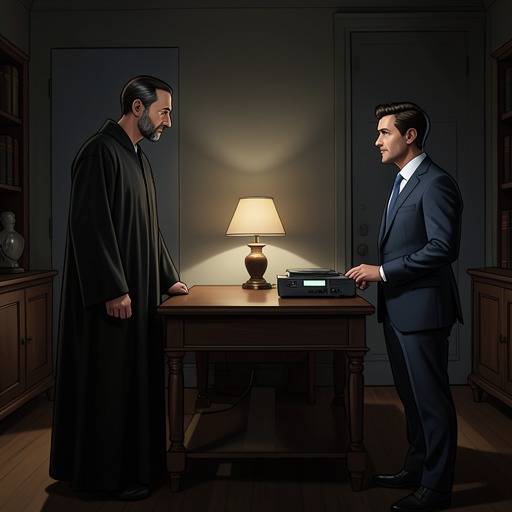
Dr Barrister is the investigators’ first university contact. He has helped them before through his knowledge of witchcraft and the occult, so Bob approaches him expecting that he may recognize an explanation for the shadow-person. Barrister’s expertise is specific rather than unlimited. He identifies himself as an authority on the folklore of the Maori tribes and on witchcraft as practised in the Caribbean and elsewhere, but says that the reported experience appears to be a true psychic occurrence outside his field.
His response distinguishes intellectual openness from belief in ghosts. Barrister says he believes in many things others do not accept as true, yet does not believe in ghosts. Rather than forcing Bob’s account into a familiar explanation, he directs the inquiry toward a colleague whose mind is open on the subject. The university therefore functions not as a single voice of authority but as a place where one scholar can acknowledge the limits of his discipline and make a referral to another.
Professor Eugenia Lantine and Parapsychology
Professor Eugenia Lantine is the head of Ruxton University’s parapsychology department. Barrister introduces her to Bob as a colleague likely to be interested in the case. His description also conveys the department’s contested position among the faculty: he says that some regard her as eccentric, while others fear she can read their minds. This is Barrister’s characterization of campus opinion, not an official account of the university’s view of her work; it nevertheless frames parapsychology as a subject that provokes both ridicule and apprehension.
When Bob and Barrister enter her office, Professor Eugenia Lantine is reading letters. She shares a note from a man in Dubuque who claims to be haunted by his sister’s ghost, although, as she points out, he has no sister. The anecdote gives a concrete glimpse of the reports reaching her and of her alert, amused manner toward them. It does not establish that she accepts the man’s claim. Instead, it shows her treating unusual accounts as material to examine, with the contradiction in the letter itself immediately in view.
The University’s Role in the Investigation
Bob first recounts the shadow-person’s appearance in Fenton Prentice’s apartment to Dr Barrister. At Professor Eugenia Lantine’s office, he tells the story again and adds Jupiter Jones’s experience with the phantom priest in the church next door. The second account broadens the material presented to the university specialist: the question is no longer limited to one visitor in one apartment, but includes another apparently supernatural figure reported by a fellow investigator.
The scene establishes a chain of inquiry rather than an answer. Barrister supplies access to a colleague; Professor Eugenia Lantine listens to Bob’s account; and the reader learns what evidence the investigators have brought to the university. The available episode does not yet disclose her explanation of either apparition. Ruxton University’s importance here lies in making the case’s uncertainty examinable: anthropological and folkloric knowledge can identify its own boundaries, while parapsychology offers a further avenue without prematurely settling whether the experiences have a supernatural cause.