St Jude’s Church
The Mystery of The Invisible DogSt Jude’s Church is the neighborhood parish at the center of a sequence of apparent hauntings and a burglary investigation. Its ordinary life—children’s hymns, Christmas pageantry, a caretaker’s duties, and the management of church keys—provides the very details that make the church useful to someone hiding from the police. The building’s sacred images and costume pieces become clues: what appears to be a mysterious saint is ultimately explained as a burglar’s disguise.
Setting and parish life
The church stands beyond Paseo Place Park and the rectory, beside the apartment building at 402 Paseo Place. The Investigators first arrive at twilight on a cold December evening. Through the church’s stained-glass windows they see lights, while an organ sounds and children sing phrases from an old hymn. The scene places the church within a lived-in parish neighborhood rather than apart from it: worship and seasonal preparation continue as the boys arrive to investigate.
The church interior is filled with the material signs of worship. When Jupiter Jones enters during a police search, he sees colored vigil candles burning in racks before the altar and statues arranged on pedestals, on the floor, in corners, and against the walls. These details matter beyond atmosphere. The statues make the interior visually crowded, and a person posing as one can exploit the expectation that figures standing among them are inanimate. The church’s openness to parish activities and its many sacred objects thus create conditions that become relevant to the case.
People responsible for the church
Father McGovern is the pastor. Earl is the caretaker, and Mrs O’Reilly works as housekeeper in the rectory. Parishioners describe the two staff members as forceful presences in parish life: each is said to think that he or she runs the parish, leaving Father McGovern to manage their competing claims. This account gives the church a domestic, sometimes comic social texture, while also establishing that Earl’s work takes him through the building and that Mrs O’Reilly is closely associated with the rectory.
The church’s staff and visitors become part of the investigation when police search the building. A stout, red-faced man holding booklets insists that nobody entered while he was there. The patrolmen bend to peer beneath the pews, while people including Mrs Bortz and Sonny Elmquist watch from the pavement. Later, the sergeant emerges and asks for the person in charge; a bystander explains that he is having tea with the pastor. The scenes show a parish space in which police activity, ordinary visitors, and church responsibilities overlap in public view.
Earl’s presence is also tied to the church’s more alarming events. After the boys and Fenton Prentice rush next door, two men in white carry Earl out on a stretcher, covered to the chin with a blanket. Mrs O’Reilly cries that he has been killed, but her exclamation is not confirmation of his death. The episode intensifies the church’s atmosphere of danger while leaving the caretaker’s fate, at that moment, unresolved.
Apparitions, searches, and the missing statue
Rumors of a ghost shape how people interpret what happens at the church. Mrs O’Reilly is described as seeing spooks, and later insists that the locked church could only have been entered by the old priest’s restless soul. Jupiter Jones has his own unsettling encounter: after seeing a brief light in a window, he finds a church door unlatched and enters. In near darkness, a person holds a candle and turns toward him. Jupiter can make out a very white face, abundant snow-white hair, and a white clerical collar above black clothing, but cannot see the figure’s eyes. When he tries to leave, the door will not open; he is locked inside.
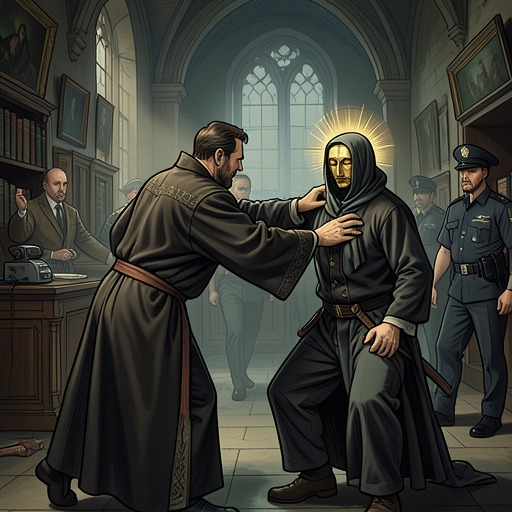
The next day, Jupiter points out that a statue has disappeared from the church. He remembers a figure in a green cape and tall pointed cap, carrying a staff, near a window. A policeman recalls seeing it too, but Father McGovern says that St Jude’s Church has never owned a statue of St Patrick. The apparent contradiction turns on a difference between a permanent church image and a temporary theatrical one. The priest remembers that a Christmas pageant had taken place in the church the previous day, with children performing the Nativity and the three wise men before famous figures from church history appeared. St Patrick was among them, wearing a mitre and green cloak and carrying a staff. Father McGovern had returned those costume items to the costume house that day.
A church used as a hiding place
The pageant supplies Jupiter with a practical explanation for the missing figure and the burglar’s escape from notice. The previous night, police were searching the neighborhood for a man who had broken into a house on the next street. Jupiter reasons that the fugitive ducked into the church, then put on the green cape and mitre and posed as a statue when the building was about to be searched. The policemen had been close enough to touch the supposed statue without recognizing a person in disguise. When Earl came down from the choir loft, he could have noticed that a figure had been added where no statue belonged; Jupiter raises the possibility that the caretaker’s encounter with the intruder led to his injury.
The church’s entrances and keys make the escape plausible without requiring a supernatural visitor. A policeman observes that the intruder must have used a key to enter and locked the door when leaving. Father McGovern says that he, Mrs O’Reilly, and Earl each have keys; Earl’s are presumably with his belongings at the hospital. There is also an extra set hanging in the coat closet in the downstairs hall of the parish house. The spare keys are an ordinary provision for lost keys, but in the investigation they turn access into a concrete question of custody and opportunity.
Material clues and narrative significance
St Jude’s Church is significant because the investigation repeatedly tests what its objects and appearances mean. The green garment, mitre, and staff first resemble evidence of a vanished saint, but their connection to the Christmas pageant makes them available as a disguise. Candles, statues, doors, and keys likewise shift from background features to elements in the boys’ reconstruction of events. The church is not merely a setting for supernatural rumors: its actual arrangements allow a human intruder to seem impossible to detect.
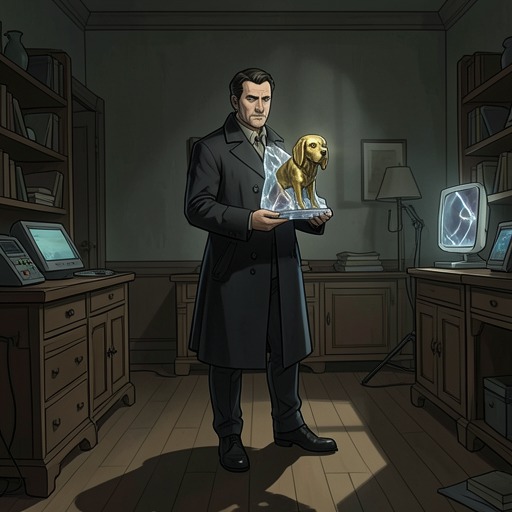
The church also forms one part of a closely connected neighborhood. The boys reach it from the apartment building by way of the courtyard and a back passage leading past a laundry and storeroom to an alley; the residence behind the apartment building is directly adjacent to the area where the investigation is unfolding. Later, Jupiter explains that the burglar concealed the Carpathian Hound in a pool by lowering it on a gilt cord that blended with the blue-and-gold tiles. That concealment is distinct from the church disguise, but both depend on the same investigative contrast: an object or person can be plainly present and still escape notice when the surroundings encourage people to misread what they see. The church’s apparent haunting and its temporary statue therefore belong to the same larger pattern of suspicion being corrected by attention to physical details.