St Jude’s Church’s alleged haunting
The Mystery of The Invisible DogSt Jude’s Church’s alleged haunting is a neighborhood legend that becomes a real obstacle to Jupiter Jones’s investigation: he enters the dark church after seeing a light, encounters a priest-like figure, and is knocked down and locked inside. The episode initially appears to confirm local ghost stories, but the investigation exposes ordinary explanations for some of its details without settling who—or what—Jupiter saw. The haunting therefore remains a live uncertainty at the edge of a case otherwise pursued through physical clues and practical deductions.
The Neighborhood Legend
The reported apparition is said to be the ghost of St Jude’s Church’s former pastor, dead for three years. According to Fenton Prentice, Mrs O’Reilly claims that she has seen the old pastor both inside the church and on the street. Her conviction is forceful enough that she resists Father McGovern’s efforts to lead her away from the scene, insisting that the restless spirit is real. Father McGovern, by contrast, tells her that the old pastor does not haunt the church. The disagreement makes the haunting part of the neighborhood’s shared life, but not a belief accepted by everyone who lives or works there.
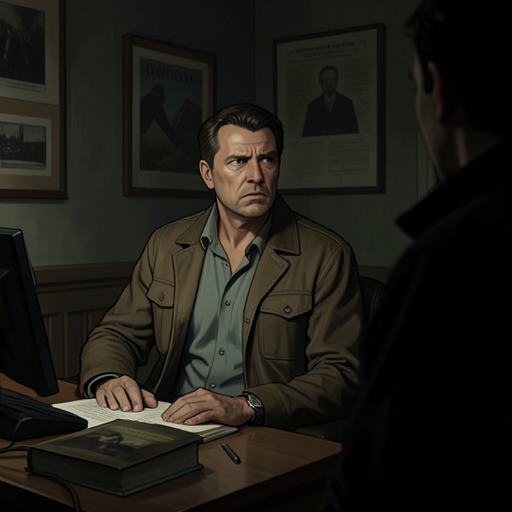
Professor Eugenia Lantine later gives the story a possible human origin. Father McGovern had asked her to investigate because Mrs O’Reilly was extremely nervous about the apparition, although the pastor himself had never seen it. Lantine says the figure’s reported appearance fits the former pastor: a thin, white-haired man in clerical clothes, whose portrait hangs in the parish-house parlour. She also connects Mrs O’Reilly’s account to her childhood in Dungalway, Ireland. The church there is reputed to be haunted by a priest lost at sea. After questioning Mrs O’Reilly, Lantine concludes that she may have reconstructed the local ghost from stories absorbed in childhood, without consciously realizing that she was doing so.
Lantine’s investigation supplies reasons for skepticism but not an eyewitness disproof. She spent several nights in St Jude’s Church and saw nothing; she also spoke with Paseo Place residents. Some older residents believed in the phantom priest, but, according to her inquiry, none had seen him. The legend thus persists through inherited accounts and belief rather than a body of independently verified sightings. Mrs O’Reilly’s certainty and the thinness of the corroboration remain in tension.
Jupiter’s Encounter
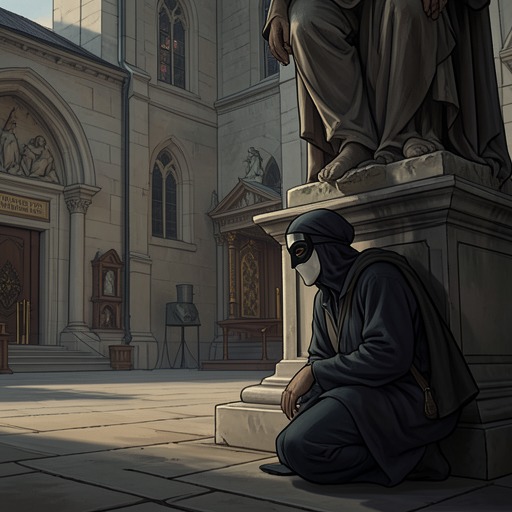
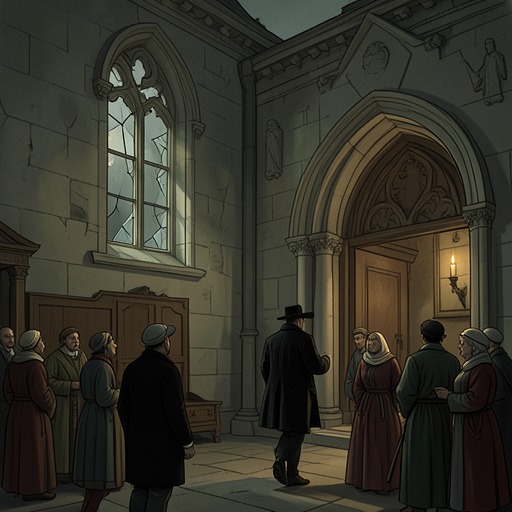
The haunting becomes more than neighborhood talk when Jupiter Jones notices a light in the church from Fenton Prentice’s apartment. A stained-glass window glows briefly and then goes dark. Later, Jupiter sees the light flicker again from the street, finds that a church door is not latched, and steps inside. Near the front, in almost complete darkness, a single candle is held by someone dressed in black. The figure turns toward him: Jupiter can make out a very white face, abundant snow-white hair, and a priest’s white collar, but the eyes remain hidden in shadow. The man says nothing.
Jupiter tells the police that someone knocked him down, went out, and locked the church door after him. Father McGovern insists that Jupiter could not have seen a priest there: the church had been locked since six, and his assistant was away. Mrs O’Reilly immediately contradicts the denial, treating Jupiter’s report as confirmation of the ghost she has long claimed to see. The physical details of the encounter support her interpretation at first glance, while the locked building and the assault suggest that a person may have entered and left by some means.
A missing statue makes the scene more complicated. Jupiter recalls a figure beside a window, down an aisle, dressed in a green cape and tall pointed cap and holding a staff. A police officer confirms that a statue had been there the previous night. Father McGovern identifies the clothing and objects as the costume of St Patrick used in the church’s Christmas pageant: the children had performed a Nativity and a procession of famous church figures, and he had returned the mitre, staff, and green cloak to the costume house that day. The apparent disappearance of a sacred image therefore has a concrete connection to recently handled theatrical props, though it does not by itself explain the candle-bearing figure or Jupiter’s confinement.
The church’s keys offer another practical route into the mystery. Father McGovern says that he, Mrs O’Reilly, and Earl have keys, while an extra set is kept on a hook in a coat closet in the parish house in case someone loses theirs. This makes entry by a person with access possible even if the door was locked at other times. The key information weakens the assumption that the locked church proves a supernatural visitor, but the evidence presented about the haunting does not identify who used a key during Jupiter’s encounter.
Investigation and Competing Explanations
When Bob Andrews recounts the church incident to Professor Lantine, she distinguishes the phantom priest from the separate apparition reported in Fenton Prentice’s apartment. Her distinction matters: the church story has its own history, reported resemblance, and possible source in Mrs O’Reilly’s childhood, while the apartment figure belongs to another line of inquiry. The book does not treat every apparently spectral event as one phenomenon merely because both involve a ghostly appearance.
At the case’s close, Jupiter considers whether Sonny Elmquist could account for the church figure. One possibility is that Elmquist’s astral body appeared in the church. Jupiter notes that Elmquist’s astral form wore whatever his physical body was wearing; seen at a distance in a white turtleneck and dark sweater, he might have been mistaken for a priest. Yet this theory has two conspicuous difficulties: Elmquist’s hair is black, not white, and an astral body should not be able to hold a real, flickering candle.
Jupiter proposes a second possibility: Elmquist may have entered the church in the flesh after his astral body saw the crystal dog there, disguising himself as the phantom priest to frighten off anyone who came in. That account could explain a deliberate human presence, but it leaves a further problem—how Elmquist got back outside after the doors were locked following Jupiter’s rescue. The various explanations therefore account for pieces of the scene without forming a complete, demonstrated solution.
Unresolved Significance
At the final discussion with Alfred Hitchcock, the phantom priest remains an open question. Jupiter’s hypotheses—astral Elmquist or Elmquist physically disguised—each encounter evidence they do not comfortably explain. Bob supplies the third possibility: that the visitor really was a phantom priest, and that the boys will never know. The ending refuses both an easy supernatural confirmation and a tidy rational solution.
That uncertainty is sharpened by the episode’s concrete objects: a briefly glowing stained-glass window, one candle in the dark, clerical clothing, a missing pageant statue, and keys kept in a parish-house closet. Each can be read as part of a staged deception or as material surrounding a genuinely uncanny event. The church’s reputation also has two competing forms: a story repeated by residents and a physical place entered by someone who can apparently lock the door behind him. Even after the crime’s other problems are resolved, Father McGovern’s question about the phantom priest remains unanswered. The haunting is significant precisely because the investigation narrows its possibilities without extinguishing the possibility that the legend might be true.