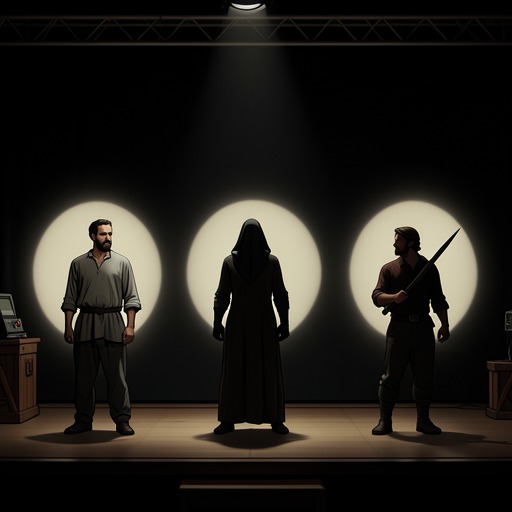
Absurd Man
The Myth of SisyphusThe Absurd Man is the human figure formed by lucid confrontation with the absurd: the irreducible divorce between a mind that desires unity and a world that disappoints that desire. He neither disguises this contradiction nor resolves it through a leap into transcendence. Instead, he accepts the limits of what can be known, lives within mortal time, and turns uncertainty into a demanding practice of revolt, freedom, and conscious action.
Definition and Intellectual Ground
The Absurd Man begins from two certainties that cannot be reconciled. He possesses an appetite for the absolute, a longing for clarity, cohesion, and unity; at the same time, he encounters a fragmented universe governed by chaos, sovereign chance, and an equivalence that offers no rational principle beyond itself. He cannot know whether the world has a meaning that transcends it, and he knows that such meaning is presently impossible for him to establish. Because he understands only what he can touch and what resists him, introducing an unverified meaning would amount to lying to himself.
This position requires fidelity to the evidence that produced it. The Absurd Man does not suppress either side of the equation: neither the mind’s longing nor the world’s refusal. Philosophical systems that remove one term are therefore evasions. The decisive danger lies in the instant before a leap, when the mind might abandon the dizzying crest of lucid uncertainty for an eternal comfort. Remaining there, without masking helplessness or converting it into doctrine, is presented as integrity. The issue is not admiration for despair but the practical question of whether a person can live with the absurd without escaping from it.
Living Without Appeal
The central rule of the Absurd Man is persistence. He refuses appeals to a future kingdom, immortal life, or any promise that exceeds the limits of his condition. When religions and prophets ask him to leap, he answers that he does not fully understand and will do only what is clear to him. Sin, hell, guilt, and immortality have no compelling authority for him because their significance depends on a future order he cannot verify. He feels not triumphant guilt but irreparable innocence, and this innocence means that he must accommodate himself to what is rather than import anything uncertain into experience.
This does not make him passive. The present becomes the field in which revolt and lucidity enter daily life. Abstract evidence is brought back into the body, affection, creation, action, and human nobility; spiritual conflicts return to the heart without being finally settled. The Absurd Man feeds his greatness on what the text calls the wine of the absurd and the bread of indifference. His life is therefore neither resignation nor consolation. It is a wager undertaken without guarantees, sustained by the repeated decision to remain conscious.
Freedom, Time, and Action
The Absurd Man’s freedom is strictly temporal. He does not negate eternity as a metaphysical proposition so much as refuse to organize his life around it. His courage teaches him to live without appeal and to make do with what he possesses; his reasoning teaches him the limits within which that life can act. He has a freedom limited by mortality, a revolt without a future guarantee, and a consciousness that knows its own death. Time, rather than eternity, is his field, and his action occupies the span of a lifetime.
Because he refuses judgment from beyond his condition, he shields his adventure from every authority except his own judgment. A greater life cannot mean another life, and posterity cannot serve as a substitute eternity. The example of Mme Roland clarifies this independence: she relied on herself, while posterity may quote her without necessarily preserving the meaning of her self-reliance. The Absurd Man therefore values lived expenditure over anticipated reputation. What matters is not what a life will become in a future accounting, but how fully and lucidly it is lived within the time available.
Innocence and the Limits of Morality
The Absurd Man does not construct a new ethical system. He observes that people can behave badly with great morality and that integrity does not require a formal set of rules. Since he lives outside the authority of a God who dictates a moral code, he sees competing systems, including immoralism, chiefly as justifications. His starting point is innocence: there is nothing outside him before which he must manufacture an excuse for existing or acting.
That innocence is dangerous precisely because it cannot be mistaken for permission. Ivan Karamazov’s declaration, “Everything is permitted,” is treated not as joyful liberation but as a bitter acknowledgment that no divine order guarantees meaning. The absurd gives no recommendation to crime and does not mean that nothing is forbidden. Rather, it removes the reassuring hierarchy by which consequences are automatically legitimized or canceled. Actions must still be faced, but their consequences are considered calmly, without remorse being granted a final metaphysical authority.
The Absurd Man is thus prepared to pay for what he does. He may be responsible, but he is not guilty in the ultimate sense imagined by a transcendent tribunal. Past experience can instruct future action, yet it cannot become a universal law capable of governing an unreasonable order. Even duty remains legitimate, but only as one experience among indifferent experiences; a person may be virtuous through a whim rather than through obedience to an eternal command. The resulting discipline is severe: not moral anarchy, but responsibility without absolution.
Examples, Consciousness, and Narrative Function
The Absurd Man is not offered as a model to imitate mechanically. The illustrations associated with him acquire meaning through their opposites, and a vocation is required before any example can be translated into conduct. The point is not to extract literal commandments from writers: drawing from Rousseau the conclusion that one must walk on all fours, or from Friedrich Nietzsche that one must maltreat one’s mother, would be as foolish as treating literature as a manual. The principle is that it is essential to be absurd without becoming a dupe.
Consciousness is the measure that equalizes apparently incomparable lives. A sub-clerk in a post office can be the equal of a conqueror if consciousness is common to both, because the relevant value lies not in social rank or historical magnitude but in the lucidity with which experience is inhabited. Experiences may help or harm a person according to whether they are consciously lived. Failure therefore becomes a judgment not simply on circumstances but on the self’s relation to them.
The figures selected for this world are people who aim to expend themselves or are visibly expending themselves. Their value is not that they provide moral templates, but that they extend the absurd reasoning into the warmth of human lives. Everything that makes a person work or become excited normally draws on hope; the thought that remains entirely free of mendacious hope is consequently sterile. In the absurd world, the value of a notion or a life is measured by that sterility: by its refusal to promise a future beyond the consciousness that presently sustains it. The Absurd Man is therefore less a conventional hero than a test of lucidity, a figure whose freedom consists in continuing to act after consolation has been removed.