Central Sporting Club
The Myth of SisyphusCentral Sporting Club, on rue du Fondouk in Oran, is presented as an improvised boxing venue whose significance exceeds its physical poverty. In its whitewashed, corrugated-iron hall, sport gathers a dense public around courage, violence, rivalry, and honor. The club becomes a temporary theater in which the long antagonism between Oran and Algiers is acted out through bodies in the ring and through the crowd’s shifting judgments.
Setting and Physical Character
The club’s boxing evening is advertised as an event for “real enthusiasts,” a phrase that signals not luxury or technical excellence but the courage of inexperienced fighters. A ring stands at the back of a violently lit, whitewashed garage covered with corrugated iron. Folding chairs form the “honor rings” around the ropes, while a crowded area called the “lounge” leaves almost no room for movement: roughly five hundred people fill it so tightly that taking out a handkerchief could cause an accident. The audience consists mainly of men, accompanied by only two or three women, and everyone sweats in the heat while a phonograph plays a sentimental Tino Rossi song before the bouts begin.
The venue’s discomfort is part of its social meaning. The fight announced for nine o’clock has not started by nine thirty, yet the enthusiasts do not protest. They endure the delay amid discussions, exploding lemon-soda corks, the singer’s repeated lament, and the pressure of late arrivals forcing themselves into the already packed hall. The club offers no cultivated distance between spectators and spectacle. Bodies, noise, heat, smell, and impatience bind the audience directly to the event.
Boxing and Regional Rivalry
The opening contests involve young hopefuls and beginners who claim to be fighting for amusement but try to prove it by attacking one another immediately and abandoning technique. Their bouts rarely last more than three rounds. One of the evening’s memorable fighters is “Kid Airplane,” who ordinarily sells lottery tickets on cafe terraces; his fist sends his opponent awkwardly out of the ring at the beginning of the second round. The crowd’s excitement remains ceremonious rather than fully released, as it watches the fighters’ slow rites and unregulated sacrifices beneath shadows projected onto the white wall.
The atmosphere changes when the loudspeaker announces Amar, “the tough Oranese who has never disarmed,” against Perez, “the slugger from Algiers.” The contest is not understood as a private quarrel between two men. It embodies the antagonism that has separated Oran and Algiers for a hundred years. Their rivalry is described as powerful precisely because it lacks a solid basis: the two cities have every reason to like each other, and therefore loathe one another in proportion. Oran accuses Algiers of sham, while Algiers treats Oran as rustic. These are not merely local insults but metaphysical judgments about competing ways of life.
Unable to besiege one another directly, the cities compete through sports, statistics, and public works. The boxing ring thus becomes a substitute battlefield. Amar, backed by a thousand shouting voices, is expected to defend the pride of Oran and its provincial identity, but his lack of reach weakens his argument. Perez’s reach gives the Algiers fighter the practical advantage, and Amar bleeds magnificently while the audience cries for violence. Perez is declared the winner on points amid catcalls. A spectator applauds ostentatiously while privately explaining that the gesture is necessary so that people in Algiers will not be able to say that the people of Oran are savages.
Crowd, Violence, and Reversal
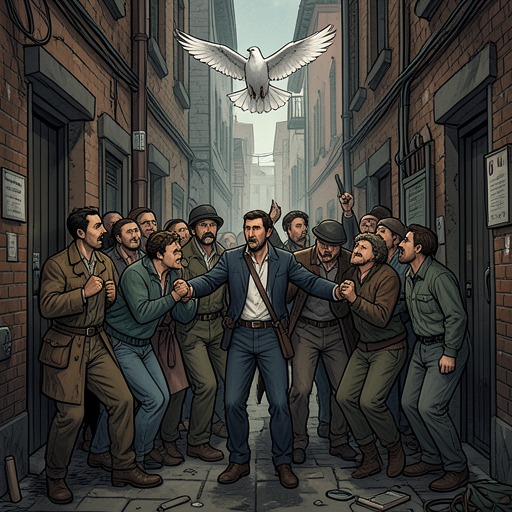
The club’s spectators continue the conflict beyond the scheduled bouts. Fights break out among the audience; chairs are brandished, police clear a path, and confused groups of combatants and self-appointed referees sway under police control. The management responds by having the loudspeaker play “Sambre-et-Meuse,” giving the hall a briefly warlike appearance while cries, mockery, and military music merge into a single uproar. The same public that has come to watch combat becomes part of the combat.
The final bout pits a French Navy champion against an Oran boxer. At first the Oran fighter’s advantage in reach does not move the exhausted crowd, which is recovering from its earlier expenditure of energy. By the seventh round, however, the real enthusiasts revive when the Frenchman touches the mat and attacks in an effort to recover points. Both boxers fight without reserve under the pitiless light, opening their guards, striking with closed eyes, using shoulders and knees, and exchanging blood. The audience rises as one body and seems to receive and return every blow through its thousand panting voices.
A draw is badly received because it violates the audience’s Manichean demand for a winner and a loser, good and evil, right and wrong. Two thousand lungs accuse the judges of having been bought or sold. The result is reversed not by a new decision but by a gesture: the French boxer crosses the ring, embraces his rival, and drinks in his fraternal sweat. The audience immediately changes its judgment and applauds. The embrace restores a form of fellowship that the contest had threatened to destroy, while the spectator’s earlier concern that Oran not be called savage is answered without erasing the violence that produced the concern.
Narrative Significance
After the crowd leaves beneath a silent, star-filled sky, it has spent itself in the same way as the fighters. The public becomes a group of black-and-white shadows disappearing into the night, with no energy left for retrospective analysis. The Central Sporting Club therefore stages a communion of the present rather than creating a durable memory. Violence and force operate as immediate gods: they distribute their effects intensely but leave nothing stable behind.
The club’s boxing spectacle condenses a broader code of masculine conduct visible elsewhere in Oran. The city’s street code values respect for one’s mother, protection of a wife’s public dignity, consideration toward a pregnant woman, and refusal to attack a fallen adversary because such conduct “looks bad.” At the club, those principles are tested against the appetite for blood, the demand for victory, and the crowd’s fear of appearing savage. Honor does not abolish violence; it gives violence boundaries and supplies the gestures through which opponents can return to one another.
The venue also belongs to the book’s larger ethic of embodied experience. Elsewhere, Mediterranean swimming and dancing make the body visible through sunlight, water, sweat, and movement; at the Central Sporting Club, the body is exposed to blows, exhaustion, and blood. In both settings, experience is measured through direct physical participation rather than through abstract moral certainty. The club’s packed audience, improvised architecture, regional antagonism, and sudden reconciliation make it a concentrated image of a life lived intensely in the present, where the struggle itself creates meaning even though its force cannot be preserved as history.