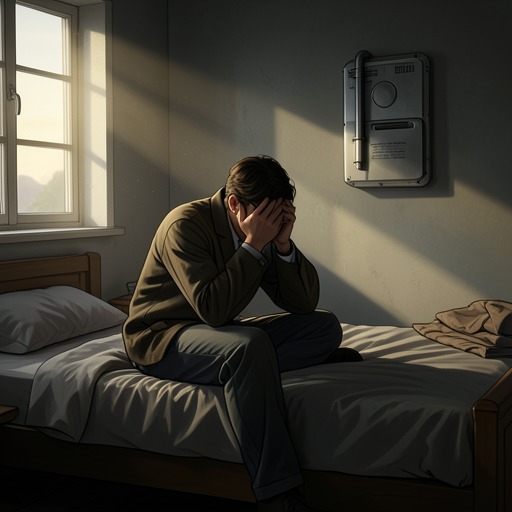
Existential anxiety
The Myth of SisyphusExistential anxiety is the conscious experience of human finitude, disorientation, and exposure before a world that offers no final guarantee of meaning. It is not merely a passing emotion but the condition in which ordinary explanations lose their authority: existence becomes limited, death becomes unavoidable, and the mind discovers that its demand for clarity meets only an unresponsive world. In this form, anxiety is the pressure under which consciousness awakens and the absurd becomes intelligible.
Definition and Awakening
The book places anxiety at the source of the initial discovery of the absurd. In the account associated with Martin Heidegger, existence is humiliated and anxiety is the only reality running through the chain of beings. For the person absorbed in diversions, anxiety may remain a brief, fleeting fear; once fear becomes conscious of itself, however, it becomes anguish, the persistent atmosphere of the lucid person in whom existence has become concentrated. Anxiety therefore marks a transition from an unnoticed condition to an explicit mode of awareness.
This awakening often begins in the apparently insignificant details of daily life. A mechanical sequence of rising, commuting, working, eating, sleeping, and repeating the same rhythm can suddenly break when the question of why emerges. Weariness belongs both to the end of that routine and to the beginning of consciousness. Anxiety gives that weariness its philosophical force: it interrupts habitual movement and compels the person either to return to the familiar chain or to continue toward a definitive awakening, whose possible consequences include suicide or recovery.
Finitude, Death, and Consciousness
Anxiety is intensified by the recognition that human existence is finite and limited. The book presents this limitation as more primordial than any abstract account of humanity. The person who becomes lucid no longer treats mortality as a distant proposition. Consciousness of death becomes the summons through which existence calls itself back from immersion in the anonymous social world. To remain awake is to refuse the comfort of sleep, distraction, or borrowed explanations while standing among the ruins of certainty.
This relation to death also alters the experience of time. Ordinary life is organized around tomorrow, later, eventual success, or the promise that understanding will arrive with age. A person who suddenly recognizes a definite age simultaneously locates the self on a curve leading toward its end. The future that had seemed desirable becomes the direction in which death advances. Anxiety is thus not simply fear of an event; it is the bodily revolt produced when the individual realizes that time carries the individual toward an irreversible conclusion.
The World as Unintelligible
The anxious consciousness also encounters the world as strange and resistant. A stone, a landscape, or nature itself can appear foreign and irreducible, stripped of the human meanings habit had projected onto it. Beauty does not abolish this estrangement. The softness of the sky and the outline of trees may lose their reassuring significance, while the primitive hostility of the world rises into view across the distance of millennia. What had seemed familiar becomes remote because the familiar images and designs imposed upon it can no longer function as an interpretive shelter.
This discovery explains why anxiety cannot be reduced to private psychology. It is produced by a relation between consciousness and reality. The person longs for happiness and reason, yet the world does not answer that longing in a language the mind can recognize. When the demand for explanation receives only contradiction, irrationality, or silence, anxiety becomes the felt form of the gap between the human need for unity and the world's refusal to provide it.
Philosophical Forms of Anguish
The book groups several thinkers around a privileged and bitter moment in which hope no longer has an obvious place. Martin Heidegger describes boredom as the ordinary person's attempt to suppress anxiety and terror as the mind's confrontation with death. Karl Jaspers begins from the failure of ontology and the impossibility of transcending the fatal play of appearances; in a world where knowledge fails and nothingness seems permanent, despair appears to be the only immediate attitude, even as he searches for a thread toward divine secrets.
Lev Shestov repeatedly demonstrates that the most rigorous system and the broadest rationalism eventually collide with the irrational. His attention turns to exceptions, contradictions, and human revolt against what cannot be remedied. Edmund Husserl and the phenomenologists approach the same crisis through a different method: rather than forcing the diversity of experience under one principle, they restore importance to the rose petal, the milestone, and the human hand as well as to love, desire, and the laws of gravity. Their extreme attentiveness enriches the field of phenomena, but it offers an attitude for understanding rather than consolation.
From Anxiety to the Absurd
The decisive consequence of existential anxiety is the judgment that the absurd arises from confrontation. Human beings possess a longing for happiness and reason; the world answers with an unreasonable silence. Neither side alone is the absurd. It is born in the encounter between the human demand and the world's refusal, and anxiety is the consciousness that keeps this encounter from being forgotten or disguised.
The mind that insists on complete explanation discovers that it can find no final clarity. If it could say once that something was clear, the crisis would end; instead, the world appears chaotic, and the only firm possession is lucidity together with knowledge of the walls enclosing human existence. At that point the mind must choose its conclusions. The book therefore treats anxiety as the threshold of the larger drama: it exposes the limits of reason, makes death present, awakens consciousness, and forces the question of whether one will evade the absurd or live in full awareness of it.