Existential exile
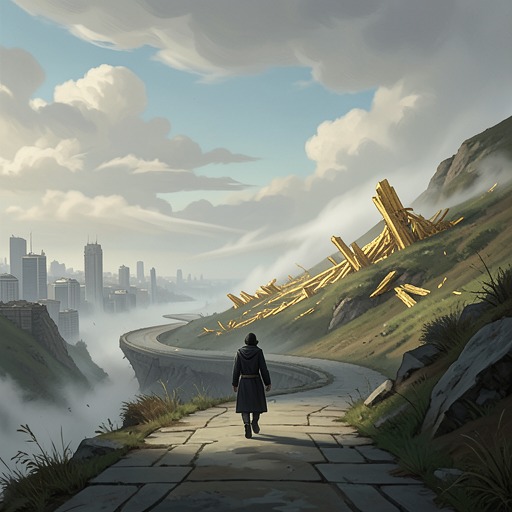
The Myth of SisyphusExistential exile is the condition in which a person no longer experiences the world as a meaningful home. It arises when familiar explanations, habits, landscapes, and moral assurances fall away, leaving the individual suspended between a lost intimacy with life and no credible promise of return. The state is therefore not merely loneliness: it is the deeper divorce between the actor and his setting, between human longing and a world that refuses to answer it.
Definition and Philosophical Ground
The essay defines existential exile through the image of a world suddenly stripped of its illusions and lights. A world that can be explained, even badly, remains familiar; once explanation fails, the human being feels like an alien or stranger. This exile is “without remedy” because there is neither a remembered home to which one can return nor a promised land toward which one can hope. The resulting separation between humanity and life is identified as the feeling of absurdity.
This condition is closely connected with the longing for death. The text presents suicide not simply as a response to one isolated sorrow but as an act that may confess that life has become too much, that its habitual movements lack a profound reason, and that its daily agitation and suffering appear useless. Yet the precise instant at which a mind turns toward death remains difficult to establish. An apparently minor encounter, such as a friend’s indifference on a particular day, may precipitate resentments and boredom that had been accumulating invisibly. Existential exile therefore develops through a tension between long-standing estrangement and an unpredictable crisis.
The World Made Strange
The state becomes perceptible when time, nature, and ordinary surroundings cease to be transparent. People ordinarily live toward “tomorrow,” postponing understanding and fulfillment until later life. But when a person recognizes an exact age, he also locates himself on a temporal curve that must end. The future that had seemed desirable becomes the approach of death, and the body’s revolt against this recognition becomes another expression of the absurd.
A further stage occurs when the world is felt as dense, foreign, and irreducible. A stone is no longer merely part of a usable landscape; nature and the landscape seem capable of negating the observer. Beauty retains something inhuman at its core, while hills, sky, and trees lose the meanings habit had placed upon them. The world withdraws its human design and becomes itself again. What had looked like familiar scenery is exposed as a stage set previously masked by custom, and the person who depended on that mask is left outside it.
The same estrangement can appear in encounters with other people and with the self. A familiar woman may suddenly appear as a stranger. A man speaking behind a glass partition becomes an incomprehensible display of gestures because his words cannot be heard. The observer sees a mechanical pantomime without access to its purpose and is forced to confront the possibility of inhumanity within humanity itself. Even a mirror or photograph can produce this disturbance by presenting a familiar yet alarming double. Existential exile thus turns outward toward the world and inward toward the self, making both seem simultaneously recognizable and inaccessible.
Historical Exile and Lost Innocence
The condition acquires a collective and historical dimension in the account of Tipasa. The narrator remembers a youthful encounter with ruins where he had once felt alive beneath a star-filled sky, then returns fifteen years later to find the site surrounded by barbed wire, accessible only through designated openings, and guarded during the day. Rain covers the ruins, and the physical restrictions make visible the distance between remembered beauty and the controlled, damaged present.
The transformation is linked to the Second World War. On September 2, 1939, the narrator had not gone to Greece as intended; war had instead come to his world and then spread to Greece. The years separating the warm ruins from the barbed wire have an equivalent within him. He had been raised amid beauty, possessing little material wealth but treating beauty as his essential abundance; afterward came tyranny, war, police forces, and an era of revolt. The ruined site becomes a historical landscape of existential exile, where political violence has turned a place of openness and delight into a memory regulated by authority.
At Tipasa, even memory begins to fade. The narrator sees a world aged at once by conflagrations, its wrinkles and wounds suddenly exposed. Empires collapse, nations and individuals tear at one another, and innocence gives way to guilt without intention: greater knowledge does not produce mastery but intensifies the mystery. The resulting concern with morality is marked by irony, because the people who now recognize moral demands feel unable to satisfy them. Existential exile here means being separated not only from a place but from the earlier self who could inhabit beauty without first having to justify it.
Consequences and Possibility of Return
Exile produces a desiccated form of life. The narrator describes himself as walking behind someone whose steps can still be heard among the stones, while knowing that this earlier presence can never be overtaken. After returning to Paris, he remains away from home for several years, carrying an obscure sense that something essential has been lost. The condition is not cured by intellectual recognition; lucidity can identify the separation without restoring the world that once appeared whole.
Yet the essay refuses to make beauty and justice mutually exclusive. Forsaking beauty in order to serve misfortune demands a nobility the narrator admits he does not possess, but isolating beauty ultimately makes it sentimental, while isolating justice makes it oppressive. To serve one against the other is to serve no one and may reproduce injustice twice. Existential exile therefore includes the danger of rigid moral abstraction: once everything is reduced to a single principle, wonder disappears, life becomes repetitive, and the soul grows dead.
A return to life requires something the narrator calls a special grace, such as self-forgetfulness or a homeland. The possibility is not presented as a restoration of lost innocence in its original form. Rather, it lies in recovering a relation to life that can hold beauty and justice together without denying either the wounds of history or the irreducible strangeness of the world. Existential exile remains the knowledge that the former home cannot simply be recovered, but it need not become a permanent refusal of all attachment.