Greece
The Myth of SisyphusGreece is not merely a geographical destination in the book. It is a remembered homeland of beauty and measure, a threatened cultural inheritance, and a point of comparison through which the narrator interprets modern Europe’s historical violence. His failed journey to Greece on September 2, 1939, becomes inseparable from the outbreak of war, while Greek thought and landscape continue to represent a balance between nature, reason, beauty, virtue, and human limitation that the modern world has abandoned.
Greece as a Cultural Measure
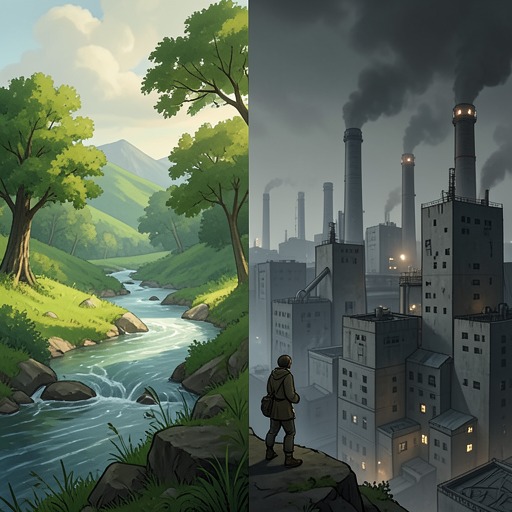
Greece appears first as the civilization against which contemporary Europe is judged. The narrator contrasts the Mediterranean sun with the tragedy of European fogs: Greek despair, when it existed, was experienced through beauty and its suffocating intensity, whereas modern Europe has fed despair on ugliness, convulsion, and historical violence. Greece therefore embodies a form of tragedy that remains proportionate to the world, while Europe represents a condition of excess in which the pursuit of totality destroys the limits that once made justice and beauty intelligible.
Greek thought is described as taking refuge behind limits. It did not carry either the sacred or reason to extremes, and it refused to negate either one. Instead, it held shadow and light together and sought equilibrium rather than absolute domination. This intellectual balance is set against Europe’s desire to glorify the future rule of reason while rejecting whatever does not fit its totalizing project. The contrast makes Greece less an idealized nation than a standard of measure: a civilization capable of recognizing that justice requires boundaries and that human knowledge begins with an admission of ignorance.
The narrator invokes Socrates as the exemplary figure of this restraint. Facing death, Socrates claimed no knowledge of what he did not know, and this proud confession of ignorance becomes, in the narrator’s account, the culmination of Greek thought and life. Modern power has forgotten that discipline. Having conquered and moved beyond natural and spiritual boundaries, modern humanity ends by ruling over a desert, deprived of the imagination required to reconcile nature, history, beauty, and virtue.
The Interrupted Journey
Greece is also the destination that history made impossible. On September 2, 1939, the narrator was supposed to go there, but war came instead; it later spread to Greece itself. The missed journey marks the moment when private expectation was overtaken by collective catastrophe. The distance between the warm ruins he had hoped to see and the later world of barbed wire is not only geographical or chronological. The narrator discovers that the same distance has opened within him.
When he returns to Tipasa after the war, the lost Greek journey remains part of the background of his disappointment. He had been formed by beauty, which was his only wealth, but tyranny, war, police forces, and the era of revolt had placed a figurative barbed wire around that inheritance. The world had aged suddenly, and those who had grown up within its earlier innocence had become guilty without intending to be. Greece thus belongs to a before-and-after structure: before the war, it is associated with freedom, youth, and unreflective abundance; after the war, it survives as a memory whose innocence can no longer be recovered.
The journey’s interruption also alters the meaning of return. The narrator knows that revisiting places of youth risks trying to live again at forty what was loved at twenty, yet the attempt is driven by a need to recover a freedom that remains unforgettable. Greece is not simply remembered as a tourist destination. It is the absent place around which the narrator measures the loss of a world, while Tipasa becomes the actual site where that loss is tested against ruins, rain, restrictions, and renewed light.
Landscape, Memory, and Return
The recollection of Greece is carried by Mediterranean space rather than by historical exposition alone. The sea, the sun, ruins, and the clarity of the light give Greek despair a material form. Beauty is not decorative background: it is the medium through which suffering becomes intelligible. The landscape allows tragedy to reach its highest point precisely because fulfillment and anguish can coexist within it.
The narrator’s later journey toward Tipasa follows a road saturated with memories of childhood, adolescence, beaches, bodies, desire, and the recurring sky and sea. Although the destination is not Greece, the return reenacts the interrupted movement toward the Greek world. The Chenoua mountain appears as a massive, enduring presence, a refuge and harbor for those who belong to it, while the ruins offer a temporary encounter with the natural abundance and clarity that history has obscured. In this sense, Tipasa becomes a near-shore counterpart to Greece: a place where the narrator can approach the remembered Mediterranean order without pretending that time has been reversed.
The return is not uncomplicated restoration. The earlier ruins had been open to wandering, night, and unguarded experience; later they were surrounded by barbed wire, entered only through designated openings, and watched by an official guardian. Rain further darkens the site, filling sarcophagi with black water and making memory itself seem to blur. The restrictions materialize the political history that separates the narrator from his youth. Greece is therefore present through absence: its beauty is recalled most intensely when war, authority, and modern control have made unmediated access to such beauty impossible.
Greece and Modern Europe
The book’s treatment of Greece belongs to a larger argument about Europe’s historical crisis. European cities are crowded with the noise of the past—revolutions, fame, empires, and accumulated violence—and this historical density prevents the silence required for spiritual and intellectual renewal. Greece, by contrast, signifies an older relation between human beings and the natural world, one in which the sea, hilltops, evening meditation, and permanent forms were not amputated from consciousness.
The narrator presents modern Europe as having placed history on the throne of God. In doing so, it approaches a form of theocracy founded not on transcendence but on historical power, resembling the barbarians opposed by the Greeks at Salamis. The comparison is deliberately unsettling: Europe claims the authority of progress while reproducing the disproportion and domination that Greek measure resisted. Greece becomes the name for a civilization that recognized limits, whereas Europe’s ambition to master heaven and earth produces only isolation in a conquered desert.
This opposition is not a simple call to escape history. The narrator elsewhere insists that the contemporary artist cannot stand aloof from an age of trenches, mobilization, and crushed forms. Greece offers a measure, not an exemption. Its beauty and limits help expose the deformity of modern violence, but the writer remains bound to the historical present and to those humiliated by it. The task is to preserve the memory of balance without using that memory as an excuse for indifference.
Narrative and Thematic Significance
Greece joins the book’s philosophical and autobiographical strands. In the philosophical argument, it represents the possibility of living without reducing the world to a single absolute: neither reason nor the sacred is permitted to erase its opposite. In the memoir-like passages, it is the destination lost to war and the cultural memory that survives through repeated returns to Mediterranean light, ruins, and sea. These two functions reinforce one another. The interrupted journey gives the cultural argument personal urgency, while the cultural argument gives the private loss historical meaning.
Greece finally stands for a disciplined form of hope. It cannot restore the narrator’s youth, erase the war, or remove the barbed wire from the ruins. Yet its remembered balance prevents despair from becoming a celebration of excess. Against a Europe that has exiled beauty and pursued totality, Greece preserves the thought that limits are not weakness, that ignorance may be a form of courage, and that suffering need not destroy the proportion that makes human life and art possible.