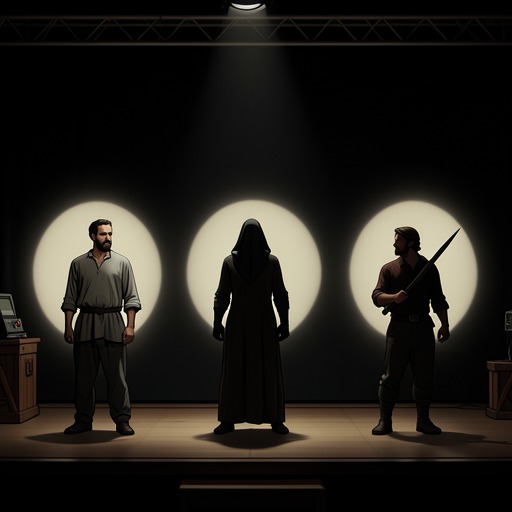
Iago
The Myth of SisyphusIago appears as one of the defining figures through whom the actor demonstrates the absurd abundance of theatrical life. For a few hours, the actor makes Iago live and die within the restricted space of the stage, giving a temporary body to a character whose existence is inseparable from performance. When the performance ends, Iago ceases to occupy the actor’s immediate present and is replaced by another destiny, making the character an instance of a life fully experienced yet radically ephemeral.
Identity and Theatrical Existence
Iago is identified not through a developed personal history but through the force of his stage presence. The actor has only a limited performance—three hours, on fifty square yards of boards—in which to bring Iago into being. That compression gives the role its peculiar intensity: a complete dramatic existence must be conveyed within a short interval, and its apparent fullness depends on the actor’s capacity to inhabit it absolutely.
The character therefore belongs to a succession of borrowed identities. After one role has ended, another takes its place: the hero suffering from uncertainty is followed by the man roaring for revenge, and Iago stands within this larger procession of exceptional destinies. The actor travels across centuries and minds, carrying characters from the periods and worlds in which they were created into the immediate present of the stage. Iago’s identity is consequently both specific and replaceable: he is an individual dramatic figure, but also one manifestation of the actor’s continual movement among lives that are not his own.
Embodiment and Knowledge
The actor’s art makes Iago intelligible through physical realization rather than through detached explanation. The theatrical convention described here requires the heart to communicate through gesture, the body, and the voice, translating inward passion into visible or audible form. The actor breaks the silence and restraint that ordinarily conceal the soul, allowing passions to emerge through gestures, shouts, and cries. Iago is thus created for display: the actor outlines or sculpts him and transfuses his own blood into the character’s phantom form.
Costume and theatrical machinery intensify this process. The mask, buskin, make-up, and exaggerated costume reduce and accentuate the face and body, sacrificing ordinary scale to appearance and making the character legible to the eye. This physical transformation produces knowledge as well as spectacle. The actor’s claim that Iago would never be fully understood without playing him establishes embodiment as the route to comprehension: hearing about Iago is insufficient, while seeing and enacting him reveal what the character is.
Multiplicity and Contradiction
Iago helps expose the actor’s central contradiction. The same body becomes many souls, moving from hero to hero while retaining a single, oppressive silhouette that is at once strange and familiar. The actor is therefore both the same and various, a unified physical presence containing a succession of irreducible characters. Iago is not merely added to the actor’s identity; he becomes one of the forms through which the actor tests the boundary between self and role.
That boundary is unstable because appearing creates being. The actor’s vocation is to simulate absolutely and to project himself as deeply as possible into lives that are not his own. In this sense, Iago illustrates the proposition that no firm frontier separates what a person wants to be from what that person is. The role is assumed as a mask, but the mask becomes a temporary mode of existence. The actor may carry such roles beyond the performance, even unconsciously repeating a character’s gesture in ordinary life; the distance between actor and the creatures he animates is therefore narrower than theatrical convention might suggest.
Ephemeral Life and Absurd Significance
Iago’s stage existence embodies the absurd because it is total without being permanent. The actor may die in three hours beneath the mask assumed for the day, experiencing and expressing an entire exceptional life before surrendering it to the next role. This is a form of losing oneself in order to find oneself: the actor lives many lives precisely by consenting to become nothing fixed, or several things in succession.
The role also clarifies why theatrical fame is so fleeting. Unlike a writer, who can hope that works will testify to his existence even if they are not appreciated, the actor leaves at best a photograph. The gestures, silences, gasping, and panting that constituted the performance do not survive in their original form. For the actor, not being known is equivalent to not acting, and not acting becomes a repeated death alongside the creatures who might otherwise have been brought to life or restored. Iago’s brief visibility is therefore both triumph and disappearance: he is made intensely present, but only under conditions that guarantee his replacement and eventual loss.