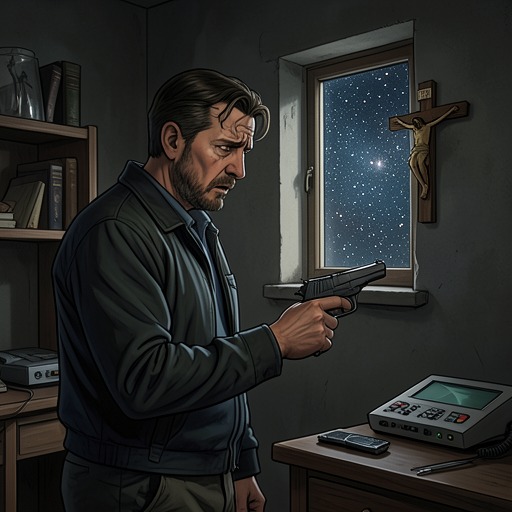
Jesus Christ
The Myth of SisyphusJesus Christ occupies a decisive but deliberately reinterpreted place in the argument. He is invoked as the figure who most completely realizes the human condition of suffering without thereby becoming a supernatural solution to it. Through Kirilov’s reading, Christ becomes the man-god: a terrestrial exemplar of freedom, torture, and sacrifice whose significance lies in the extremity of his human ordeal rather than in a divine escape from it.
Identity and Reinterpretation
Jesus Christ is distinguished from the conventional idea of a god-man. Kirilov does not simply set himself apart from Christ; he attempts to annex Christ to his own argument. Christ, in this account, is not primarily proof of divine intervention but the complete human being, the one who realized the most absurd condition. His death places him inside the drama shared by all human beings: each person can be crucified and victimized, at least to some degree.
This interpretation shifts divinity from heaven to earth. Kirilov’s claim that, if God does not exist, he himself is god depends on defining divinity as independence rather than immortality or supernatural power. Christ becomes relevant because his suffering can be read as the fullest embodiment of human exposure to falsehood, pain, and death. The sacred figure is therefore translated into an earthly measure of what a human being can endure and enact.
Suffering and the Absurd Condition
Kirilov imagines that, at his death, Christ discovered that his torture had been useless and that he had died for a falsehood. The laws of nature, in this interpretation, forced Christ to live amid falsehood and to die for it. His importance lies precisely in that contradiction: he represents a human life compelled to confront suffering without receiving a conclusive worldly justification.
The comparison with Kirilov is therefore exact but not identical. Kirilov wants to demonstrate freedom by killing himself, yet he also understands that such freedom should logically lead to continued life. His suicide becomes pedagogical: he sacrifices himself to show humanity a difficult path toward independence. Christ functions as the prior and more complete image of this human drama, but the comparison also exposes the contradiction in Kirilov’s project. If freedom has already been won on earth, death cannot simply be treated as its final proof without reopening the problem that freedom was meant to solve.
Christianity and Future Life
The text does not treat Christianity itself as the element that necessarily contradicts the absurd. It allows that a person could be Christian and still remain absurd, particularly if Christianity were separated from belief in a future life. The decisive conflict is instead the announcement of eternity as a final answer to earthly suffering.
That distinction preserves the force of Christ’s human example while rejecting the theological conclusion that would resolve it. An absurd work, unlike a work that merely presents the absurd problem, does not provide a reply. The Christian promise of another life supplies precisely such a reply. In the judgment applied to Dostoevsky’s fiction, the creator ultimately answers Kirilov by joining two claims that resist each other: existence is illusory, yet it is eternal. Christ thus stands at the boundary between an uncompromising recognition of suffering and the hope that suffering possesses an eternal meaning.
Narrative and Thematic Significance
Jesus Christ serves as a mediating figure between divine language and human experience. He allows the discussion to move from the abstract proposition that the death of God makes human beings free to the concrete image of a person crucified, victimized, and left within the limits of nature. The figure does not erase the contradiction; he concentrates it.
His role also clarifies why the text can recognize nobility in religious art without calling that art absurd. A novel may give dramatic form to the struggle between human beings and their hopes, and Christ may be its most powerful image of that struggle. Yet when the narrative promises a future life, it moves beyond the unresolved condition it has so vividly represented. Jesus Christ therefore remains central as the fullest image of terrestrial suffering and self-sacrifice, even as the doctrine of eternity becomes the point at which the absurd analysis must part company with Christian affirmation.