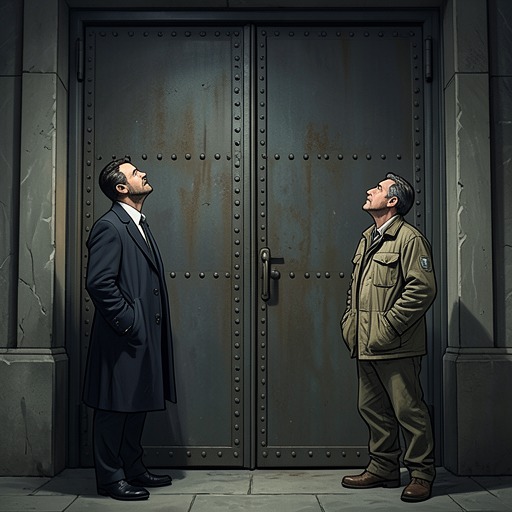
Joseph K.
The Myth of SisyphusJoseph K. is the protagonist of Franz Kafka’s The Trial, a man seized by accusation without a stated crime and carried toward a sentence whose meaning he never fully grasps. His decisive significance lies in the contradiction between the extremity of his situation and the composure with which he continues to work, love, eat, and read the newspaper. He is condemned, yet his deepest failure of recognition is that he never shows enough astonishment at the fact that he is not astonished.
Identity and Introduction
Joseph K. appears as an average European rather than as an exceptional hero. Kafka gives him the initial “K.” rather than a fully identifying name, making him at once a flesh-and-blood individual and an anonymous variable: he could have been called Schmidt or Franz Kafka, but he is named Joseph K. He is not Kafka, yet he is also Kafka; he is like everybody else while remaining the particular entity K., the unknown quantity in a human equation.
His predicament begins with accusation. Joseph K. is accused, but he does not know of what. He is presumably eager to defend himself, but he does not know why a defense is required. The lawyers regard his case as difficult, and the legal machinery surrounding him offers neither a clear charge nor a stable explanation. The absence of information does not produce an immediate rebellion or escape. Instead, it becomes the condition within which he continues to behave as though daily life could proceed normally.
Life Under Accusation
The force of Joseph K.’s character comes from his divided attention. While the proceedings gather around him, he does not neglect to love, to eat, or to read his paper. These ordinary gestures are not separate from the trial; they are the means by which he remains inside it. The legal crisis does not replace everyday existence with a clearly marked extraordinary realm. It infiltrates ordinary life and is accepted through the same practical habits that govern meals, reading, and personal attachments.
Eventually Joseph K. is judged. The courtroom is very dark, and he understands little of what occurs there. He merely assumes that he is condemned, while barely asking what the condemnation is for. At moments he suspects the truth of his situation, but suspicion never becomes complete knowledge. His continued life therefore has the strange shape of movement without comprehension: he responds to consequences whose cause remains inaccessible.
This combination of pursuit and non-recognition makes Joseph K. a central example of the absurd character. His adventures are extraordinary, yet the narrative treats them with a naturalness that belongs to routine experience. The mind’s spiritual tragedy is projected into concrete circumstances, while daily gestures acquire the weight of permanent, almost metaphysical ambitions. Joseph K. does not stand outside the absurd world to explain it; his conduct gives that world its form.
The Trial and Execution
Joseph K.’s final movement begins when two well-dressed and polite gentlemen come to collect him. Their politeness makes the event more disturbing rather than less: they invite him to follow them, and they lead him courteously into a wretched suburb. The execution proceeds without a corresponding clarification of the charge. They place his head on a stone and slit his throat, completing the judgment through an act that is both formal and brutally physical.
Before dying, Joseph K. says, “Like a dog.” The words register humiliation, but they also crystallize the novel’s deliberate refusal of explanatory closure. The execution confirms that the condemnation is real, even though its grounds remain obscure. His death does not solve the mystery of the court; it converts the mystery into the final fact of his existence. The process has achieved its end without granting him the knowledge that would make that end intelligible.
The execution also gives concrete shape to the freedom attributed to Kafka’s characters. Joseph K. is constrained by accusation, procedure, judgment, and death, yet he moves through these forces with a manner that is neither heroic defiance nor simple surrender. His mute participation exposes a freedom stripped of comforting alternatives: he continues acting within a world whose rules he cannot master and whose verdict he cannot successfully appeal.
Absurdity and Interpretation
Joseph K.’s situation is more particular than a generalized image of the human condition. It is deeply connected to Kafka’s own imaginative world, in which a personal spiritual tragedy takes the form of a concrete case. Joseph K. is therefore both typical and singular. His anonymity makes him representative, but the precise contours of his accusation and execution preserve the pressure of an individual confession.
The novel’s absurdity depends on consistency rather than on chaotic impossibility. Its events are rendered with an orderly, almost procedural logic, even when the order itself has become incomprehensible. Joseph K.’s world is not simply irrational; it is an indescribable universe in which torment is pursued through structures that retain the appearance of reason. The more extraordinary his experience becomes, the more natural it seems to him, and this divergence between the reader’s alarm and the character’s acceptance produces the novel’s central paradox.
The Trial therefore makes Joseph K.’s flesh prevail over abstract explanation. The work contains unexpressed revolt, lucid and mute despair, and an astonishing freedom of manner, but none of these is presented as a detached doctrine. They are embodied in the character’s conduct and brought to their ultimate expression in his death. Joseph K. is not merely a symbol to be decoded; he is the concrete figure through whom contradictions remain active: the individual and the universal, the tragic and the everyday, the absurd and the logical.
Narrative Role and Significance
Joseph K. makes the reader confront a world in which the most consequential fact may remain unavailable as knowledge. His accusation supplies the plot’s mystery, but the narrative does not reward investigation with a final explanation. Instead, the character’s ordinary behavior forces repeated reconsideration of what counts as extraordinary. The reader is compelled to reread the events from another point of view because the ending suggests interpretations without stating them plainly.
His role is consequently not that of a detective who uncovers a hidden crime. No clear chain of clues leads from offense to verdict. Joseph K. is the person inside the problem, not the outside intelligence capable of solving it. His failure to formulate the charge, his limited understanding of the dark courtroom, and his near-indifference to the basis of his condemnation make him the living measure of a system whose power lies partly in withholding the question that would allow resistance to become precise.
Joseph K.’s final words leave the novel suspended between recognition and bewilderment. He knows enough to experience degradation, but not enough to possess a complete account of his fate. In that gap, he becomes at once an ordinary man and a universal figure: condemned in a particular body, yet reduced to the anonymous “K.” through which Kafka makes everyday life carry the pressure of supernatural anxiety.