K–the Castle relationship
The Myth of SisyphusThe K–the Castle relationship governs the central movement of The Castle: Land Surveyor K. arrives in the village after being appointed to serve the Castle, but discovers that no reliable communication connects the two places. His attempt to gain recognition therefore becomes an endless negotiation with an authority that remains distant, opaque, and possibly indifferent. The relationship is decisive because K. does not merely want information or professional employment; he wants the Castle to adopt him, and the failure of that desire gradually reshapes his identity, his relationships, and his understanding of hope.
Identity and Structure
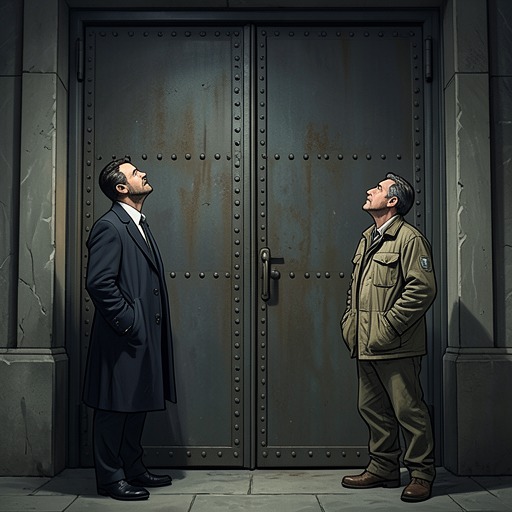
The relationship begins with an official designation that promises connection. K. is named Land Surveyor to the Castle, a role that should place him within an intelligible administrative order. Instead, his arrival in the village exposes the gap between appointment and acceptance. He possesses a title, but not a place; a presumed task, but no accessible authority capable of confirming it. The Castle thus appears less as a visible destination than as a power whose effects determine village life while its own intentions remain uncertain.
Communication between K. and the Castle is impossible in practical terms. When K. telephones, he hears confused and mingled voices, vague laughter, and distant invitations rather than a clear answer. These sounds do not establish contact, yet they are enough to keep the possibility of contact alive. The Castle’s silence is therefore not absolute: it is punctured by signs too indistinct to interpret and too suggestive to dismiss. The relationship is built on this unstable interval between refusal and promise.
K.’s Pursuit of Admission
K. persists for hundreds of pages in seeking a way from the village to the Castle. He makes every advance available to him, using trickery and expedients, while refusing to surrender to anger. His persistence has a consistent method even when it produces no progress: each chapter brings a new frustration and, with it, a new beginning. The repeated pattern makes the pursuit more than a sequence of failed attempts. It becomes the governing discipline of K.’s existence.
The scale of the effort gives the relationship its tragic quality. K. is not defeated by one explicit rejection; he is held in a condition where every obstruction leaves room for another interpretation. The Castle’s distant voices, like signs appearing in summer skies or evening anticipations, provide just enough encouragement to feed his hope. The possibility that the latest obstacle may not be final is what keeps the quest moving. K.’s relation to the Castle is consequently neither simple rebellion nor passive submission. He advances through uncertainty because uncertainty itself has become the medium of his hope.
Belonging, Work, and the Village
K.’s great hope is to have the Castle adopt him. Since he cannot accomplish this directly, he tries to deserve its favor by becoming an inhabitant of the village and by losing the status of foreigner that everyone makes him feel. His objective becomes strikingly ordinary: he wants an occupation, a home, and the life of a healthy, normal man. He can no longer endure the madness of his condition and wants to become reasonable, to cast off the curse that marks him as a stranger.
This attempt to enter ordinary life does not break the relationship with the Castle; it deepens it. K. treats village belonging as a possible route toward official recognition, turning domestic and social acceptance into evidence that the Castle might finally acknowledge him. The everyday becomes an ethic because ordinary existence is no longer merely a private desire. It is the form through which K. hopes to prove that he deserves admission to the order governing the village.
Yet the effort also reveals how thoroughly the Castle controls his conception of a normal life. K. wants a home and occupation not simply for their own sake, but because they would certify that he is no longer an outsider. The Castle remains present even in the most practical ambitions, converting work, residence, and social identity into stages in an administrative and spiritual trial.
The Relationship’s Human Consequences
The Castle’s inaccessible authority affects not only K. but also the people around him. They become attached to the void and nameless pain that shape his existence, as though suffering has acquired a privileged status. Frieda’s attachment makes this pattern explicit: she tells K. how forsaken she feels when he is absent after she has come to know him. Her dependence links intimacy to abandonment, so that K.’s relationship with the Castle indirectly reorganizes the emotional lives of those who draw close to him.
K.’s relationship with Frieda is itself connected to his desire for the Castle. He takes her as his mistress because she has known one of the Castle’s officials. Her past seems to offer him something that transcends him, even as he recognizes that the same past makes her forever unworthy of the Castle. Their intimacy therefore carries an instrumental and symbolic burden: Frieda is both a person to whom K. is attached and a possible intermediary to the authority he cannot reach directly.
K.’s later break with Frieda and movement toward the Barnabas sisters changes the meaning of his pursuit. The Barnabas family is the only family in the village utterly forsaken by both the Castle and the village. Amalia, the elder sister, rejected shameful propositions from one of the Castle’s officials, and the curse that followed cast her permanently outside the love of God. By turning from Frieda toward the Barnabas sisters, K. moves closer to those who bear the most complete form of exclusion. His relation to the Castle thus becomes increasingly defined not by proximity to favor, but by identification with abandonment.
Hope, Exile, and Final Meaning
The Trial and The Castle present different but complementary forms of the same predicament. The Trial diagnoses its problem through a quasi-scientific method and without concluding, whereas The Castle, to a certain degree, explains it and imagines a treatment. The proposed remedy does not cure the underlying malady. It brings that malady back into normal life and helps people accept it, even cherish it. In this structure, K.’s relationship with the Castle is the strange mechanism by which anxiety becomes livable without becoming resolved.
K. cannot imagine another anxiety than the one tormenting him. His hope is therefore inseparable from the power that crushes him. The Castle’s refusal produces suffering, but its faint signals preserve the possibility of a future in which suffering might acquire meaning. This is why hope remains neither comic nor incidental. The more tragic the condition, the firmer and more aggressive the hope becomes; the more absurd the world, the more moving and illegitimate K.’s leap toward the Castle appears.
The Barnabas story marks the furthest point of that movement. K.’s last attempt is to recapture God through what negates God, seeking recognition not through goodness, beauty, morality, or logic, but behind indifference, injustice, and hatred. The stranger who asked the Castle to adopt him ends his voyage even more exiled because he abandons morality, logic, and intellectual truth in order to enter, sustained only by mad hope, the desert of divine grace. His pursuit does not culminate in acceptance. It culminates in a transformation of what acceptance would mean.
The relationship between K. and the Castle consequently progresses without ordinary resolution. The Castle never becomes a stable home or a transparent institution, and K. never achieves the secure belonging he seeks. Nevertheless, the movement from The Trial to The Castle represents a conquest in the realm of evasion: the closed world acquires a strange hope, and the impossible authority becomes the object of a passionate leap. K.’s exclusion is not overcome; it is made into the condition from which hope arises. The relationship ends by turning the desire for admission into a form of existential surrender, in which the Castle is pursued precisely because it remains unreachable.