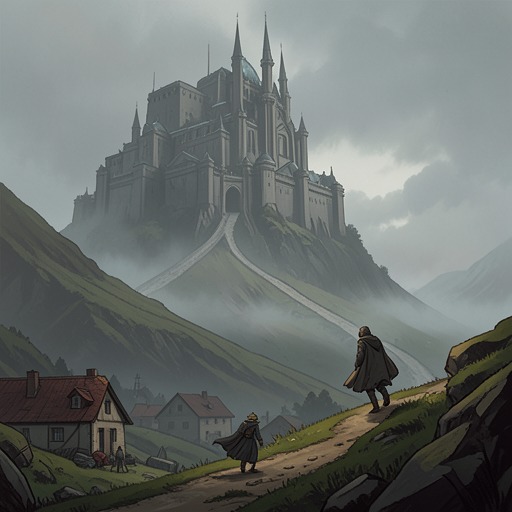
Land Surveyor K.
The Myth of SisyphusLand Surveyor K. is the central protagonist of The Castle and the figure through whom the novel turns bureaucratic exclusion into an existential quest. Appointed Land Surveyor to the Castle, he enters the village as a foreigner and spends the novel trying to make an inaccessible authority recognize him. His decisive significance lies in the contradiction governing his conduct: he is lucid enough to perceive the futility of his situation, yet hopeful enough to continue acting within it. Every failure deepens his exile, but also supplies the next reason to begin again.
Identity and Arrival
Land Surveyor K. arrives in the village under the authority of an appointment that should establish his place, yet the appointment does not give him access to the institution that supposedly made it. The Castle remains unreachable, and communication between the village and the Castle is impossible. K. therefore possesses an official identity without the social reality that identity ought to provide. He is named, summoned, and apparently required, but he is not received.
His foreignness is not merely a geographical circumstance. The villagers continually make him feel that he does not belong, and his central ambition becomes the destruction of that condition. He wants the Castle to adopt him, but he understands that he cannot accomplish this simply by insisting on his appointment. He must become deserving in the eyes of the village and, through the village, acceptable to the Castle. The apparently administrative problem thus becomes a struggle over existence: whether he can cease to be a stranger and become an inhabitant, a worker, a householder, and a normal man.
The Quest Through Repeated Frustration
K.’s movement toward the Castle is defined by persistence rather than progress. For hundreds of pages he seeks a route from the village to the Castle, using every advance, stratagem, and expedient available to him. He does not simply rebel against the obstruction. He tries to work through it, pursuing the duties attached to his appointment with what is described as disconcerting good will. His method is consistent even when the world is not intelligible: each chapter brings a new frustration, and each frustration becomes a new beginning.
The pattern gives his quest its tragic quality. K. never receives a decisive explanation or a stable sign that his efforts are succeeding, but neither does he encounter an absolute silence. When he telephones the Castle, he hears confused and mingled voices, vague laughter, and distant invitations. These sounds are insufficient as evidence, yet sufficient to keep hope alive. They function as the smallest possible signs of contact, allowing K. to interpret uncertainty as a reason to continue rather than as proof of defeat.
The result is a protagonist suspended between knowledge and expectation. His journey resembles a quest, but its traditional reward is withheld; it resembles an adventure, but its episodes return him to the same structure of exclusion. The journey’s achievement is therefore not arrival. It is the extraordinary endurance of a man who continues to act when every practical indication points toward futility.
Work, Belonging, and Frieda
K.’s great hope is to secure the Castle’s acceptance by becoming part of ordinary village life. He seeks an occupation, a home, and the existence of a healthy, normal man. He can no longer tolerate the condition that appears to him as madness, and he wants to become reasonable by casting off the curse that makes him an outsider. The modesty of these aims is crucial. He does not initially demand transcendence; he wants recognition in the everyday world.
His relationship with Frieda is shaped by this desire for access. K. takes her as his mistress because she has known one of the Castle’s officials, and her past appears to connect her to the authority he cannot reach. Through Frieda, he seeks something that exceeds him while also recognizing that her history places her permanently outside the Castle’s full approval. Their attachment therefore contains both intimacy and strategy. Love becomes entangled with the longing for institutional acceptance, and the person who might offer emotional shelter also becomes a possible bridge to the inaccessible power above the village.
Frieda’s attachment reveals the reciprocal nature of this suffering. She tells K., “How I need you,” and describes herself as forsaken when he is absent. Her dependence shows that K. is not alone in being bound to the world that wounds him. The void and nameless pain surrounding the Castle can become an object of attachment; what crushes the characters can also become what they fear losing. In this sense, K.’s relationship with Frieda embodies the novel’s strange transformation of anxiety into intimacy.
The Barnabas Family and the Turn Toward Absurdity
K. eventually breaks with Frieda and turns toward the Barnabas sisters. This change marks more than a new romantic alignment. The Barnabas family is the one family in the village utterly forsaken by both the Castle and the villagers, so approaching them means approaching the most complete form of exclusion. K.’s movement away from Frieda’s connection with a Castle official and toward the Barnabas sisters reverses his earlier strategy of seeking legitimacy through proximity to accepted authority.
Amalia, the elder sister, has rejected shameful propositions made by one of the Castle’s officials. The punishment that follows has cast her permanently outside the love of God and the favor of the social order. Her rejection of the official’s demand makes her morally honorable, yet that very honor becomes the reason for her exclusion. The episode presents a truth that runs contrary to ordinary morality: obedience to moral dignity may make a person unworthy of grace, while surrender to the irrational demands of authority may appear to open the way toward it.
K.’s path from Frieda to the Barnabas sisters consequently leads from trusting love toward what the interpretation calls the deification of the absurd. The Barnabas story is placed at the end of The Castle because it concentrates K.’s final attempt to recover God through what negates conventional ideas of God. He seeks recognition not behind goodness, beauty, justice, or coherence, but behind indifference, injustice, and hatred. His quest has become a theological experiment conducted through social abandonment.
Change, Ending, and Narrative Significance
At the beginning, K. hopes to be adopted by the Castle and to establish himself through work and domestic normality. By the end, he is more deeply exiled because he has become unfaithful to the principles that once might have allowed him to judge his situation. He forsakes morality, logic, and intellectual truth in the hope of entering the desert of divine grace with nothing but his mad hope. The apparent direction of his development is therefore not integration but a more radical form of estrangement.
The Castle offers no cure for the anxiety that torments K. Instead, it brings the malady into normal life and teaches the characters to accept, and perhaps even cherish, it. K. cannot imagine another anxiety than the one already governing him. His persistence is thus both resistance and submission: he refuses to stop seeking the Castle, but the search gradually becomes the condition that defines him.
K. is paired with Joseph K. as one of two poles in Kafka’s work. Joseph K. in The Trial represents the diagnosis of an opaque condition without conclusion, while Land Surveyor K. inhabits the attempted treatment imagined by The Castle. The second novel explains or responds to the first without curing its disease. Together, the two figures represent the passage from hope to grief and from desperate wisdom to intentional blindness. Land Surveyor K.’s enduring importance lies in that passage: he calls life an apprenticeship in death while continuing to derive reasons for believing from the very despairs that make belief illegitimate.