Machine Age
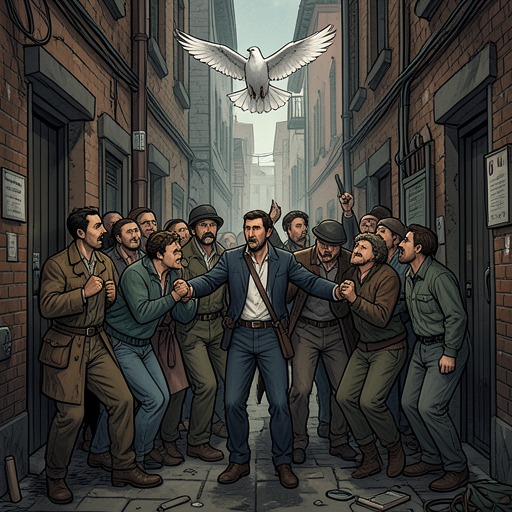
The Myth of SisyphusThe Machine Age is not merely a period of technological progress in the book; it is the historical world in which inherited values, individual dignity, and artistic independence are tested by routine, war, and mass power. It gives concrete shape to the modern absurd: daily life is standardized and repetitive, while history becomes overwhelming, violent, and impossible to contemplate from a safe distance.
Historical Condition
The book’s philosophical argument was written in 1940, amid the French and European disaster, when eternal values appeared absent or distorted. Its starting point is an absurd sensitivity widespread in the age rather than a finished absurd philosophy. The Machine Age therefore names a condition of experience before it names an ideology: a world in which people must decide how to live when inherited assurances no longer settle the questions of meaning, suicide, responsibility, or creation.
The preface links this condition to a movement from the problem of suicide toward the problem of murder. The first inquiry asks whether life has meaning and whether suicide can be justified; the later direction pursued in The Rebel asks how violence against others can be judged without relying on stable eternal values. In that sequence, the Machine Age is the historical pressure that makes both questions urgent. Nihilism is not treated as a final answer but as a desert through which lucid living and creation must still be sought.
Standardized Time and Repetitive Life
Modern life imposes shared rhythms on large numbers of people. The book contrasts the ancient Greek code of leisure with the modern code of the eight-hour day, suggesting that social values are shaped not only by abstract principles but also by the quantity and form of experience available to human beings. Under the Machine Age, the ordinary person’s time is organized by work, commuting, meals, and sleep, producing a common structure of existence even when individual lives differ.
That structure appears in the repeated sequence of rising, taking the streetcar, spending four hours in an office or factory, eating, returning by streetcar, working another four hours, eating again, sleeping, and repeating the cycle from Monday through Saturday. The routine normally carries people without demanding interpretation. Its decisive interruption is the sudden question of why. Weariness then becomes more than fatigue: it awakens consciousness, and consciousness may lead either back into the chain of habitual gestures or toward a definitive awakening whose consequences include suicide or recovery.
The Machine Age thus turns time into an impersonal mechanism. People live in anticipation of tomorrow, later, advancement, or eventual understanding, even though every such promise leads toward death. When a person recognizes a definite place on the curve of time, the future ceases to be a comforting abstraction and becomes the approach of a final limit. The revolt of the body against this temporal order is one form of the absurd.
Mass Violence and Historical Complicity
The Machine Age also marks the collapse of the distance that once allowed artists and thinkers to imagine themselves protected by eternal values. The book recalls Dutch painters working during the bloody wars in Flanders and Silesian mystics formed amid the Thirty Years’ War, whose art and prayer could appear to survive secular turmoil. Modern artists, however, are described as deprived of that serenity because everyone, including the saint, is mobilized. Forms, metaphors, and prayers are crushed under steel; the eternal loses ground to organized historical force.
This condition changes the meaning of individuality. Earlier societies could still weigh the virtues of society against those of the individual because neither had revealed the full extent of its power. In the Machine Age, its ruins and blood overwhelm inherited speculation with facts. The individual is no longer considered primarily as an abstract bearer of universal dignity, but as a being made ridiculous and humiliated by forces that claim to act in the name of history, society, or necessity.
The response is not withdrawal. The speaker chooses history over the eternal because history is the force visibly crushing human beings and because its reality cannot honestly be denied. He recognizes that there are no permanently victorious causes and is drawn to lost causes precisely because they demand a soul capable of remaining uncontaminated in defeat as well as in temporary victory. The Machine Age therefore produces anguish, but it also creates an ethical demand to share in the fate of the world rather than contemplate it from outside.
Social Labor and Collective Responsibility
The historical condition described by the Machine Age extends beyond abstract philosophy into the lives of workers and the persecuted. The miner exploited or shot down, the slaves in camps, colonized peoples, and the legions of persecuted throughout the world require those who can speak to communicate their silence and remain in contact with them. Artistic work cannot be defended as a retreat into beauty when everyday life is saturated with humiliation and debasement.
This does not mean that the artist must abandon creation for social preaching. The artist still has the task of giving life to imagined creatures, and artistic language remains primary. Yet intervention as a human being inevitably alters the tone of that language. A militant life gives a particular force to works that speak of deserts or selfish love, because the artist’s relation to the suffering of others cannot be completely separated from formal creation.
The Machine Age consequently makes art and humanity interdependent. The artist must neither sacrifice the values of creation to a simplified doctrine of humanity nor sacrifice humanity to artistic autonomy. The greatness of an artist lies in maintaining the balance between the two, while contemporary events force that tension into life itself. The historical age does not remove the artist’s responsibility; it makes the responsibility audible in the work’s language and stance.
Significance for the Absurd
The Machine Age intensifies the contradiction at the center of the book. On one side, modern existence is reduced to shared schedules, repetitive gestures, measurable work, and habits whose purpose can suddenly appear ridiculous. On the other, the same age exposes people to wars, police forces, tyrannies, camps, and collective mobilization on a scale that makes private innocence difficult to preserve. The absurd is therefore both intimate and historical: it begins in the individual’s interruption of routine and expands into a confrontation with an age that has become impossible to escape.
The return to Tipasa makes this historical transformation personal. The speaker remembers an earlier world of ruins, sunlight, and bodily freedom, then finds the site enclosed by barbed wire and altered by war. On September 2, 1939, he had not gone to Greece as planned; war had come instead and then spread there. The distance between warm ruins and barbed wire is also a distance within himself. Tyranny, war, police forces, and the era of revolt have replaced an innocence that once existed without conscious knowledge of morality. The world has aged suddenly, and those living in it have aged with it.
Yet the Machine Age is not presented as an excuse for surrender. Its disasters destroy innocence, but they also compel lucidity. To live within it is to refuse both the false comfort of an eternal escape and the permission to treat historical violence as justified merely because it follows the direction of history. The age gives the absurd its most severe setting, but it also clarifies the duties that follow from recognizing it: remain awake, resist humiliation, share responsibility for the present, and continue to create without pretending that history can be transcended.