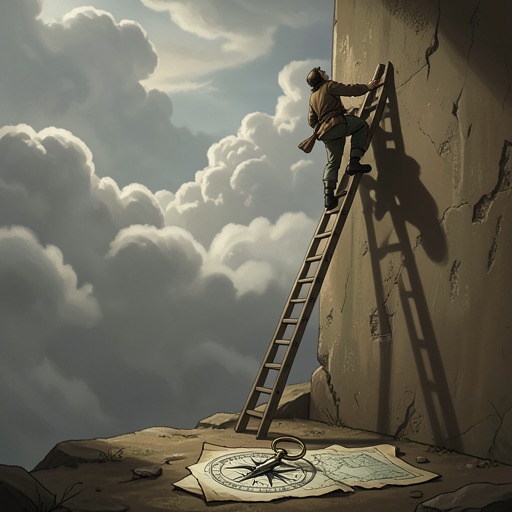
Plato
The Myth of SisyphusPlato is presented as the major classical figure of unity and intelligible order, but also as a recurring test case for the limits of that aspiration. His importance lies not in narrated action but in the way his philosophical model organizes contrasts among reason, experience, transcendence, nature, history, and the absurd.
Unity and the Desire for Explanation
The essay places Plato within the deepest movement of human thought: the appetite for clarity and the wish to reduce the world to a familiar, humanly intelligible form. The mind seeks relations capable of summing phenomena up in a single principle, and the resulting intellectual joy is imagined as greater than any myth of blessedness. Plato therefore represents the grandeur of the hope that reality possesses an underlying unity, one that thought might discover and possess.
Yet that hope cannot simply be treated as fulfilled. The desire for unity does not prove that unity exists in a form immediately available to human reason. If thought asserts the reality of the One, it falls into a contradiction: the very assertion distinguishes the mind making it from the diversity it claims to resolve. Plato thus stands near the source of a powerful intellectual longing while also belonging to the tradition whose certainties the absurd reasoning subjects to pressure.
Phenomenology and Fragmentary Platonism
In the discussion of Edmund Husserl, Plato becomes a point of comparison for a modern theory of essences. Husserl’s descriptions do not reduce every object to one universal idea; instead, they posit an infinite number of essences corresponding to an infinite number of objects. The world thereby both comes to a stop and lights up. The essay calls this a kind of abstract polytheism, because thought abandons a single explanatory principle without abandoning the claim that intelligible essences are present in perception.
This position is described as a form of intuitive Platonic realism. Even when the essences are not perfect models, they are said to be directly present in each datum of perception. The result is not the disappearance of Plato’s structure but its multiplication: instead of one idea explaining everything, countless essences provide meaning for countless things. Even hallucinations and fictions are admitted into this realm of extra-temporal essences, so that centaurs stand beside the ordinary species of metropolitan humanity.
The essay also identifies a truth and a bitterness in the claim that every aspect of the world is privileged. If everything is privileged, everything is equivalent. Each image presupposes an equally privileged essence, producing an ideal world without hierarchy in which the formal army consists entirely of generals. Transcendence appears to have been eliminated, but a fragmentary immanence returns and restores depth to the universe. Plato therefore remains present as both an alternative to total abstraction and a name for the metaphysical tendency to give every appearance an enduring intelligible counterpart.
Reason, Permanence, and the Modern Break
The later historical argument contrasts the world associated with Plato with modern philosophy’s concentration on cities, history, and power. Plato is credited with containing nonsense, reason, and myth together, whereas modern philosophers are said to contain only nonsense or reason because they have closed their eyes to the remainder of experience. The contrast is not merely between two thinkers; it is between a capacious vision of reality and a modern order that has amputated nature, the sea, hilltops, and evening meditation from the field of consciousness.
The essay sets Plato against Georg Wilhelm Friedrich Hegel as the true rival of the classical model. Hegel claims that only the modern city offers the mind a field in which it can become aware of itself, while the essay objects that history cannot explain the natural universe that preceded it or the beauty that rises above it. Plato’s importance here is therefore architectural: his thought is invoked as an image of intellectual breadth, a structure in which reason does not need to destroy myth, nature, or beauty in order to remain reason.
Plato and the Measure of the Absurd
Plato is not simply endorsed. The absurd perspective recognizes both the attraction and the danger of his legacy. A mind that demands total intelligibility may convert its own longing into evidence for an absolute order, thereby confusing desire with conquest. The essay’s recurring distinction between what people think they know and what they actually know prevents Plato’s unifying vision from becoming an unquestioned refuge.
At the same time, the text suggests that the absurd mind may feel closer to Plato than to systems that abolish transcendence only to replace it with another invisible guarantee. The alternative to a single transcendent unity is not automatically freedom from metaphysics: multiplied essences, eternal laws, and abstract reason can reproduce consolation in dispersed form. Plato thus marks a limit and a resource. He names the noble ambition to make the world intelligible, while the essay insists that intellectual nobility must not conceal the unresolved gulf between human desire and the world’s silence.
Classical Balance and the Present World
The essay’s account of Plato also belongs to its meditation on Greece as a lost equilibrium among nature, history, beauty, and virtue. Modern reason has driven these elements apart and ended by ruling over a desert. Against that desert, Plato represents a more inclusive image of order, one capable of holding together incompatible materials rather than reducing existence to a single modern principle.
His significance is consequently relational rather than biographical. He is the measure by which the essay exposes modern disproportion: values that are no longer prior to action, history elevated to the place of God, and power replacing the boundaries once imposed by reason. The final image of European philosophy moving from the hammer to the cannon makes the contrast severe. Plato belongs to the remembered possibility of balance, but the essay refuses to restore that possibility through faith. His presence sharpens the central problem: how can thought preserve the world’s richness without pretending that its contradictions have been solved?