Sisyphus's rock
The Myth of SisyphusSisyphus's rock is the object at the center of the punishment imposed on Sisyphus and the decisive image of the absurd condition. The gods condemn him to roll it endlessly to a mountain summit, where it falls back under its own weight, making repetition, failure, and compulsory labor inseparable. Yet the rock's significance changes when Sisyphus becomes conscious of what he is doing: it remains physically unchanged, but it becomes the measure of his rebellion, the possession through which he refuses the gods' authority, and the material focus of a happiness created without hope of completion.
Form and Punishment
Sisyphus's rock belongs to a punishment designed to make labor useless. The gods judge that no penalty is more dreadful than futile and hopeless work, and the rock enforces that judgment through an exact recurring sequence: Sisyphus strains to raise the mass, pushes it toward the summit, reaches the end of the effort, and then watches it rush down again. The punishment has no final achievement and no accumulated result. Every ascent is erased by the descent, so the object turns time into repetition rather than progress.
The rock is therefore more than a heavy stone. It gives visible form to the absence of a profound reason behind daily agitation and habitual action. In the analysis of voluntary death, life is described as a chain of gestures maintained largely by habit; the recognition that such activity may be ridiculous, groundless, and useless can produce a crisis. Sisyphus's task externalizes that crisis in monumental form. Unlike an ordinary laborer, whose repeated work may be concealed within the routine of a social day, he confronts the uselessness of his labor as the whole structure of his existence.
The Labor of the Ascent
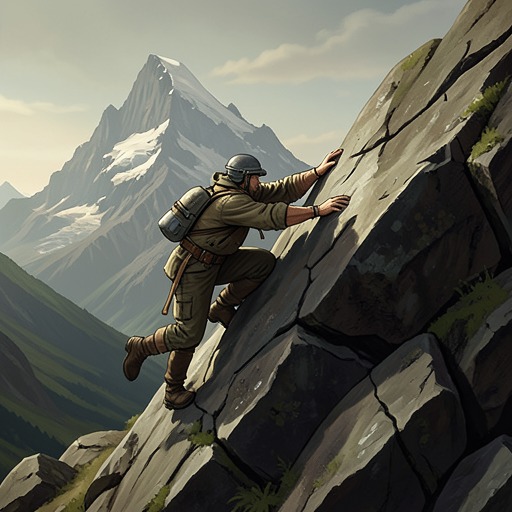
The physical relation between Sisyphus and the rock is described with unusual concentration. His body braces the clay-covered mass: cheek against stone, shoulder supporting it, foot wedged into the ground, hands thick with earth as he begins again. The effort is not abstract or merely symbolic; it consumes the entire body. The rock demands strength, balance, pressure, and repeated renewal, while the mountain turns each achievement into the preparation for another failure.
That bodily effort also makes the rock a figure for modern repetitive labor. The fate of the workman who performs the same tasks throughout life is no less absurd, but it becomes tragic only at the rare moment when the worker becomes conscious of it. The comparison shifts the rock from mythic antiquity into the ordinary world of employment, where repetition can be endured as routine until consciousness interrupts it. The object thus connects divine punishment with human labor without making the two identical: Sisyphus is a condemned figure, while the modern worker is bound by a social and economic order, yet both confront the possibility that action may continue without a final justification.
The Descent and Consciousness
The rock's most important moment is not the ascent but the return after it has fallen. During the descent, Sisyphus leaves the heights and moves toward the place where the rock waits. This pause is a breathing-space within the punishment and the interval in which consciousness becomes possible. At that instant he sees the whole extent of his condition rather than being absorbed in the immediate strain of pushing. His lucidity is painful because it removes the consoling possibility that the work will finally succeed, but it is also what makes him superior to his fate.
The rock can defeat Sisyphus physically only if the fall is accepted as the meaning of his life. Once he understands the cycle and refuses to disguise it, the gods no longer possess the whole significance of the punishment. The rock still rolls downward; Sisyphus still has to return; nothing in the external order has been repaired. Nevertheless, consciousness changes the relation between the condemned man and the object. The rock remains stronger than his body, but he becomes stronger than the fate represented by it because he can contemplate it without submitting his judgment to it.
Ownership, Rebellion, and Happiness
The rock becomes Sisyphus's through an act of interpretation and defiance. His scorn of the gods, hatred of death, and passion for earthly life have earned the sentence, but those same passions continue inside it. The punishment is the price of his attachment to this world, especially after he has escaped the underworld, recovered the sight of water, sun, warm stones, and the sea, and refused to return until the gods forcibly reclaim him. Against that background, the rock is not simply an alien object imposed from above; it is the object through which his earthly loyalty survives inside a divine sentence.
When Sisyphus contemplates his torment, the idols fall silent and the rock becomes “his thing.” That possessive relation does not mean that he has chosen the punishment or can stop it. It means that the fate imposed on him can be taken up as a human matter rather than accepted as a higher destiny. The rock's weight and repetition remain, but the gods lose the power to dictate what those facts must mean. Sisyphus says yes to the world without converting the rock into a promise of progress, redemption, or escape.
The final image leaves the rock at the foot of the mountain, ready to demand another ascent. There is no resolution in the ordinary narrative sense: the cycle does not end, the labor is not completed, and the burden is not removed. Its significance lies precisely in that refusal of closure. Each mineral flake and atom of the stone belongs to a world made intelligible through attention, while the struggle toward the heights becomes sufficient to fill a human heart. The rock does not produce happiness by becoming useful; it permits happiness when Sisyphus owns his days, rejects a higher destiny, and meets the unending task with lucid defiance.
Wider Images of Stone and Repetition
The rock's meaning is reinforced by other scenes of labor against stone. On the coast of Oran, rails, dump-cars, cranes, toy-like trains, drills, and steel jaws attack the mountain under a broiling sun. Men break off masses of rock, send them down in dust and rumbling, and pour them into the sea to form a jetty. This labor also seems temporary and ultimately futile: stone is not destroyed but moved, and the construction will outlast the workers while remaining vulnerable to repetition. Yet the heaps of rock testify to the masked men who move among them, just as Sisyphus's rock testifies to the body and consciousness invested in its raising.
The contrast is important. The Oran workers act collectively and visibly transform a coast, whereas Sisyphus works alone and produces no lasting structure. Even so, both scenes resist the conclusion that uselessness makes action meaningless. Moving things from one place to another may be useless in the largest reckoning, but it remains the work of human beings, and choosing action over nothing gives the labor its immediate dignity. The rock therefore stands at once for alienated repetition and for the stubborn human capacity to make an imposed task one's own.
The image also echoes the book's account of awakening. Mechanical days proceed through transport, work, meals, sleep, and the repeated names of the week until the question of why suddenly arises. Weariness ends one cycle but inaugurates consciousness; what follows may be a return to routine or a definitive awakening, with suicide or recovery as possible consequences. Sisyphus's descent is the mythic equivalent of that interruption. The rock is the routine made visible, while the descent is the instant in which the routine is seen, judged, and answered without illusion.