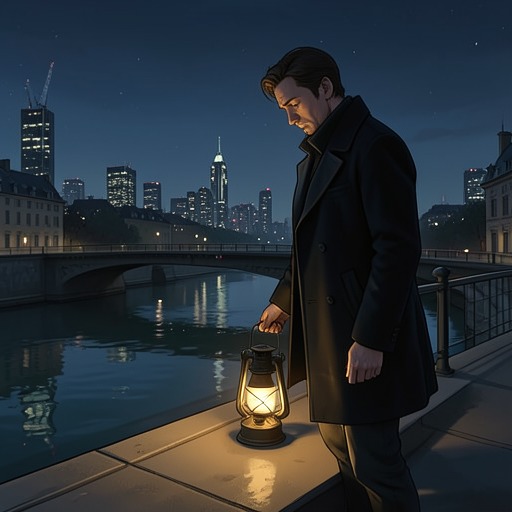
Stavrogin
The Myth of SisyphusStavrogin embodies the practical and morally disquieting afterlife of Kirilov’s ideas. In the account of Dostoevsky’s absurd characters, Kirilov’s death liberates Stavrogin and Ivan Karamazov to test the consequences of radical freedom in lived experience. Stavrogin does not merely contemplate an abstract doctrine: he turns its implied sovereignty into a way of existing, one marked by irony, emotional detachment, and hostility from those around him.
Identity and Introduction
Stavrogin appears alongside Ivan Karamazov as a character who tries out the absurd truths generated by Kirilov’s suicide. Kirilov imagines that a person who fully feels his freedom becomes a “tsar,” no longer subject to fear of death or divine authority. Stavrogin inherits this possibility in a distorted form. He is described as living an “ironic” life and as becoming “a tsar in indifference,” a figure whose sovereignty consists not in constructive power but in refusal to be bound by ordinary attachments or aversions.
Life and Moral Disposition
The central clue to Stavrogin is his farewell letter, whose declaration that he has not been able to detest anything gives the character his defining shape. The statement does not make him benevolent. Instead, it identifies an absence of hatred as a form of radical incapacity: he stands apart from the passions that ordinarily organize moral response, yet this distance does not produce peace. His indifference arouses hatred around him, so his detachment becomes socially active and destructive. The more he refuses to feel, the more intensely others react to him.
This contrast gives Stavrogin’s character its irony. Kirilov seeks to demonstrate freedom through a deliberate death undertaken for humanity, while Stavrogin expresses freedom through an existence stripped of ordinary emotional allegiance. Kirilov’s “tsar” is imagined as a teacher and liberator; Stavrogin’s sovereignty is instead negative, defined by indifference. The same liberation from inherited limits therefore produces radically different forms: one sacrificial and pedagogical, the other ironic and antagonistic.
Relationships and Conflict
Stavrogin belongs to a network of characters shaped by the consequences of Kirilov’s death. He and Ivan Karamazov are described as the ones who are liberated by that death, and both attempt to exercise the powers that Kirilov’s theory places in human hands. Stavrogin’s relationship to the surrounding world is consequently one of provocation rather than communion. He arouses hatred, but his farewell letter insists that he has been unable to detest anything, creating a severe asymmetry between the emotions he produces and those he himself can acknowledge.
His position also stands in implicit opposition to characters who seek meaning through humility, belief, or the promise of immortality. In the broader movement from Kirilov’s death toward The Brothers Karamazov, Stavrogin represents the unresolved experiment: what happens when human beings claim royal freedom without finding a sustaining moral or spiritual end for it? His indifference is not presented as a stable answer. It is one expression of the problem that Dostoevsky’s novels continue to stage.
Ending and Thematic Significance
Stavrogin is ultimately grouped with Kirilov and Ivan Karamazov as defeated figures. Their attempt to inhabit the consequences of absurd freedom does not prevail against the affirmative conclusion associated with Alyosha Karamazov and the expectation of meeting again after death. The contrast is decisive: Stavrogin’s indifference belongs to a world in which human beings assume godlike authority, whereas Alyosha’s assurance exchanges that divinity for happiness grounded in immortality.
Yet Stavrogin’s defeat does not erase his importance. He helps make visible the gap between proclaiming freedom and being able to live meaningfully with it. His farewell letter preserves the contradiction at the heart of his character: he cannot detest anything, but hatred gathers around him. Through that contradiction, he becomes a familiar rather than monstrous presence within Dostoevsky’s “passionate world of indifference,” embodying anxieties that the reader recognizes as part of everyday human life. The novels therefore do not simply offer Stavrogin as an absurd hero; they use him to propound the absurd problem and to show how the experiment with absolute human sovereignty turns into moral and existential failure.