The Castle
The Myth of SisyphusThe Castle is the inaccessible center of Kafka’s novel and the governing image of a spiritual quest. It is at once an institution that refuses communication, a power that distributes belonging, and the imagined source of grace for those who remain outside it. Its decisive significance lies in the contradiction between distance and hope: the Castle offers no dependable arrival, yet its faintest signals are enough to keep the Land Surveyor K. moving through frustration, humiliation, and self-transformation.
Nature and Spiritual Meaning
The Castle may be read as a theology in action, but it is first presented as the individual adventure of a soul seeking grace. K. asks the objects of the world for their “royal secret” and looks to women for signs of the god believed to sleep within them. The Castle therefore exceeds the status of a building or administrative headquarters. It is the name given to a transcendence that has entered ordinary life without becoming intelligible within it.
Its power depends on ambiguity. Kafka’s work repeatedly sets everyday existence beside supernatural anxiety, and The Castle makes that conjunction spatial: village routines, occupations, sexual attachments, and social humiliations all unfold under the pressure of an authority that remains remote and nearly unreadable. The result is neither a simple supernatural world nor an ordinary bureaucratic one. The Castle’s apparent rationality conceals an anxiety that feels theological, while its possible divinity is expressed through procedures, delays, and mundane obstacles.
Arrival and the Impossible Route
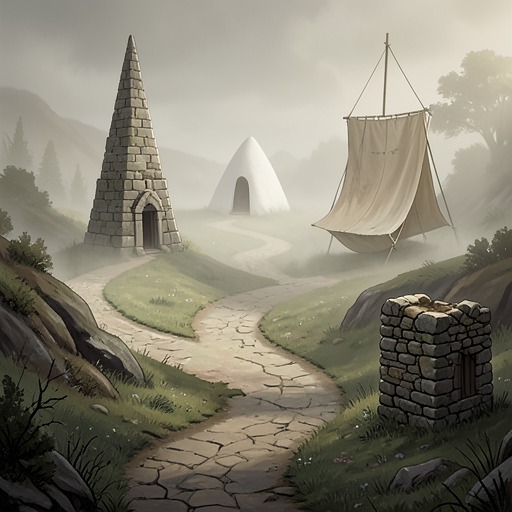
K. is appointed Land Surveyor to the Castle and arrives in the village, but the route from the village to the Castle cannot be converted into communication. For hundreds of pages he persists in trying to find his way. He advances through trickery and expedients, attempts to perform the duties assigned to him, and does so without surrendering to anger. Each chapter brings a new frustration, but each frustration also becomes a new beginning. The novel’s movement is consequently governed less by ordinary logic than by a consistent method of insistence.
The Castle’s remoteness is made especially vivid when K. telephones it. Instead of receiving a clear answer, he hears confused, mingled voices, vague laughter, and distant invitations. These sounds provide no proof of access, but they are sufficient to nourish hope. Like a few signs appearing in the summer sky or the anticipations of evening that help make life bearable, the telephone exchange turns uncertainty itself into fuel. The Castle does not need to promise admission directly; the possibility that its voice has been heard is enough to renew the quest.
Authority, Belonging, and the Village
The Castle’s authority is exercised through social exclusion. K.’s great hope is to have the Castle adopt him, and because he cannot achieve this by direct appeal, he tries to deserve its favor by becoming an inhabitant of the village. He wants an occupation, a home, and the life of a healthy, normal man. More deeply, he wants to shed the status of foreigner that the villagers continually impose upon him and to escape the sense that his own conduct has become inexplicable. His wish to be accepted is also a wish to be made reasonable.
This structure makes the Castle both a destination and a system of classification. To belong is to receive a place within its order; to remain outside is to be marked by a peculiar curse of foreignness. The Castle does not merely stand at the end of a road. It organizes the village’s ideas of legitimacy, disgrace, usefulness, and grace, even when its decisions are inaccessible and its standards appear morally unstable.
Frieda, Amalia, and the Logic of Grace
K.’s relationship with Frieda is significant because she has known one of the Castle’s officials. His choice of her as a mistress is connected to this past: she seems to possess something that transcends him, even while he recognizes what makes her forever unworthy of the Castle. Her attachment to K. reveals the emotional effect of this shared exclusion. Frieda tells him, “How I need you,” and describes how forsaken she feels when he is absent. The relationship thus makes suffering intimate; the void created by the Castle becomes something the characters cling to rather than merely endure.
K. eventually breaks with Frieda and turns toward the Barnabas sisters, whose family is utterly forsaken by both the Castle and the village. Amalia, the elder sister, rejected shameful propositions from one of the Castle’s officials, and the curse that followed cast her permanently outside the community’s love of God. Her refusal creates a moral paradox: preserving honor becomes, within the Castle’s economy of grace, the very act that makes her unworthy of grace. The episode links truth against morality and makes the institution’s alleged holiness inseparable from injustice.
The Barnabas story is placed at the end of the book because it marks K.’s furthest attempt to recover God through what seems to negate God. He seeks recognition not through accepted categories of goodness and beauty, but behind indifference, injustice, and hatred. In pursuing the Castle through this abandoned family, he becomes still more exiled. He forsakes morality, logic, and intellectual truth in the hope that mad hope alone might carry him into the desert of divine grace. The Castle’s spiritual promise therefore culminates not in certainty but in a more radical estrangement from the self that began the journey.
Complement to The Trial
The Castle does not simply repeat the structure of The Trial; it changes its direction. The two novels complement one another. The Trial presents its problem through a quasi-scientific method and does not conclude, while The Castle to a certain degree explains it. The Trial diagnoses the condition; The Castle imagines a treatment. Yet the proposed remedy does not cure the malady. It returns the malady to normal life and helps the sufferer accept it, even cherish it.
The contrast gives The Castle its peculiar form of hope. The more tragic Kafka’s world becomes, the firmer and more aggressive hope appears within it. K. cannot imagine another anxiety than the one tormenting him, and the people around him become attached to the nameless pain itself. The Castle’s power lies precisely in this reversal: what crushes the characters also gives their lives direction. Its unreachable authority produces not liberation, but an existential leap in which evasion is experienced as salvation.
Place in the Essay’s Spatial Imagination
The essay’s later reflections on difficult places of retreat extend the meaning of The Castle beyond Kafka’s novel. When deserts and islands have disappeared, large cities can still provide a form of solitude, provided that they contain enough distance from the world’s inherited noise. The modern city is described as a space dominated by streets and history, while nature, the sea, hilltops, and evening meditation are pushed aside. In this wider argument, a place becomes spiritually significant not because it offers beauty, but because its conditions force the human creature to confront itself.
Oran provides the sharpest urban parallel. Its walls turn away from the sea, its dusty streets form a labyrinth, and the Minotaur that devours its inhabitants is boredom. The city’s people have ceased wandering and accepted being eaten. Yet its stones also testify to human action: workers tear rock from the mountain, move it into the bay, and build toward the open sea, knowing that the work is ultimately temporary. The true monuments of Oran are its stones, durable beyond the men who move them. This image echoes The Castle’s larger tension between futile labor and stubborn persistence.
The Castle thus belongs to a geography of obstruction, exclusion, and desire. Like Oran’s yellow wall and labyrinth, it converts space into a condition of consciousness. But whereas Oran’s emptiness may strip the heart bare by denying distraction, the Castle keeps consciousness in motion through the promise of a response. Its ultimate importance is not that it can be reached, but that its distance creates the tragic discipline, emotional dependency, and illegitimate hope through which Kafka’s absurd world becomes visible.