The Stone Commander
The Myth of SisyphusThe Stone Commander is the cold statue that appears in the legend of Don Juan as the agent of supernatural retribution. Its decisive significance lies not in any independently described action, but in what it represents: the total authority of divine wrath, universal morality, and an ordered universe confronting a man who has chosen lived experience, sensual knowledge, and human honor over religious judgment. The statue gives visible form to the forces Don Juan has negated, while the interpretation of its failure exposes the absurd distance between a promised cosmic punishment and the bare fact of mortality.
Identity and Legendary Function
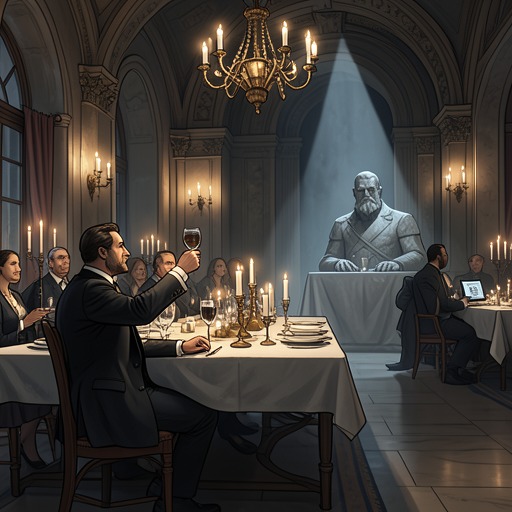
The Stone Commander belongs to the traditional Don Juan story in which the supernatural figure comes to punish the seducer. Don Juan invokes human honor rather than divine morality: he claims that he keeps his promise because he is a knight. The statue therefore enters a conflict between two kinds of authority. On one side stands the Commander, whose cold stone body condenses the claims of eternal order; on the other stands Don Juan, an ordinary seducer made absurd by consciousness, who refuses to complicate his life with a moral problem imposed from beyond it.
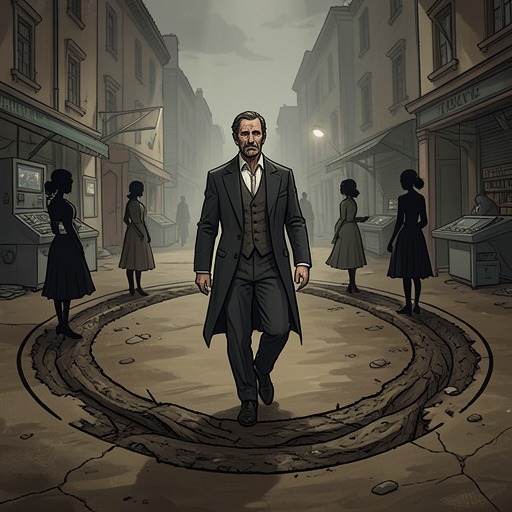
The Commander is not presented as a psychologically developed character. He is an emblematic presence, a rigid and monumental answer to Don Juan’s mobile existence. Don Juan moves from woman to woman, rejects regret, and refuses to live from portraits of the past; the statue, by contrast, suggests immobility, judgment, and the fixed sentence of a system that interprets action according to guilt. Its very lack of inward life is part of its force. It is a gigantic, soulless form through which an imagined heaven makes its demand.
The Forces Represented by the Statue
The Stone Commander gathers together “all the powers of eternal Reason, of order, of universal morality,” as well as the foreign grandeur of a God open to wrath. Its stone is thus less a material detail than a sign of abstraction made solid. The statue turns moral law into an apparition that can arrive, confront, and ostensibly punish. It is the monumental face of a universe in which human conduct is measured against a transcendent standard.
The opposition is especially sharp because Don Juan’s way of knowing is bodily and immediate. Loving and possessing, conquering and consuming are treated as his mode of knowledge; the carnal act itself carries the scriptural association of knowing. Against that active, temporal knowledge, the Commander offers a morality that claims to stand above time. Yet the statue’s mission stops at representation. Thunder and lightning may return to the imitation heaven from which they were summoned, because the spectacle of supernatural justice does not settle the existential question raised by Don Juan’s life.
The same structural opposition appears in the account of Sisyphus. The gods condemn Sisyphus to roll a rock endlessly up a mountain, and the rock’s fall makes visible the gods’ idea of punishment as futile labor. Sisyphus’s scorn of the gods, hatred of death, and passion for life make him an absurd hero; during the descent after each failed ascent, consciousness makes him superior to his fate. The Stone Commander belongs to the same mythic order of divine sentence, but where Sisyphus’s rock becomes the measure of a repeated bodily struggle, the Commander becomes the image of moral and theological judgment confronting human defiance.
The Question of Don Juan’s Death
The legend claims that Don Juan dies beneath the Commander’s punishment, but the narrative refuses to grant that account unquestioned authority. A chronicler reports that the true Burlador was assassinated by Franciscans who wished to end his excesses and blasphemies, after which they declared that heaven had struck him down. The account is neither proved nor disproved. Its uncertainty matters because it preserves the statue as a story imposed upon death rather than an established explanation of it.
The interpretation goes further and imagines that the Commander never came. Don Juan is pictured waiting at Anna’s house; after midnight, the blasphemer may have felt the dreadful bitterness of those who have been right. In this version, the decisive reversal is not the statue’s arrival but its absence. The man who has denied divine punishment is not theatrically defeated by a stone hand. Instead, he faces the possibility that his defiance was logically consistent and that no transcendent power will appear to correct him. The supernatural confrontation collapses into a more severe solitude.
This is why Don Juan’s fate is distinguished from punishment. A fate is not a punishment. His life has already included the knowledge of old age and its horror, and he accepts that the rules of his game may include chastisement; what he rejects is the claim that his final condition proves a moral verdict. The Commander can symbolize the punishment desired by the men of God, but it cannot transform mortality into evidence that their theology has prevailed.
Afterlife, Asceticism, and the Empty Heaven
A second version of Don Juan’s ending places him in a monastery. The account is not accepted for its edifying lesson, as though sensuality had finally discovered religious truth. Instead, burial in a monastery symbolizes the logical outcome of a life completely absorbed in the absurd. Sensual pleasure ends in asceticism, not because one has necessarily defeated the other, but because both can become aspects of the same impoverishment when the body and its finite possibilities are exhausted.
The imagined Don Juan is therefore not triumphantly redeemed by the Commander or by the Church. He is an old man betrayed by his body, alive only because he did not die in time, awaiting the end while facing a God he does not adore. He kneels before a void, stretches his arms toward a heaven without eloquence or depth, and serves that empty heaven as he once served life. In this final image, the statue’s stone has become almost the architecture of the world itself: hard, silent, and incapable of answering.
The last view of Don Juan places him in a cell in a Spanish monastery, looking not at the ghosts of former loves but, perhaps, through a narrow opening in a sun-baked wall toward a silent Spanish plain. The land is noble and soulless, and he recognizes himself in it. The Stone Commander’s apparent triumph has thus yielded to a landscape of resemblance rather than revelation. The ultimate end is awaited but never desired, and its arrival remains negligible beside the lucid life that preceded it.