
Memory, Evidence, and Forgetting
The Narrow Road to the Deep NorthThis flow traces the struggle to preserve the dead through poems, sketches, testimony, personal memories, and the recognition that all records remain incomplete.
increasing Bearing strength in each event
 decreasing
Bearing strength in each eventdecreasingA Sketchbook’s Claim
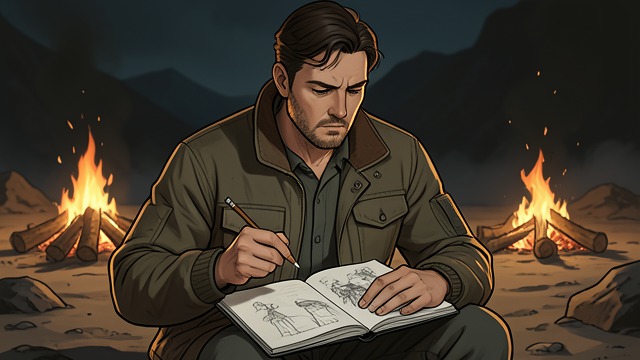
The Hope of Evidence
A Witness’s Work
Rabbit Hendricks’s drawings record the camp’s labour and violence. Bonox Baker believes that the images might help the future know what happened.
Doubt About Justice
Dorrigo Evans fears that a record can be ignored or repurposed. Their disagreement establishes that preserving evidence cannot guarantee understanding.
A Poem About Forgetting
Remembrance and Loss
The Recessional
Dorrigo Evans recites lines from Recessional to explain that empires and memories fade. He resists the comforting idea that a memorial can make the dead permanently present.
The Need to Remember
Bonox Baker still wants the drawings saved. Their exchange shows how people continue to preserve records even when they know remembrance cannot defeat time.
Faces That Disappear
The Failure of Recall
Details Without Faces
Dorrigo Evans remembers voices, objects, and fragments but cannot summon the faces of many dead men or Amy Mulvaney. Memory does not obey the importance he assigns to it.
Witness and Loss
His inability to remember troubles his role as a witness. The failure is personal, but it also reveals how easily individuals vanish behind broad historical narratives.
The Survivor’s Evasion
Memory Softened
A Life Recalled Differently
Jimmy Bigelow remembers less and less of the forced labour, disease, and violence. He continues to recall jokes, friendship, and moments of hope.
A Defence of Life
His forgetting allows him to inhabit old age without reliving every horror. The novel does not treat this as simple dishonesty; it is a form of survival that has its own cost.
The Railway’s Memorial
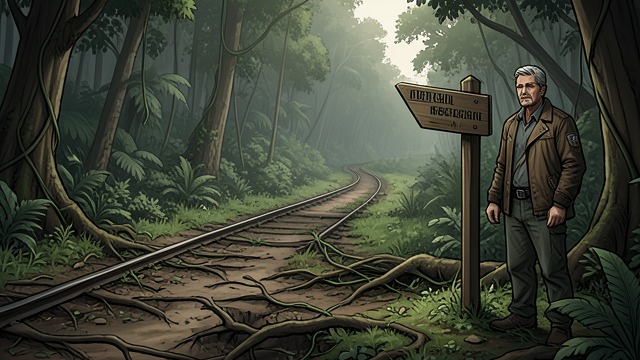
History Made Visible
A Broken Landscape
The railway is partly cleared for visitors and remembrance, even as most of it returns to jungle. The dead remain beneath a landscape that no longer speaks for them.
Commemoration’s Limits
Memorials can name some histories but cannot preserve every life or voice. The Line’s transformation makes remembrance necessary without making it complete.
At Rabbit Hendricks’s cremation in the jungle camp
During a funeral pyre in the camp
During the railway years and Dorrigo’s later life
In Jimmy Bigelow’s old age
Decades after the war, as the Line becomes a tourist and memorial site
