“Charge the windmill” and faith in illusion
The Narrow Road to the Deep North“Charge the windmill” is Dorrigo Evans’s shorthand for acting through faith in an outcome he cannot guarantee. The phrase joins an image of forward motion to a more unsettling claim: that belief in illusions can sustain life, while an unyielding belief in reality can defeat it. In the prison camp, this is no abstract creed. Dorrigo invokes it as he prepares to amputate Jack Rainbow’s leg, with the tools, water, and confidence available to him all precarious. Years later, he repeats it while meeting civilian life, carrying the same imperative into a world that has changed but offers him no corresponding inner certainty.
The Idea of Advancing
Dorrigo explains the phrase to Squizzy Taylor as the closest thing he has to an explanation of himself. Asked what comes into his head, he recalls that his only idea is to advance and charge the windmill. He says that faith in illusions makes life possible and that believing in reality is what defeats people. The windmill image gives this principle a direction: when no reliable solution is visible, keep moving toward the obstacle rather than waiting for certainty or retreating from it.
The idea is not presented as confidence that circumstances will turn out well. Dorrigo’s words instead acknowledge the gap between what can be known and what must still be attempted. He can make life up each day and find that trusting his fancy seems to work, but the phrase does not erase danger or promise success. Its force lies in permitting action amid uncertainty. That makes it more severe than uncomplicated optimism: Dorrigo knows that the belief is, in one sense, an illusion, but treats the capacity to believe as a condition of continuing to live and act.
In the Operating Theatre
The phrase takes shape under immediate pressure as Dorrigo prepares to operate on Jack Rainbow. The theatre is a small, makeshift hut, equipped with a bamboo operating table, a kerosene-tin steriliser, and surgical instruments fashioned from honed engine steel. Its water comes through a bamboo pipe from a nearby stream, which Dorrigo suspects may carry cholera. With illness spreading and efforts seeming only to lead to more deaths, even basic preparation feels compromised.
Dorrigo is panicking, and he knows it. He steadies himself by following the familiar sequence of washing: cleaning each finger, attending to his nails, and remembering his wrists. The routine offers actions he can still perform, even when he cannot believe he can accomplish the operation. His hold on himself depends partly on the belief others have placed in him; if he can believe that they believe in him, he may be able to keep going. He calls the belief required to live ridiculous, but insists that life demands it above all else. In this scene, “Charge the windmill” is less a battle cry than a way to cross the distance between fear and the next necessary act.
Once the preparations are made, Dorrigo gives the signal to begin. He tells those assisting him that they will be as quick as they can and stresses keeping the bleeding to an absolute minimum. Jimmy Bigelow and Wat Cooney hold Jack, while Squizzy Taylor raises a bent spoon in a mock salute. Dorrigo then says, “Charge the windmill.” The phrase precedes the operation’s decisive work: Taylor presses the spoon into Jack’s belly, and Jimmy brings a torch to illuminate the stump. The words do not certify that the operation will succeed; they mark Dorrigo’s commitment to proceed despite the limits and risks surrounding it.
Repeated at the Return
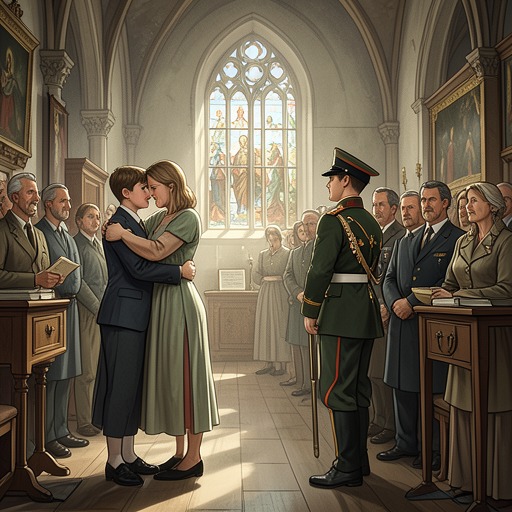
Seven years after the last meeting with the people awaiting him, Dorrigo walks across the Sydney tarmac toward a crowd he does not know. He resolves to approach civilian life with charm and daring, as he has met other obstacles, and tells himself, “Forward,” before gathering his face into a smile. He repeats, “Charge the windmill.” The return of the phrase links this arrival to the operating theatre: in both scenes, Dorrigo faces a situation he cannot make fully familiar and answers by summoning a way to move forward.
But the civilian reunion exposes the limits of that strategy. Dorrigo recognizes the woman’s voice after she has spoken, yet cannot remember her name until after they kiss. He finds the encounter emotionally empty and disappointing before identifying her as Ella. The phrase can summon forward motion, but it cannot guarantee connection, restore what has been lost, or make the life ahead feel real. Its recurrence therefore carries both continuity and irony: the old method remains available to Dorrigo even as the hoped-for feeling or certainty fails to arrive.
Illusion, Reality, and the Aftermath
Dorrigo’s later reflections deepen the distinction between practical belief and confidence in reality. In the decades after the war, he feels that his spirit is asleep; adultery, outbursts, acts of compassion, and reckless surgery do not rouse it. Although he admires reality and, as a doctor, preaches and tries to practise it, he doubts that reality exists. Having belonged to what he understands as a slave system headed by a divine sun king, he sees unreality as a powerful force in life.
That judgment also shapes his view of postwar priorities. Professional ambition, social status, wallpaper, office size, and parking privileges receive disproportionate importance, while pleasure, joy, friendship, and love are treated as peripheral. The contrast reframes the earlier faith in illusion: it was a means of sustaining action amid mortal danger, whereas the ordinary world can invest its illusions in status and routine while neglecting what matters. “Charge the windmill” thus names neither a cure for Dorrigo’s later numbness nor a settled philosophy of hope. It is a recurring imperative for proceeding without assurance, set against a life in which survival and outward success do not necessarily restore meaning.