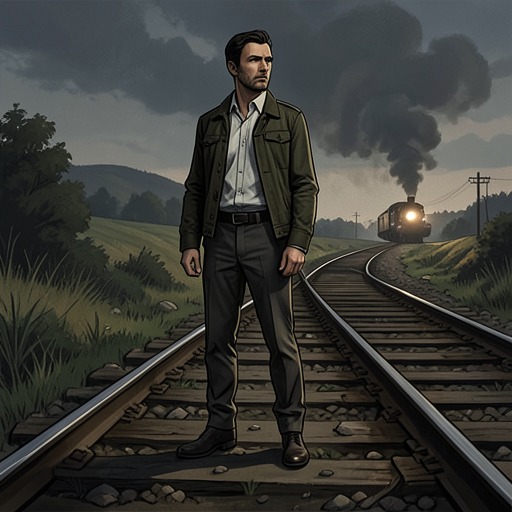
“Horror just is”
The Narrow Road to the Deep North“Horror just is” is the novel’s stark formulation of suffering that resists both explanation and remembrance. The phrase contrasts the meaning a book can give horror with the formlessness of horror as lived, and it frames the Death Railway not only as a history of forced labor and death but also as a history that can be erased, miscounted, or memorialized without its victims.
The phrase and the limits of meaning
The narration sets the phrase against the work of writing itself. A book can contain horror, give it form, and offer meaning; life offers no such assurance. The suffering and deaths of the railway laborers may exist, for later readers, only in these pages and a few other books. The blunt finality of “Horror just is” refuses to turn catastrophe into a lesson or a consoling explanation: while horror reigns, it seems to fill the universe, yet afterwards it may be treated as if it never happened.
That claim sits close to Dorrigo Evans’s attempt to write a foreword to Guy Hendricks’s illustrations of the POW camps. He has set aside three uninterrupted hours to finish a task months overdue, but even the completed draft feels like another failed attempt to understand what the railway meant. His tone seems at once too obvious and too personal; he cannot bring all the names and dead to the page, and one name in particular remains unwritten. The difficulty of making an account is part of the phrase’s force: representation can preserve a fragment, but it cannot make lived horror coherent or complete.
The railway and its missing dead
The historical scale behind the phrase is given in concrete, disputed numbers. After the fall of Singapore, Japan’s need for a land supply route through Burma drove the railway project, undertaken without the money, machinery, or time needed for ordinary construction. Of 22,000 Australian POWs, 9,000 were sent to work on it; the narrative says one in three of those Australians would die. When locomotive C 5631 travelled the completed railway on 25 October 1943, carrying Japanese and Thai dignitaries, it passed beds of human bones.
The Australian prisoners were only a fraction of the labor force. About 60,000 Allied POWs worked alongside a quarter of a million or more Tamil, Chinese, Javanese, Malayan, Thai, and Burmese laborers. Estimates for the deaths among these Asian laborers range from 50,000 to 200,000, with no agreed total. The uncertainty is not a small gap in an otherwise settled record: the narration stresses that no one knows how many died, and that their names have already been forgotten. The book offers its account as a fragment for the people whose lost lives have no equivalent record.
Memorials, trials, and selective remembrance
The contrast between remembrance and omission is made visible at Yasukuni Shrine in Tokyo, where C 5631 is displayed in a museum. The shrine also contains the Book of Souls, which lists more than two million people who died in service to the Emperor of Japan in wars between 1867 and 1951. Enshrinement at the site carries absolution from evil acts; among the listed dead are 1,068 men convicted of war crimes after the Second World War and executed, including men connected with the railway and the mistreatment of POWs. Yet the locomotive’s plaque says nothing about the railway’s construction or its dead. Commemoration preserves some histories while leaving others unspoken.
The postwar trials likewise expose gaps between violence, testimony, and accountability. Choi Sang-min’s two-day trial takes place in an Australian military court, where most proceedings are in English and he understands little. The court dismisses the charge that he participated in the murder of Sergeant Frank Gardiner, but finds him guilty of ordering the murder of Private Wat Cooney and of other mistreatment, including withholding food and medical supplies. Choi disputes the allegation and points to uncertain camp records; the prosecution relies on Colonel Kota’s testimony, even though Choi has heard that Kota was released without charge. The passage does not erase Choi’s conviction, but it shows how incomplete records and unequal outcomes complicate any simple account of justice.
A parallel silence follows the vivisections recounted by Sato. After the war, Professor Ishiyama hangs himself in prison; others are sentenced, have their sentences commuted, and are eventually freed. Sato says that he once feared being tried, but that the moment has passed, and that both the Americans and the Japanese want the matter forgotten. Here, forgetting is not merely the fading of private memory: it is also a postwar condition in which responsibility can be set aside.
Forgetting, survival, and the fragment that remains
The cholera funeral gives remembrance a fragile physical form. Because anything touched by cholera must be burned, a pyre maker brings Dorrigo Evans Rabbit Hendricks’s sketchbook, and Dorrigo tells him to burn it. The command is practical within the rules for containing contagion, but the scene makes preservation collide with survival: even a personal record must go onto the pyre. Later, Dorrigo tells Bonox Baker that everything is forgotten in the end and that it is better to live now. Bonox answers with the appeal “Lest we forget,” leaving the two impulses—endurance in the present and obligation to remember—unreconciled.
Jimmy Bigelow’s later recollections make that tension intimate. As he grows older, he remembers jokes, stories, the taste of a duck egg Darky Gardiner gave him, and the hope and goodness he found among the men. He remembers Wat Cooney waiting at the cookhouse for the last man, saving him food and ensuring everyone received something, however little; at Wat’s grave, no one wanted to be first to throw a sod. Yet Jimmy does not remember that Wat died on the march north to Three Pagoda Pass or the cruelties of that march. His sons and other observers correct the inconsistencies in his accounts, but for Jimmy, the remembered care is more fully present than the details of death. The phrase does not reduce this to a choice between accurate history and personal consolation. Instead, it holds together the immense suffering that demands witness and the partial, human memories through which survivors continue living.