“Winter ice melts into clean water—clear is my heart”
The Narrow Road to the Deep North“Winter ice melts into clean water—clear is my heart” is the death poem Tenji Nakamura chose when, weakened by illness and aware that his death was approaching, he found himself unable to write a poem he thought could surpass Hyakka’s. Its three lines move from winter ice to clear water and end with a claim about the speaker’s heart. The poem reaches the reader not directly from Nakamura but in a copy sent by Ikuko Nakamura to the Tomokawas, accompanied by her account of his last night and the life she wished them to remember.
The poem at the end of life
The poem was written on the night before Nakamura died. Ikuko’s card says that he knew his time was rapidly approaching its end and, as an amateur poet acting in accordance with tradition, set out to compose a death poem. The poem’s situation is therefore explicit: it is an attempt at a final statement made under the pressure of imminent death, rather than a poem introduced independently of its circumstances.
Nakamura struggled for some hours. Illness had weakened him, and he eventually concluded that he could not better Hyakka’s poem. He regarded that earlier work as expressing everything he felt, but doing so far more beautifully than he could manage. The surviving poem is thus also the trace of an unfinished effort: its significance lies not in a claim to surpass another poet, but in Nakamura’s recognition that another poem already gave form to what he wanted to say. The modesty Ikuko ascribes to him in this moment is bound to that admission of artistic limitation.
Ice, water, and clarity
The poem’s image proceeds through a small transformation: winter ice melts into water, and the last line identifies the heart as clear. The movement gives the brief text its shape. An image of cold and solidity yields to one of liquid transparency; the final statement makes that change an inward comparison. The poem offers no account of the illness itself and names no particular memory or deed. Instead, its natural image and direct conclusion condense the feeling Nakamura believed Hyakka had already expressed.
That compression is important to how the poem is presented. Ikuko does not provide a longer explanation of what Nakamura meant by a clear heart, and the poem remains his own short, first-person declaration. Its plain sequence permits a reading of clarity as the peace or self-understanding he hoped to express, but the account does not specify a single interpretation. What it does establish is that Nakamura considered Hyakka’s poem more beautiful and more adequate to his feelings than anything he could produce while dying.
The letter’s portrait of Nakamura
The poem arrives in a card from Ikuko to the Tomokawas the following spring. She says that her husband’s final act may have been inspired by his visit to wintry Sapporo the year before, and sends a copy for that reason. The suggestion ties the poem’s winter image to a remembered place without claiming that the landscape alone explains its meaning. Ikuko’s letter supplies a possible connection; the poem itself remains brief and unelaborated.
The card also shapes the account of the death by what it leaves out. Ikuko does not mention Nakamura’s final ravings, his petty bad temper, or his vicious attacks on her and their daughters while they nursed him. Even simple acts such as stroking his cheeks or smiling could provoke those attacks. Instead, she recalls that his family was with him when he died and describes him as a kind man who could not bear to see even animals suffer, a blessed and lucky man who had led a good life. The poem’s assertion of inward clarity consequently sits beside a difficult reality the letter declines to recount. It can be read as part of Ikuko’s loving final portrait, but it does not erase the suffering her account omits.
Copy, reading, and remembrance
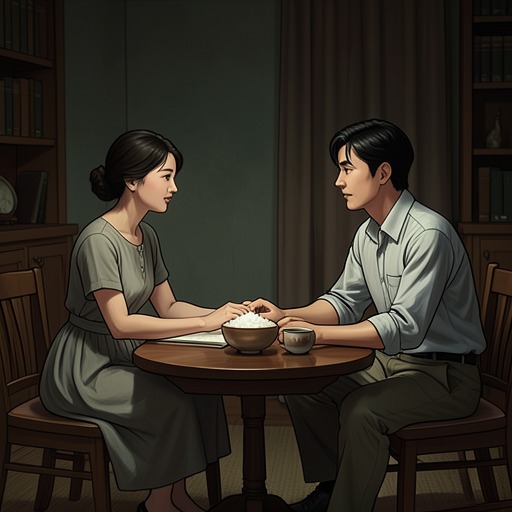
Ikuko forwards a copy of the poem, and Mrs Tomokawa reads it aloud to her husband from a separate page. Its passage from Nakamura’s effort, to his wife’s letter, to a copied sheet read by another household makes the poem both intimate and transmissible: a private attempt at final expression becomes a keepsake shared with others. The act of reading aloud preserves the three-line poem as the emotional center of the account, while the surrounding letter gives it a setting, a possible source of inspiration, and a posthumous character portrait.
The poem’s place in the narrative therefore depends on both its words and the framing that carries them. Its image of melting ice and its concluding claim of a clear heart offer a distilled form for Nakamura’s final feelings, but readers encounter that claim through Ikuko’s selective remembrance. The result holds together tenderness and unease: a spare poem offered as the expression of a dying man, and a letter that honors him by recalling his kindness while withholding the harshness of his last days.