2·7th Casualty Clearing Station
The Narrow Road to the Deep NorthThe 2/7th Casualty Clearing Station was an Australian Imperial Force medical unit whose work placed its personnel close to the shifting front line. Dorrigo Evans trained and served with it as a doctor, later becoming its second-in-charge. The unit’s history connects the routines of military medicine to the dislocation of retreat and, through the fate of the men under Dorrigo’s command, to captivity in Java and labor on the railway.
Identity and wartime role
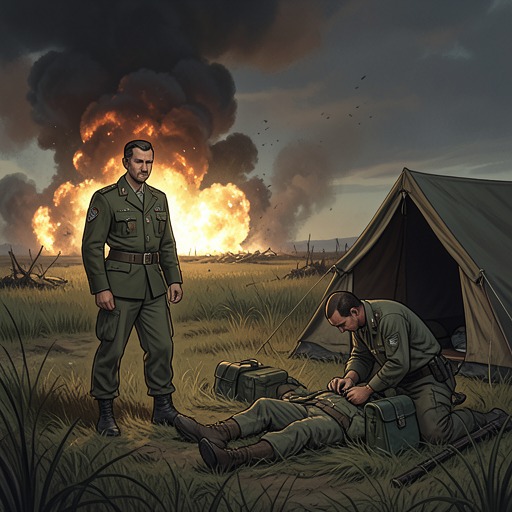
The station was a field medical unit, and Dorrigo’s position within it combined professional responsibility with military command. Near the front line, he served as second-in-charge when the unit received orders to pack up its field hospital during a tactical retreat. The situation soon changed character: the retreat became, by the following day, the confusion of a strategic advance. The episode presents the station not as a fixed hospital but as a medical service required to move amid rapidly changing military circumstances.
Training and preparation in Adelaide
In late 1940, Dorrigo was completing his final training with the 2/7th Casualty Clearing Station at the Warradale army camp in Adelaide, before the unit embarked for an unknown destination. His preparations were military and professional, but the days also contained ordinary interruptions. On a half-day leave pass, he had intended to visit his uncle Keith Mulvaney, who lived near Adelaide; when the car he hoped to borrow broke down, he instead planned to meet fellow doctors from the station at a Red Cross dance in the city. The episode places the unit within the social world of young medical officers just before deployment, while the destination and demands of service remained uncertain.
From the unit to Evans’ J Force
The later fate of the men associated with Dorrigo’s command extended beyond the station’s medical role. In Java, a group that had arrived in rags left two weeks later in the same condition; Wat Cooney was among them. They were officially designated Evans’ J Force and transported to the railway station in small, closed steel wagons intended for carrying rice, with twenty-seven men packed into each wagon and too little room to sit. This evidence traces the men’s passage into captivity, rather than establishing that the 2/7th Casualty Clearing Station itself continued to operate as a unit in the prisoner-of-war camps.
The prisoners were then made to work on the railway with basic tools, including ropes, poles, hammers, bars, baskets, and hoes. Food diminished as the monsoon arrived, while small comforts such as an occasional duck egg, palm sugar, or a repeated joke helped sustain hope. Dorrigo’s later responsibilities among the prisoners included arguing over how many sick men would be sent to work: he offered four hundred, grounding his proposal in his medical assessment, though he understood that this expertise offered no real protection against the demands imposed on the prisoners. These later scenes show the distance between the medical judgment associated with his training and the limited power available to him in captivity.
Significance
The 2/7th Casualty Clearing Station gives Dorrigo’s wartime role a concrete institutional beginning: he was a doctor trained for service with a mobile field hospital, then a second-in-charge responsible during a military withdrawal. The men’s subsequent designation as Evans’ J Force marks a change in circumstance from military deployment to captivity and coerced labor. The distinction matters: the evidence follows people connected through Dorrigo’s command, not an uninterrupted institutional history of the station. Through that trajectory, the unit’s medical purpose is set against the later conditions in which Dorrigo’s knowledge and authority could not secure adequate rest or exemption from work for the sick.