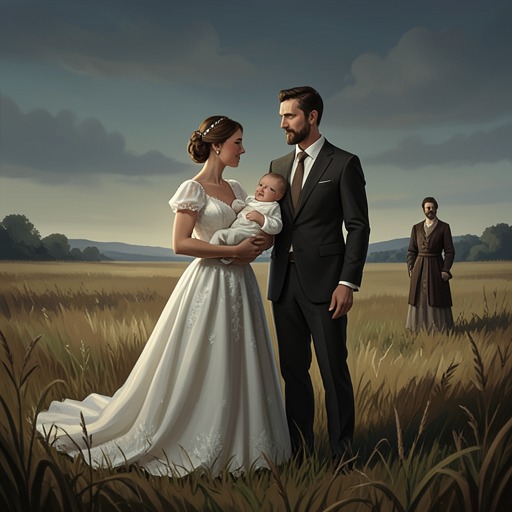
Amy Mulvaney–Keith Mulvaney marriage
The Narrow Road to the Deep NorthAmy Mulvaney and Keith Mulvaney’s marriage begins as a response to an unintended pregnancy and is later undone by the guilt, loneliness, and concealed attachments that neither security nor goodwill can resolve. Their relationship is not presented as a simple opposition between a cruel husband and an unhappy wife: Keith is generous and caring, while Amy recognizes his decency even as she cannot make their marriage answer her deepest desires. Its collapse turns on a painful contradiction: marriage was meant to protect a child, but the pregnancy ended, and Amy eventually understands that the loss has become bound up with the end of their life together.
A marriage formed in crisis
Before they married, Amy became pregnant by Keith. He did not think it right to have a child outside marriage, while Amy wanted to marry in order to protect the baby. She understood their decision as a response to the pregnancy rather than a straightforward beginning to a shared life. The difference in their wishes was already present: Keith was reluctant to marry at first, while Amy wanted the security of marriage for the child.
In November, Keith arranged for Amy to see a doctor in Melbourne, who terminated the pregnancy. Amy later explains that she had to present the trip as an outing for a race. She studied horses and betting, perhaps becoming briefly interested, so she would have a plausible reason to be away. Afterwards, that interest faded; she describes the betting she does later as a small remnant of the story she had once used to conceal the real purpose of the journey.
After the abortion, Keith became kind, and guilt may have contributed to his wish to marry her. Amy was distressed and unable to make decisions with confidence. His proposal, with its certainty and respectability, seemed like a way out of the confusion. She persuaded herself that the differences between them might be no greater than those of any other couple. The marriage thus offered real security, but it was also formed when Amy felt lost and when neither partner could restore what the pregnancy had represented.
Comfort, care, and loneliness
Keith provides Amy with a materially comfortable life. He is gentle and generous, maintains the King of Cornwall Hotel, and sees that the household has what it needs: wood for the winter fires and ice for the kitchen in summer. Their age difference is about twenty-seven years, and he allows her some freedom to come and go. Amy is not unaware of what is good in him; he can be easy company, and she does not describe their home as wholly miserable.
Yet the orderliness that sustains their life also defines its limits. Keith keeps the hotel and occupies his spare time with work as a sporting-club secretary and alderman. Amy feels that he cares for her as part of the life he maintains: he attends to her needs, but she does not feel the force of a deep, shared passion. The household’s dependable comforts cannot supply the adventure and uncertainty she wants. Their marriage can be comfortable in its routines while remaining emotionally empty for her.
Amy’s account of that emptiness is not simply that she feels no affection. She sometimes thinks she loves Keith in her own way, and she sees that he loves her. But she repeatedly experiences loneliness in his company and cannot offer him the response he hopes for. She fears that speaking honestly would be cruel, while silence keeps both of them inside a marriage that fails to meet their needs. The result is an attachment sustained by care and obligation but troubled by an intimacy Amy cannot make reciprocal.
Concealment and a divided life
As Amy’s relationship with Dorrigo Evans deepens, the contrast between her marriage and her inner life grows harder to maintain. Over the summer, the marriage remains outwardly comfortable and may even become more so. Amy returns to Keith and their shared bed amicably, but privately she is absorbed by a life he does not know about. Her efforts to preserve ordinary domestic peace coexist with a growing sense that the marriage is withering.
The secrecy produces guilt as well as distance. Amy sometimes wants to confess, not in order to receive Keith’s forgiveness, but because she wants her actual life and the truth of what she has done to be brought together. She imagines that honesty might allow her to leave. At the same time, she wants a crisis that would bring the marriage to an end and fears the changes such a crisis would force. She wants Keith to understand how badly things have gone, yet also tries to spare him the pain of knowing about Dorrigo. These conflicting wishes leave her both concealing the affair and behaving in ways that make the marriage feel increasingly exposed and unstable.
The strain also enters their private life. Amy withholds affection and refuses the kisses Keith seeks; he comes to accept that distance on her terms, although it hurts them both. Her withdrawal is not presented as a clean separation: she feels that she is hurting him, while also believing that pretending to offer a love she does not feel would be untruthful. Keith’s repeated efforts to find reassurance receive no affirmation from her. In Amy’s view, love cannot be reduced to goodness or happiness. Her understanding of the marriage is therefore more complicated than a choice between a kind husband and a lover: she can recognize Keith’s kindness while feeling lonely with him, and her feelings for Dorrigo do not make the consequences disappear.
Discovery and the final reckoning
Keith eventually confronts what he has suspected about Amy and Dorrigo. Amy understands that he had carried his knowledge silently and had hoped that he was mistaken. When he speaks, he does not raise his voice; what frightens Amy is his clear judgment and the hurt it makes visible. His confirmation of the affair changes the conditions of their silence. The suspicions that had remained unspoken become part of their shared knowledge.
The couple briefly consider whether they could still become something together. Amy assents to the possibility, but the recognition does not restore their marriage. She connects its failure directly to the pregnancy and abortion: they had wanted to be a couple, she says in effect, but could not become one again because the child was lost and their relationship was damaged with it. The admission makes the beginning and ending of the marriage meet. The decision to marry had been made to protect the pregnancy; the loss of the pregnancy became, in Amy’s understanding, a wound that neither Keith’s remorse nor his care could repair.
The marriage’s decisive ending is therefore emotional rather than a sudden reversal from comfort to hostility. Keith’s kindness remains part of Amy’s understanding of him, even as their inability to share an honest, sustaining intimacy becomes unmistakable. Their final exchange recognizes both the wish that they might have been a couple and the fact that they could not continue as one. The relationship ends with that contradiction unresolved: the marriage once seemed a way to make things right, but its original reason became inseparable from what it could not mend.
Narrative significance
The marriage gives the novel a counterpoint to Amy’s attachment to Dorrigo. Keith and Amy’s life contains practical care, respectability, and material security, but these do not guarantee happiness or mutual understanding. Conversely, Amy’s intense feelings elsewhere do not free her from responsibility toward Keith or undo the harm concealed within their household. The relationship resists a simple moral division between a good marriage and a bad one: kindness is real, and so is loneliness.
Its history also shows how a single decision can acquire meanings that neither spouse can control. The marriage begins as a proposed safeguard for a child; after the abortion, Keith’s proposal becomes a route out of Amy’s distress and a means of building a respectable shared life. Much later, Amy identifies the same pregnancy and its loss as the point at which their marriage was fatally altered. The novel thus presents their bond as shaped not only by what the couple feel for one another, but by the consequences of a choice made under pressure and by the years of care, concealment, and disappointment that follow.