Australian Imperial Force
The Narrow Road to the Deep NorthThe Australian Imperial Force appears in the novel through the wartime service of Dorrigo Evans and the Australian prisoners who become Evans J Force. Its presence is traced from a casualty clearing station near the fighting in Syria to the forced labor camps of Siam, where Dorrigo’s military and medical responsibilities persist under conditions that make both leadership and treatment matters of survival.
Identity and Wartime Service
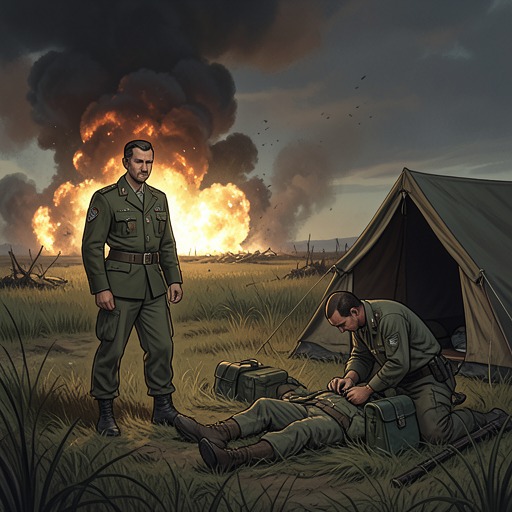
Dorrigo serves in the Australian Imperial Force as second-in-charge of the 2/7th Casualty Clearing Station. In late 1940, he is completing training with the unit at Warradale army camp in Adelaide before deployment. The novel gives no broader institutional history of the force; instead, it establishes its wartime presence through the work and movements of this medical unit and the men associated with Dorrigo.
During the Syrian campaign, the 2/7th receives orders to pack up its field hospital amid a tactical retreat that becomes a strategic advance. The rest of the station evacuates by truck, while Dorrigo stays with the remaining supplies awaiting the final vehicle. New orders instead send him forward with a twenty-strong mule train and three Cypriot handlers to a village at the new front. Their maps disagree about the destination and distance, and Dorrigo gives a compass reading that matches neither map, relying on an instinct for movement when certainty is unavailable. The episode presents his service as a mixture of medical logistics, confused orders, and responsibility for keeping a small group moving.
From Military Unit to Prisoner Force
The novel later follows Australian servicemen from Changi into a new phase of captivity. After a football match against the camp’s leading side, the men leave in the same worn clothes in which they arrived; Wat Cooney, who had been uncrated, is among them. They are officially designated Evans J Force and transported in closed rice wagons, twenty-seven men to a wagon. The journey takes five days and covers a thousand miles, with no food and three deaths before they are taken off the train at Ban Pong and loaded into trucks for the journey through the jungle.
Their arrival in Siam in early 1943 precedes the worst privations described later. Imperial Japanese Army engineers have marked a projected railway route with surveyors’ pegs: a line of 415 kilometres running from north of Bangkok toward Burma. The Japanese High Command’s plans and exhortations have yet to become a completed railway, but the prisoners are given axes and rope and ordered to clear a kilometre of giant teak trees along its intended path. The contrast is stark: men organized by military service are made into a labor force for an imperial project they do not control.
Forced Labor and the Erosion of Health
As the seasons change, the conditions of labor deteriorate. The monsoon darkens the camp landscape, food diminishes, and the Speedo removes rest days, raises quotas, and lengthens shifts. Prisoners are increasingly made to work two shifts, by day and by night. The distinction between fit and sick men collapses into distinctions among the sick, the very sick, and the dying; the railway’s demand governs the routine of the camp.
The men nevertheless sustain forms of mutual life within that imposed routine. An occasional duck egg, a little palm sugar, or a repeated joke offers a small reprieve. Their work spans clearing jungle, breaking rock, moving earth, and carrying railway sleepers and iron rails. These details show how a planned infrastructure project becomes a daily system of compulsory labor, while the prisoners’ shared resources and humor help them endure it.
Command, Medicine, and Responsibility
As commanding officer and senior medical officer, Dorrigo must report the prisoners’ condition to Major Nakamura during a roll call. He records 838 men remaining: 67 in the cholera compound, 179 in hospital with severe illness, 167 too sick for ordinary work, and 62 more reporting sick that morning. He calculates that 363 men are available for railway work. The count is not simply administrative: it forces medical judgment into a labor system that demands workers regardless of their condition.
When the dispute over numbers continues, Dorrigo offers 400 men, arguing that a larger number would leave men dead who might recover and later be useful. He knows that medical knowledge cannot shield him from Nakamura’s demands. Under pressure, he recalculates who might survive light duties and arrive at a maximum of 406, while recognizing that the number genuinely fit for the Japanese expectation is zero. His daily task becomes a grim act of selection among men weakened by hunger and illness, rather than a return to the ordinary purpose of military medical care.
Dorrigo’s work as a doctor also reaches the limits of what treatment can accomplish. In an improvised operation, he uses scarce water carefully and works with makeshift materials to try to save Jack Rainbow. The bleeding is stopped and, for a time, Dorrigo believes the operation has succeeded; when he finally looks up, Jack has already died. This outcome sits alongside the railway tallies and labor quotas as another measure of the gap between responsibility and control. The Australian Imperial Force’s significance in these episodes is therefore conveyed not through institutional history, but through the people whose service, medical duties, and comradeship continue after military command has given way to captivity.