Australian POWs’ forced-labor captivity
The Narrow Road to the Deep NorthAustralian POWs’ forced-labor captivity was a system in which prisoners captured during the Second World War were compelled to build the Death Railway under conditions that treated their lives as expendable. The work was not simply a backdrop to imprisonment: quotas, transport, food scarcity and medical incapacity shaped the prisoners’ days, while their continuing sense of belonging to Dorrigo Evans’s J Force resisted the reduction of people to labor units.
Identity and Scale
The Japanese Empire held about 22,000 Australian POWs, most of whom had surrendered at the fall of Singapore before the fighting had properly begun. Around 9,000 were sent to work on the railway. Their captivity formed part of a much larger forced-labor undertaking: Allied POWs numbered about 60,000 among the workers, alongside a quarter of a million or more Tamil, Chinese, Javanese, Malayan, Thai and Burmese laborers. These groups experienced the same immense project of coercion, but the account identifies them as distinct populations rather than treating their circumstances as interchangeable.
The railway served a military purpose. By 1943, Japan’s forces were overstretched and the Allies controlled the seas; the railway was intended to carry men and supplies overland to the Burmese forces. The Japanese Empire lacked the machinery, money and time to build it by ordinary means. The project proceeded instead through the forced labor of prisoners and other workers, under an imperial conviction that The Emperor’s will and Japanese spirit would prevail. Major Nakamura understood that prisoners might die attempting the work, yet the railway’s demands and the command to complete it governed his decisions. Colonel Kota expressed the governing logic starkly: completion was required even if most workers, or everyone, died.
Transport and the Labor Regime
After leaving Changi, the thousand men who became known as Dorrigo Evans’s J Force were transported in closed steel wagons designed for carrying rice. Twenty-seven men were packed into each wagon, with too little room to sit. The journey lasted five days and covered roughly a thousand miles. The men travelled without food; by the time they were taken off the train at Ban Pong, six stops had been made and three men had died. They were then crowded into trucks for the journey onward through the jungle. Transport thus began the railway labor regime before the men reached the work itself: confinement, exhaustion and the loss of control over movement were part of the transfer to the camps.
Conditions worsened with the monsoon and the introduction of the Speedo. Rest days ceased, work quotas repeatedly increased and shifts lengthened until prisoners were sent to work by day and by night. The distinction between the fit and the sick gave way to one between the sick and the dying. Prisoners cleared jungle, broke rock, moved earth and carried sleepers and rails with basic tools and their own bodies. Food diminished as the work intensified; an occasional duck egg, a little palm sugar or a familiar joke could become a rare aid to survival.
The workday extended beyond the labor site. Prisoners walked seven miles each way, and after a day of work in heat and rain, their food might amount to one small ball of sticky rice. A punishment could also delay the evening meal for everyone required to remain and watch. The account places hunger and compelled labor in the same frame: the need to eat persisted, but the system could make even that modest relief contingent on events controlled by the guards.
Counting, Selection and Mutual Reliance
The camp’s labor supply was repeatedly calculated against illness and death. During one count, Dorrigo Evans reported that four men had died the previous day and two overnight, leaving 838 POWs. Of these, 67 had cholera, 179 were hospitalized with severe illness, 167 could undertake only light duties, and 62 more were reporting sick. Dorrigo calculated that 363 men were available for railway work. The numbers made visible how little of the force could safely be treated as labor, but the Japanese authorities continued to demand more.
After further argument, Dorrigo offered 400 men for work, grounding the figure in his medical knowledge and the prisoners’ conditions. He recognized that his expertise offered neither a reliable shield nor a guarantee that the decision would be respected. The negotiation shows the narrow space in which he could act: he could contest the demand and try to limit the number exposed to work, but he could not end the forced labor or control the authority imposing it.
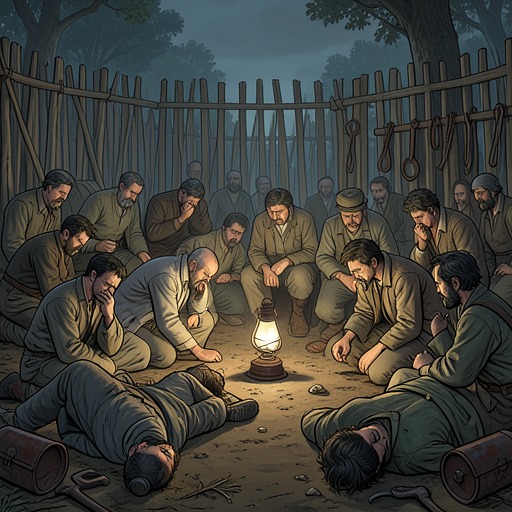
The official arithmetic did not exhaust the prisoners’ sense of who they were. Though death continually reduced their number, the men remained Dorrigo Evans’s J Force, a thousand souls in identity even if only one man should ultimately march out. Their belief in one another became more important as deaths accumulated. The account presents that shared identity not as a claim that suffering ennobled them, but as a bond through which the living continued to recognize the dead and their own obligation to one another. Darky Gardiner’s effort to make his way along the Dolly while acutely ill became an unsettling point of identification for the others: what he endured might be demanded of any of them.
Human Cost and Aftermath
The railway’s first train travelled its full length on 25 October 1943. By then, the line had passed through the deaths of workers on a scale that could not be reliably counted. Estimates for the non-POW laborers alone range from 50,000 to 200,000 deaths; no agreed total exists. Of the Australians sent to the railway, the remains of one in three were included among the human bones beside the completed line. The figures establish the scale of loss while also exposing how much of it cannot be recovered as a precise count.
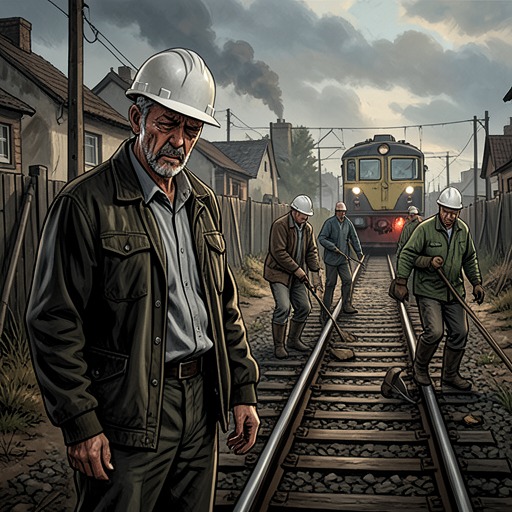
After the war, the railway quickly lost its purpose and support. Japanese engineers and guards were imprisoned or repatriated, and the laborers who had remained to maintain the line were freed. The Thais abandoned it, the English dismantled it, and local tribespeople pulled up and sold its rails. Banks broke, bridges and embankments washed away, and the cuttings filled in; vegetation returned among the graves and remnants of construction. The physical line was gradually undone, but its disappearance did not undo the captivity that had built it.
The contrast between public commemoration and omitted labor sharpens the account’s treatment of memory. Steam locomotive C 5631 is displayed at Yasukuni Shrine in Tokyo, where the Book of Souls records more than two million people who died in service to the Emperor of Japan, including executed war criminals connected with mistreatment of POWs. Yet the locomotive’s plaque does not mention the horror of railway construction, and the shrine’s memorial gives no names to the hundreds of thousands who died building the line. The railway’s history therefore survives in an uneasy form: its machinery is displayed, its workforce remains only partly counted, and many of the dead have no memorial record.