Bonox Baker
The Narrow Road to the Deep NorthBonox Baker is an Australian prisoner of war whose importance in the Siamese camp emerges through two forms of service: caring for the sick and protecting a record of what the prisoners endured. A corporal who volunteers as an orderly in the cholera compound, he accepts work that carries exceptional personal risk. He also insists that the pictures made by Rabbit Hendricks matter because people in the future should know what happened. Against Dorrigo Evans’s skepticism about memory, Bonox holds to the possibility that witness can serve the dead and the living.
Identity and Camp Circumstances
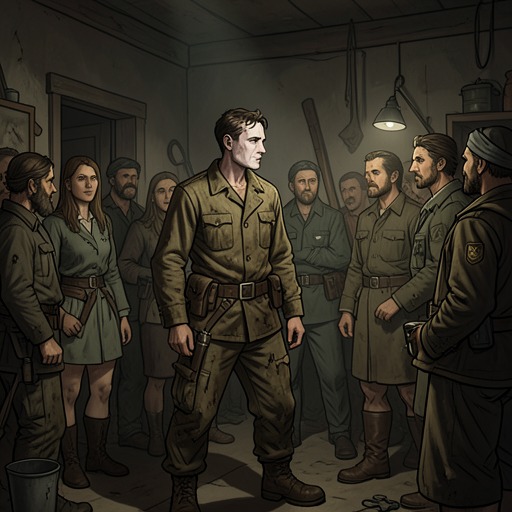
Bonox appears within the group of Australian POWs whose captivity is organized around forced work, illness, and dwindling resources. The men have been transported in crowded, closed railway wagons before being taken onward into the jungle. Later, as the monsoon arrives and food becomes scarcer, the Speedo removes rest days, raises work quotas, and lengthens shifts. This is the setting in which Bonox’s care takes shape: the demands of the railway keep pressing even as sickness leaves fewer prisoners able to work.
The camp’s medical burden is also a burden of choice. Dorrigo, both the prisoners’ commanding officer and senior medical officer, must report deaths and sort the remaining men by illness and capacity for work. In one count, he reports that four men died the previous day and two overnight; of 838 prisoners, 67 are in the cholera compound, 179 are seriously ill in hospital, and 167 can manage only light duties. Bonox’s later work among cholera patients belongs to this larger crisis, where treatment, isolation, and the need to supply workers are entangled rather than separate concerns.
Voluntary Service and Care
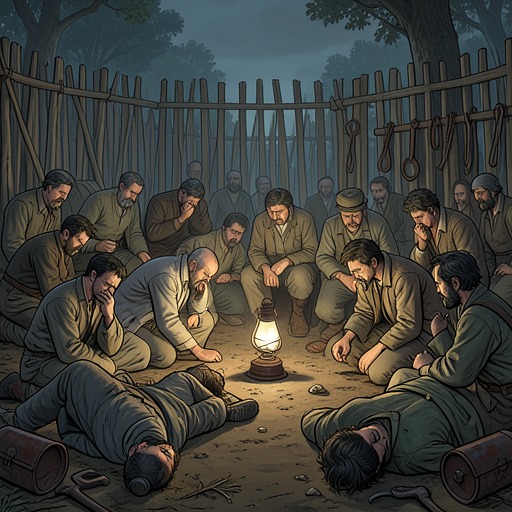
Bonox has volunteered as an orderly at the cholera compound, an open-sided collection of shelters where patients are isolated and many die. Dorrigo learns from him that two other orderlies have contracted cholera. The risk is not incidental: volunteering in the compound is understood as a choice that may cost the orderly his life. Dorrigo accepts danger as part of his medical calling, but cannot understand why men who might avoid it choose to remain. Bonox’s decision gives that question a human answer without explaining it away: when Dorrigo tells him he has done more than his share and should return to the main camp, Bonox says he would rather stay.
His service is not presented as a cure for the compound’s conditions. The epidemic continues, and Dorrigo’s thoughts about the patients move between the hope of saving some and the terrible uncertainty of whether isolation can protect others. The orderlies themselves fall ill. Bonox’s willingness to remain therefore carries both practical and moral weight: he continues to care for patients despite the danger, while the story makes clear that individual commitment cannot undo the conditions producing the suffering.
Bonox also appears beside Dorrigo in the rhythms of work beyond the compound. When rain and a letter momentarily disorient Dorrigo, Bonox calls him back to the immediate obligation of going out, warning that delay could mean another prisoner is sent to work in his place. The reminder is practical rather than consoling. Care in the camp involves not only tending the ill but also keeping watch over who will bear the next demand.
Witness and Rabbit Hendricks’s Record
Bonox’s other central concern is the survival of Rabbit Hendricks’s pictures. Asked why the drawings were made, he explains that they are a record intended to let people in the future know and remember what happened to the prisoners. He reports Rabbit’s conviction that the pictures would survive and that the world would know. Bonox treats the record as an act of witness, not merely as an object made in captivity.
The pictures show atrocities, including an ink drawing of severed Chinese heads on spikes in Singapore after the Japanese occupation. Bonox points to this image as evidence of what the record contains. His insistence that memory can be a form of justice meets Dorrigo’s objection that memory may instead produce new horrors, or create a misleading sense that people have done right simply by remembering. Their disagreement is not about whether the events were terrible; it is about what the act of preserving them can accomplish.
Relationships and Narrative Significance
Bonox’s relationship with Dorrigo is built through practical trust and a difference in outlook. He serves under Dorrigo’s authority, but his decision to stay in the cholera compound exceeds what Dorrigo asks of him. Elsewhere, he draws Dorrigo toward the immediate needs of the prisoners, while his defense of Rabbit’s record challenges Dorrigo’s belief that remembrance cannot endure. Bonox does not resolve that contradiction. His conviction remains beside Dorrigo’s doubt, giving the question of witness a distinct voice within the camp narrative.
The contrast becomes especially sharp when Bonox shows the drawing of the heads. Dorrigo can see the flames and the dead, and thinks of Amy Mulvaney, but cannot recover her face. Bonox speaks for a future in which the record may preserve what individuals cannot hold in memory; Dorrigo answers from the fragility of memory and the certainty of death. The scene does not establish that pictures can defeat forgetting. Instead, Bonox’s insistence makes the attempt to testify consequential even when its lasting success is uncertain.
Bonox therefore links the novel’s immediate ethic of shared survival to its concern with historical memory. His service is measured in the choice to remain among the sick, while his faith in Rabbit Hendricks’s pictures reaches beyond the camp toward unknown future readers. Both commitments confront limits: the epidemic continues, the prisoners remain subject to forced labor, and Dorrigo doubts that memory can last. Bonox’s significance lies in maintaining care and witness within those limits, without treating either as a guarantee of rescue or justice.