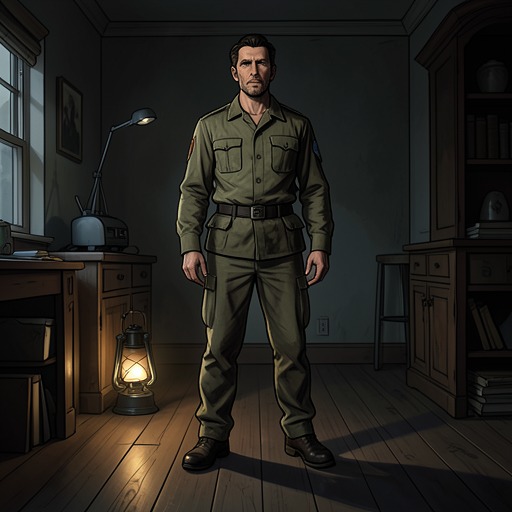
Choi Sang-min
The Narrow Road to the Deep NorthChoi Sang-min, whom Australian prisoners call the Goanna, is a Korean guard whose authority over prisoners is real but sharply bounded by the Japanese military hierarchy above him. His story traces how obedience and imposed subordination shape his conduct, without excusing the violence he commits, and ends with his conviction and execution as a Class B war criminal. The trial brings him face to face with the consequences of his actions, while leaving him convinced that responsibility and punishment are distributed unequally.
Identity and Military Background
Choi's position in the Japanese military begins with a contradiction: he receives training like an Imperial Japanese Army private, but Koreans in his unit are not to become soldiers. Their assigned task is guarding surrendered enemy troops. At Pusan, training includes marching, weapons practice, and binta, a prescribed routine of face-slapping for errors. Trainees are made to strike one another in turn, and orders are to be obeyed. In Choi's recollection, binta and obedience become the pattern of his life in the military.
His compliance is not presented as uncomplicated loyalty. As a child in Korea, he had been placed at the back of his class after whispering in Korean rather than speaking Japanese. Later, working for a Japanese family, he occupied a position he regarded as lower than that of the family's pet. In the army, too, he is beneath Japanese soldiers. He longs to leave and return home, but fears consequences for his family under Japanese authority; the prospect of a monthly wage of fifty yen also figures in his decision to stay. The system that gives him power over prisoners has itself trained him through subordination and compulsion.
Authority and Conduct in the Camp
As a guard, Choi participates in the coercive camp regime imposed on Australian prisoners. The prisoners are forced to build the railway under escalating demands: the Speedo removes rest days, raises work quotas, and extends shifts, while hunger and illness leave men increasingly unable to work. Choi is not simply a distant representative of that regime. During his trial, he acknowledges that beating prisoners had made him feel powerful, even though they were much larger than he was. He had learned to treat punishment as an ordinary response to perceived slowness or failure, following practices he had been taught by the Japanese military.
His dealings with Frank “Darky” Gardiner reveal a more particular, compromised relationship. Choi does business with Gardiner, who can obtain goods such as fresh beef for the non-commissioned officers. He dislikes Gardiner's singing and whistling, yet also finds him useful. When ordered to punish Gardiner, Choi considers the order pointless and expects Gardiner will still need him afterward. Nevertheless, he has the guards drag the hospitalized, unable-to-walk prisoner to the parade ground. His private reluctance does not stop him from carrying out the order; the episode makes clear the gap between recognizing an act as futile and refusing to participate in it.
The prisoners' nickname for him, the Goanna, becomes part of his sense of himself. At trial, he learns that the Australians regarded him as a distinct figure, even a monster, and he is not displeased that their hatred marks him out. Their contempt recalls the low status he experienced under Japanese authority, but their recognition also gives him a sense of importance. That recognition does not amount to remorse: he remains aware that his beatings may have contributed to deaths, while telling himself that the prisoners might have died anyway in the conditions of the camp.
Trial and Unequal Accountability
Choi's Australian military trial lasts two days. Apart from the questions put directly to him, the proceedings are conducted in English, which he understands only in fragments. The court dismisses the charge that he participated in the murder of Australian Imperial Force Sergeant Frank “Darky” Gardiner because the written testimony is contradictory. It upholds the charge that he ordered the murder of Wat Cooney, along with lesser charges concerning ill-treatment and the withholding of food and medical supplies that led to avoidable suffering and death. The sentence is execution by hanging.
Choi disputes the evidence that he ordered Cooney's death, arguing that Cooney was no longer in the camp when the alleged order was given. The camp records are confused and incomplete, however, and do not establish that claim. The prosecution also relies on Colonel Kota's interrogation evidence. Choi notes that Kota's testimony helped convict Korean and Formosan guards, while Kota himself was later released without charge. He refuses his Australian defence counsel's request to petition for clemency, seeing no point in prolonging the ordeal.
The proceedings teach Choi about the Geneva Convention, chains of command, and the structure of the Japanese military—subjects he had previously understood only vaguely. They also sharpen his sense of the disparity between those who gave or carried out orders and those who escaped punishment. He sees officers with connections to Japanese nobility being freed while lower-ranking Koreans and Formosans are left to face execution or imprisonment. His perception is not a denial that he harmed prisoners: rather, it is a conviction that the system of responsibility has selected men like him to bear consequences that others evade.
Condemnation and Ending
In Changi Prison, Choi's final days are marked by anxious repetition. Without a watch or clock, he cannot tell how long the night has lasted. His thoughts swing between fear of his approaching execution and anger that he has not received the fifty yen a month he believes is still owed to him for military service. The sum becomes an emblem of the bargain that brought him into the army: he stayed partly for the wage, but now believes he will never receive it. The fixation offers no escape from his sentence, only a recurring argument with the injustice he feels has been done to him.
On the morning he is taken to the gallows, Choi resists the guards and becomes preoccupied with killing a cockroach he has seen in the prison. He is offered medication to calm him; after the first tablets do not settle him, he is given an injection. Before leaving the prison, he crushes the insect beneath his boot. At the gallows, asked whether he has anything to say, he cannot produce the idea he had wanted to express. Instead, the fifty yen returns to mind, now seeming too small to have been an answer to anything. He is executed by hanging.
Choi's ending holds individual culpability beside the pressures and inequalities of the system in which he served. Military training and discrimination help explain how obedience and violence became ordinary to him, but his actions against prisoners remain his own. The trial assigns him responsibility for specific offenses while exposing the incomplete evidence and uneven outcomes that shape postwar justice. His death resolves the legal sentence, not the larger conflict between personal accountability and the structures that trained, used, and sometimes protected those who enforced imperial rule.