Choi Sang-min’s death-row status
The Narrow Road to the Deep NorthChoi Sang-min’s death-row status is the aftermath of a divided war-crimes verdict and a passage from confinement into an execution he cannot accept as meaningful or just. The story follows him from the disputed charges and his transfer to Changi Prison’s condemned prisoners’ hall through the long wait for the notice that names him, ending with his execution. His fixation on fifty yen, the monthly pay he says he never received, makes that passage more than a private fear: it gives concrete form to his sense that he has been used by an empire and then abandoned by the authorities judging him.
Conviction and the charges
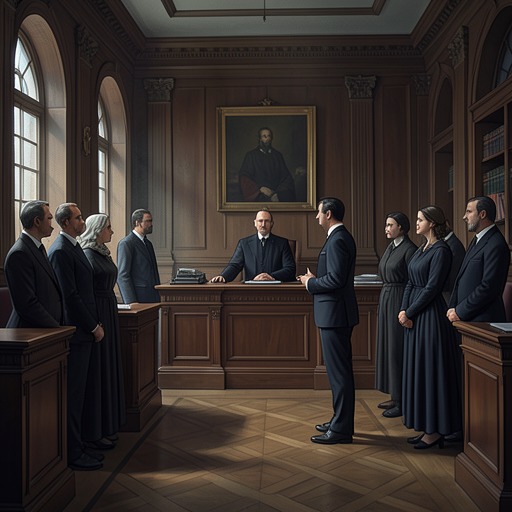
The judgment distinguishes between accusations rather than treating Choi’s wartime record as a single undifferentiated case. The charge that he participated in the murder of Australian Imperial Force Sergeant Frank “Darky” Gardiner is dismissed because of contradictions in the evidence and written testimony. The charge that he ordered the murder of Private Wat Cooney is upheld, as are lesser charges of ill-treatment, including withholding food and medical supplies in ways that caused avoidable suffering and death. He is found guilty as a Class B war criminal and sentenced to execution by hanging.
The verdict does not settle Choi’s doubts about how responsibility has been assigned. He had tried to explain that, as a Korean sergeant, he could not have ordered a prisoner’s death. The prosecution relied on the interrogation of Colonel Kota, whose evidence connected him to the order; Choi had also heard that Colonel Kota was later released without charge. Choi further argued that Wat Cooney was no longer at the camp when the order was supposedly given, but confused and incomplete camp records did not establish that claim. The dismissal of the Gardiner charge alongside the upheld Cooney charge leaves the verdict sharply divided: one allegation falls for want of consistent proof, while another and the charges of mistreatment determine his fate.
The railway and the system of captivity
The case emerges from a camp shaped by the forced construction of the railway. The men designated as Evans’ J Force had been transported in crowded, closed wagons, twenty-seven to a car, on a journey lasting five days without food. By the time the monsoon arrived at the work site, food was dwindling and the Speedo had removed rest days, raised quotas, and lengthened shifts. Prisoners were increasingly required to work successive shifts, while the distinction between the fit and the sick blurred into a distinction between the sick and the dying. The railway’s demands governed both labour and survival.
Prisoners endured this system with scarce food and makeshift equipment, clearing jungle, breaking rock, and moving earth and rails. Deaths accumulated as the hospital filled with men too sick to work. The same camp setting also makes the verdict’s charges of withholding food and medical supplies especially consequential: control over provisions and care operated within a structure already making prisoners vulnerable to exhaustion and disease. Choi’s death sentence follows the war, but the conduct for which he is condemned belongs to this wartime order of forced labour and deprivation.
Life among the condemned
After conviction, Choi is moved to P Hall at Changi Prison, where condemned men live together as equals, whether Japanese, Korean, or Formosan. He is issued a dirt-brown uniform marked with the English letters CD, which he is told designate a man convicted to die. The mark makes his status visible, but his response is not simply despair. He observes that the other condemned men fill their days with activities and do not appear either depressed or excessively concerned about what lies ahead. In himself, he feels fear and inferiority receding, as if those old pressures have lost their force now that death has become his assigned future.
The hall’s routine gives that future an interval rather than a single announcement. Each morning the prisoners leave their cells, wash, and spend the day in the central gallery. They play go or shogi, reread the few books and magazines available, or sit alone. Every few weeks an Indian captain arrives with an execution notice. The men wait in silence, each relieved when the notice names someone else. The repeated visits turn uncertainty into a collective practice: everyone remains within the same condemned group, yet each announcement separates one man from the rest.
On the third visit, Choi understands that he will be executed. His feelings seem absent, and the paper itself does not immediately connect the official sentence to his own life. He considers the distance between a document, which appears to contain nothing, and a human being, who changes and holds many different qualities. The notice nevertheless proves decisive. The relief he sees in the other prisoners finally makes him recognize that his execution is set for the following morning. The hall’s shared fear reveals his fate to him more forcefully than the notice alone.
The last hours and the meaning of fifty yen
The preparations for his final night do not reconcile Choi to the sentence. The condemned men receive a Japanese meal and cigarettes, and a Buddhist monk attends. Choi remembers that his father had said he was Chongdoist, and the monk’s presence angers him. He cannot eat the rice, miso soup, and tempura provided as his last meal. To eat would mean accepting that it really was his last; refusing it allows him to imagine that another meal might still follow. The refusal cannot alter what is coming, but it preserves, for a moment, his resistance to the official conclusion that his life is over.
He thinks of his parents and of the absence of any national cause that could explain his death to them. He had done nothing for Korea, he believes, and Korea had done nothing for him. He does not identify himself as Japanese or Korean; he understands himself as a man of a colony. That uncertainty of belonging sharpens his anger at the unpaid fifty yen. He insists to himself that this monthly wage was the reason he had served, yet he had seen none of it since before the war ended. The sum is modest, but its importance is not simply financial: it stands for the bargain that drew him into military service and the recognition he believes he was owed.
On the morning of his execution, Choi’s attention remains caught between panic and anger over the unpaid wages. He notices the scaffold, the people present, and the chalk marks that show where he must stand. Asked whether he wishes to speak, he cannot turn his thoughts into a final statement. The process proceeds, and his last thought returns once more to the fifty yen before it is cut off. The ending gives no resolution to his account of the money or to his disputed understanding of the verdict. His sentence is carried out, while the question that has occupied him remains unanswered.
Narrative significance
Choi’s condemned status is presented as both a legal condition and a crisis of identity. In P Hall, the CD uniform and the recurring execution notices reduce the future to an administrative sequence, but Choi continues to think of a person as more than a fixed judgment. His attempt to hold onto that distinction cannot save him; it does, however, expose the gap between a sentence on paper and the changing life it claims to conclude.
The repeated return to fifty yen gives the episode its organizing contradiction. Choi’s final concern may appear small beside the accusations and the death sentence, yet its recurrence shows how completely the unpaid wage has become his measure of the institutions that once employed him and now condemn him. Neither the dismissal of the Gardiner charge nor the upheld finding over Wat Cooney settles his sense of abandonment. The condemned man’s last insistence is therefore not an acquittal or an appeal, but a demand that the terms of his life be acknowledged even as the state takes it away.