Colonel Kota
The Narrow Road to the Deep NorthColonel Kota is a Japanese officer charged with railway work in the prisoner-of-war system. His arrival in the camp brings orders that expand the work already underway and redirect prisoners to another site. The practical authority he exercises is set against a formative memory from his early military service: as a young officer in Manchukuo, he took part in an execution exercise involving Chinese prisoners. Together, these details introduce a figure whose command is bound to both the railway’s demands and the violence through which he learned to serve them.
Identity and Railway Orders
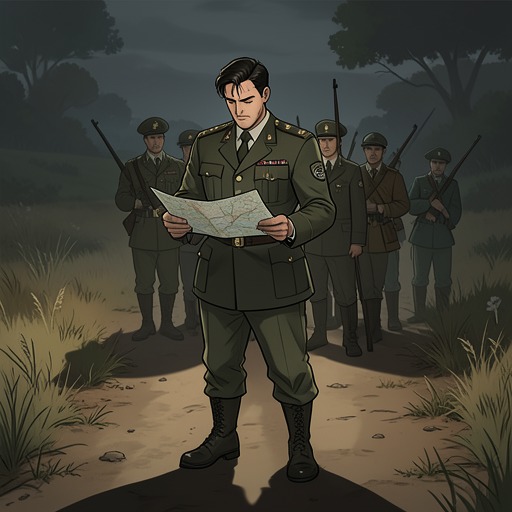
Kota appears at the camp before dawn, sitting at a bamboo table and eating tinned fish when Nakamura finds him. He has come with orders from the Railway Command Group, carried in an oiled folder with technical drawings so damp they cling to Nakamura’s fingers. Kota says he will leave as soon as transport can be arranged, but first delivers instructions that alter the work at the site.
Although the main railway cutting is already half complete, the plans now require it to be enlarged by a third to address gradient problems in the next sector. That change means a further three thousand cubic metres of rock must be cut and removed. The order arrives without corresponding provisions for the work: Nakamura lacks saws and axes for clearing jungle, prisoners break rock by hand with hammer and chisel, and there are too few proper chisels and insufficient coke to sharpen the tools that blunt. Kota’s presence thus connects distant engineering decisions to the camp’s immediate shortage of equipment and the labor expected to overcome it.
A further instruction requires one hundred prisoners from Nakamura’s camp to be sent to a camp near Three Pagoda Pass, roughly one hundred and fifty kilometres north on the Burmese border. Nakamura calculates that he needs more men, not fewer, to finish his own section on schedule. The reassignment makes Kota the bearer of a demand that conflicts directly with the manpower needs of the work already in progress, while showing how the railway’s labor force is allocated across camps by command.
Training in Manchukuo and the Formation of Command
Kota traces his understanding of command to a training exercise five years earlier, after he had left officer school and arrived in Manchukuo as a newly appointed second lieutenant. The exercise took place at a prison, where Chinese prisoners were made to serve as subjects in a test of the officers’ courage. A lieutenant demonstrated how to use a sword, and the young Kota watched closely. He later recognized that his attention had extended beyond the act itself: he was learning how to carry out an execution and how to remain composed while doing so.
When his turn came, Kota says, he was horrified inwardly but performed the task without outwardly shaking. He used a sword given to him by his father and followed the instructor’s demonstration. Watching water run across the blade helped him steady himself. In his account, this detail marks the beginning of a method by which he could focus on technique while suppressing his response to what he was doing.
Kota describes the experience as a transformation that made him feel as if he had become another man. For a time, he believed he could read the men around him simply by looking at them, and that his gaze alone could frighten them. That sense of power eventually diminished: his men resumed speaking insolently behind his back, and he felt the loss of the effect as a craving for something he wanted to experience again. He compares that desire to dependence on Philopon, which he also associates with wanting a renewed effect despite its costs.
The exercise did not remain an isolated memory. Kota tells Nakamura that, if several weeks passed without an execution, he would seek out a prisoner he believed was near death and make him prepare for it. Over time, he says, he began to see people chiefly in terms of their necks and whether they could be killed with a clean sword stroke. The memory therefore links his military training to a lasting fixation: violence becomes, for Kota, both a learned technique and a way of asserting control.
The Railway Inspection and Darky Gardiner
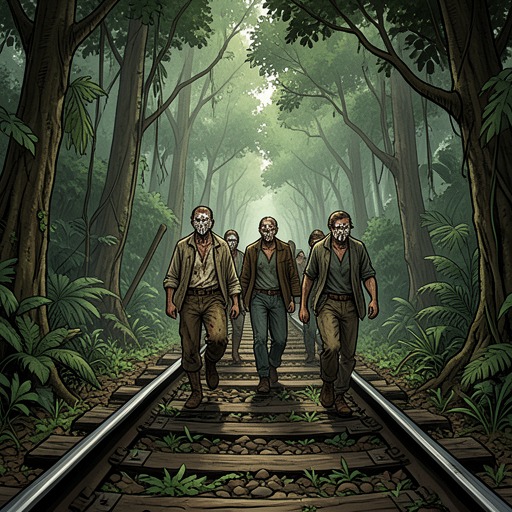
Kota’s inspection of the railway brings his earlier account of execution training into the camp’s present. His truck had been left in the jungle overnight, and thieves had taken several hoses, leaving it unable to run. While he waited for replacements, he went to inspect the line with the Goanna as his guide. They found two prisoners on the track: one sitting and one lying in the mud, too weak to respond to threats or blows. Kota recognized the prone man as Darky Gardiner and ordered the Goanna to position him kneeling so he could examine his neck.
Kota reasoned that carrying the sick prisoner back would consume another man’s strength, while food at the camp would be spent on someone likely to die soon. But his thoughts also return to the fixation he had described to Nakamura: he sees killing as a way to control the timing and manner of death, and, by extension, some part of his own life. He unsheathes his sword and asks for the Goanna’s water bottle. Although he feels no fear or conscience, he notices that his hands are trembling.
To steady himself, Kota recites Kikusha-ni’s haiku twice, then pours water over the sword. The gesture recalls the training exercise in Manchukuo, when watching water bead and run along his blade helped him master his inward horror. Now the same ritual steadies his hands before he lowers the sword until it rests on Darky’s neck, making his intention plain. The scene turns the memory he recounted as a lesson in acquired composure into an immediate threat to a weakened prisoner; the evidence here ends with Kota poised to act.
Narrative Role and Moral Significance
Kota’s scenes connect the railway’s administrative machinery to the habits of violence that sustain it. The orders move labor and enlarge a worksite on paper; his recollection shows how a military institution trained him to treat killing as a procedure that could be mastered. When the narrative returns from that recollection to the railway, the past is not merely background: it shapes how he interprets the exhausted prisoner before him. The movement between scenes makes institutional command and personal history legible together without making one a justification for the other.
The contrast between Kota’s confidence in technical control and the limits of that control gives his characterization its tragic unease. He believes he can manage the conditions and timing of another person’s death, yet his trembling hands expose a response his practiced ritual cannot entirely erase. The passage stops with his intention unmistakable but its outcome unresolved. That pause leaves the reader at the boundary between a learned routine and an individual act, where the railway’s abstractions have become a decision about a particular prisoner.