Darky Gardiner's Beating
The Narrow Road to the Deep NorthDarky Gardiner's beating becomes one of the defining failures of Dorrigo Evans's memory and moral confidence. It took place during the Speedo, the Death Railway's punishing period of work, on the same day the prisoners cremated Guy Hendricks. Years later, when Dorrigo tries to write about it, he cannot make the event resolve into a noble act, a clear account, or an explanation. Instead, the beating returns in broken particulars and unanswered questions: who was present, how many men took part, what Dorrigo himself did, and whether the violence had any meaning beyond its continuation.
Setting and Circumstances
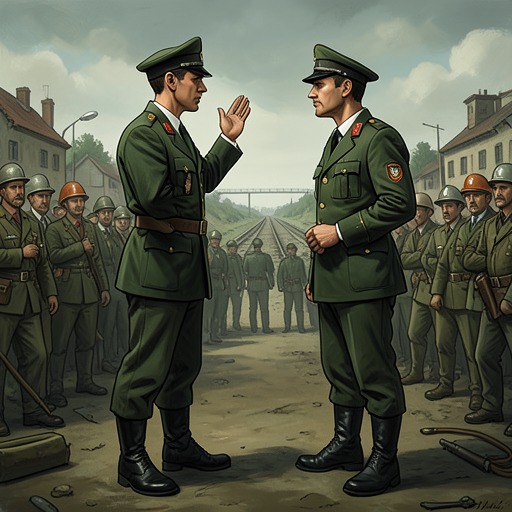
The beating occurred during a stretch of forced railway labour in which the prisoners worked for seventy days and nights without a day off through the monsoon. Dorrigo recalls the period as the Speedo, when the men were driven to clear jungle, break rock, move earth, and carry sleepers and rails. Their labour was organized around the Line, while exhaustion and punishment were part of the conditions under which it was built. The larger railway project was enforced by a system that treated completion as more important than the lives of the workers: Colonel Kota says that the work must be completed even if everyone dies. That policy gives the remembered beating its context without making it an isolated accident; the violence belonged to a regime that subordinated individual lives to the railway. The beating coincided with the cremation of Guy Hendricks, a prisoner who died on the Line. That shared date binds two forms of loss in Dorrigo's account: the immediate violence against Darky and the funeral of a fellow prisoner. Dorrigo later describes being unable to write the event as either terrible or noble. Those categories would give it a shape and moral clarity that his recollection cannot sustain. The coincidence of the beating and cremation instead leaves him with a memory in which death, violence, and the prisoners' daily labour cannot be cleanly separated.
What Dorrigo Remembers
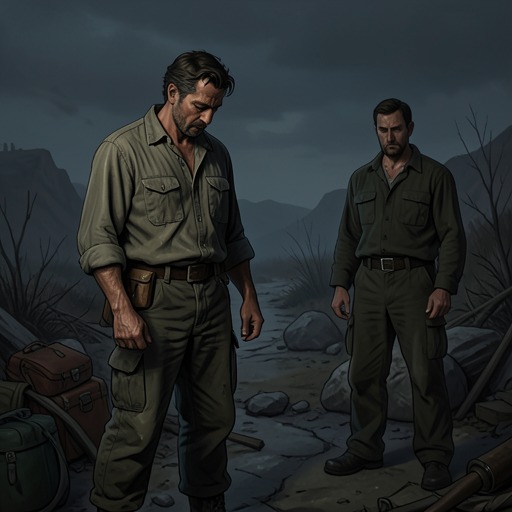
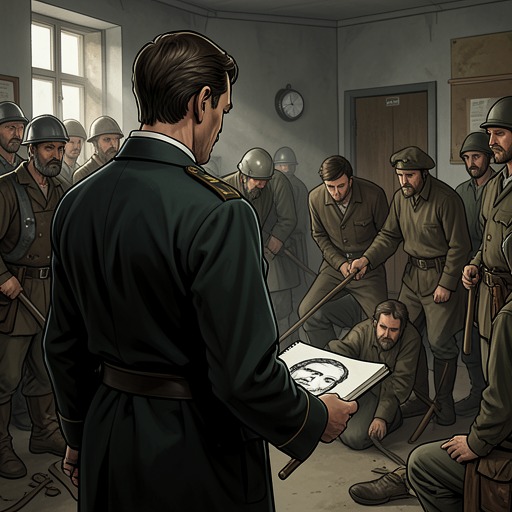
When Dorrigo attempts to reconstruct the beating, his account is notably uncertain. He recalls Major Nakamura, the Goanna, and two other Japanese engineers, but then questions whether there were two or three. He cannot settle even that small count. The uncertainty is not presented as a discovery that the event did not happen; Darky's beating is precisely what Dorrigo is trying to remember. Rather, the gaps make him doubt his adequacy as a witness and frustrate his effort to make a reliable written account. One detail remains sharply lodged in his memory: a man stopped, raised a hand to his forehead, flicked away sweat, and then returned to beating Darky. Dorrigo remembers the pause as ordinary and brief, like a worker stopping momentarily during hard labour before resuming a task. Its banality is central to his later difficulty. The pause offers no explanation, change of heart, or interruption that would give the violence a comprehensible turning point. In Dorrigo's recollection, the beating could become tedious to those carrying it out, as repetitive as the work itself, and still continue. Dorrigo also remembers the prisoners watching. In the later scene of recollection, three hundred men look on as three men destroy someone they know, yet do nothing. Dorrigo includes himself among them: he arrived too late, did too little, and came to feel that he had somehow assented to what was happening. The memory therefore concerns not only what the attackers did but also the paralysis of the witnesses and the responsibility Dorrigo attaches to his own presence. His conviction that he had failed is part of the event's continuing force, not a conclusion that resolves it.
The Failed Act of Telling
Years afterward, Dorrigo is asked to write a foreword for a book of sketches and illustrations made by Guy Hendricks. Dorrigo had carried and hidden Hendricks's sketchbook through the rest of the war; preparing the foreword brings the death and the day of the cremation back into his attention. He had not thought about Darky for years, he realizes, until he began trying to write about the beating. Writing does not simply recover a finished memory. It reopens the scene and exposes how little of it he can confidently arrange into prose. The difficulty is sharpened by what Dorrigo cannot retrieve. He wants to remember Darky's face, his singing, and his sly split smile, but the image that comes to him instead is a dirty, bruised-looking sky seeming to race away from the horror. This recurring substitute matters: Dorrigo reaches for the person and finds the setting of his suffering. The sky does not provide evidence about the beating's precise sequence; it marks the limit of Dorrigo's attempt to recover Darky as a particular person rather than as part of a traumatic scene. In conversation with Lynette Maison, Dorrigo admits that he became stuck while writing the foreword. He can name the period of labour, the beating, and its coincidence with Guy's cremation, yet he cannot make the account sound true by giving it a stirring moral finish. His hesitation keeps the writing from turning the event into a simple story of courage or meaning. The remembered facts remain, but the act of telling exposes their incompleteness and Dorrigo's discomfort with the part he played as witness.
Aftermath and Narrative Significance
The memory also reaches beyond Dorrigo's effort to write. On a later occasion, a journalist's refusal to bend to the authority of Dorrigo's celebrity recalls Darky to him. Dorrigo cannot identify a shared face, manner, gesture, or habit. What he senses instead is a resemblance in the journalist's integrity and insistence on truth. The recognition brings shame: Dorrigo wonders whether he had been foolish and wrong, and whether since the day Darky was beaten he had been sure of anything. Darky's memory thus becomes a measure against which Dorrigo assesses his own judgment and his public standing. The event also informs Dorrigo's understanding of collective survival. The prisoners of Evans's J Force remain, in his account, one thousand people bound by belief in one another, even as deaths diminish their number. That shared identity does not erase individual failures of help or witness. At the beating, Dorrigo sees men who know Darky and nonetheless remain still; in the aftermath, the dead remain part of what the living must carry. The two ideas coexist uneasily: comradeship sustains the prisoners, but it does not guarantee that they can protect one another in every moment. Dorrigo's later reflection enlarges the episode into a bleak recognition of violence's persistence. Watching the men fail to intervene, he feels that they have entered a world in which violence seems eternal and human beings transmit it from one to another. The narrative does not make this recognition a justification for the attackers or a claim that violence is inevitable in every circumstance. It shows how the beating alters Dorrigo's sense of the world, leaving him with the fear that brutality can outlast the institutions and ideals that surround it. His inability to write a definitive account is part of that aftermath: the event remains important precisely because memory preserves its consequences while refusing to supply a complete, consoling explanation.