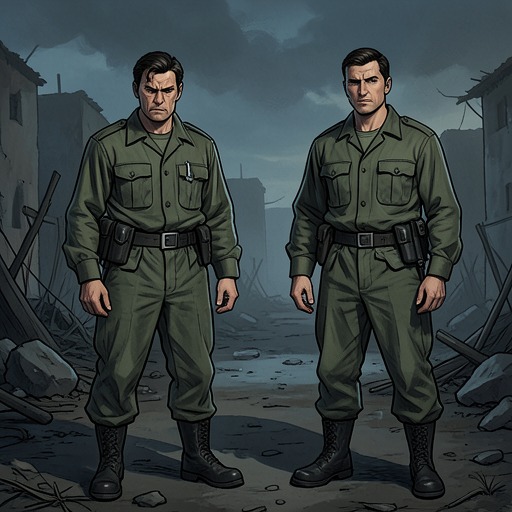
Darky Gardiner–Tiny Middleton comradeship
The Narrow Road to the Deep NorthDarky Gardiner and Tiny Middleton’s comradeship is forged in forced labor, tested by the damage Tiny’s competitiveness causes, and remade when Tiny can no longer rely on his formidable strength. Darky resents him for raising the work demanded of everyone, yet stays beside him through collapse and decline; later, Tiny returns that care. Their changing bond gives practical form to the camp’s understanding that an individual’s survival cannot be separated from the survival of his companions.
Workmates and Unequal Burdens
Tiny and Darky are assigned complementary jobs at the rock face: Tiny pounds a steel bar with a sledgehammer to make holes for explosives, while Darky holds the bar and turns it after each blow. Tiny approaches the work as a contest. He takes pride in completing his quota before the other prisoners, treating this achievement as a personal victory over his captors. But the Japanese engineers use his output to raise the quota for everyone. Darky is therefore not simply Tiny’s partner at work; he is among those who must bear the consequences of Tiny’s determination.
As the daily target rises from one metre to two and then three, Tiny continues to meet it faster than required. Other prisoners try to conserve their limited strength, but the quota makes that strategy harder. Sheephead Morton voices the resentment that Tiny’s behavior brings upon the group: his records become the measure imposed on men who are fevered, starving, or already dying. Tiny imagines his effort as a contest with the guards, while Darky sees that the Japanese benefit from it and the prisoners pay. The difference between Tiny’s self-understanding and the work’s collective consequences becomes the first deep strain in their relationship.
Darky’s anger grows as Tiny repeats this pattern. Tiny treats the cutting like competitive work from his earlier life, pursuing the status of the fastest worker even as the conditions worsen. When the Speedo intensifies the labor, the prisoners are driven to work longer, with less food and more punishment; night shifts begin as they fall behind the railway schedule. The distinction that matters to Darky is stark: Tiny may experience each new effort as his own triumph, but the engineers turn it into a demand on everyone. Their partnership at the steel bar thus makes the conflict intimate. Darky works beside the man whose performance helps make his own burden heavier.
Collapse and the Work of Staying
During a night shift in the cutting, Tiny’s strength finally falters. Malaria has weakened him, and he can no longer handle the sledgehammer with his former control. When he drops to the ground, the Goanna beats him. The change in Tiny is more than a loss of physical power: the man who had seemed able to absorb every hardship begins to sob and repeatedly cries out without making his meaning clear. Darky witnesses a collapse that neither the earlier image of Tiny’s invulnerability nor the camp’s usual stoicism can explain away.
Darky responds by helping Tiny back to his feet and changing their working arrangement. He takes the sledgehammer while Tiny holds the steel bar. Because Tiny becomes immobile, Darky gently prompts him to turn the bar after each blow, repeating the instruction throughout the night. Their old division of labor remains recognizable, but its balance has reversed: Darky now supplies the strength and steadiness that Tiny once contributed. The small repeated task gives Tiny something to hold and lets the pair continue together when the old competitive rhythm is gone.
In the weeks that follow, Darky watches Tiny’s health and attention deteriorate. Tiny’s once-prized body wastes away; he becomes indifferent to the beatings and to the conditions around him. Darky remains his companion, but care does not erase resentment or revulsion. He privately thinks Tiny has given up, then recognizes that this judgment comforts him with the false idea that survival depends on choosing correctly. He understands that he has no such control over death. His divided response—disgust at Tiny’s decline, fear of what it means, and determination to help him—makes their comradeship more difficult and more substantial than uncomplicated affection.
Food, Reciprocity, and Recognition
Care becomes material when Darky shares food with Tiny. One night, after saving part of a small fried rice ball, Darky wakes Tiny and divides an egg and the rice between them. He does not make a public gesture of generosity; the two eat quietly, out of sight of the other prisoners. The secrecy reflects the scarcity in which they live, but the act also marks how far Darky’s conduct has moved from his earlier hostility. He gives Tiny a share despite having reason to blame him for making the work harder.
The exchange is not one-way. Later, when Darky is down, the much thinner Tiny helps him to his feet and gives him half of his own rice ration. Rooster MacNeice sees Tiny return the help by sacrificing food, a choice that unsettles his expectation that a humiliated person would act only from self-interest. For Darky and Tiny, however, the gesture belongs to a relationship already sustained by practical care: one has stayed when the other could not manage alone, and now the assistance passes in the other direction. Tiny’s diminished strength does not cancel his capacity to act for Darky.
Their fellowship is also visible when they approach the Wailing Wall in heavy rain. Tiny crawls toward the gathering of prisoners while Darky walks beside him. Darky offers support twice, but Tiny insists on making the journey under his own effort. The scene holds two forms of care together: Darky accompanies him and makes help available, while Tiny retains a measure of agency by refusing to be carried. To Rooster, who has mocked and despised them, the sight of the pair’s connection is difficult to comprehend. He recognizes that the two men possess a loyalty he does not, and that recognition turns his response into hatred rather than admiration.
Comradeship Under Captivity
Darky and Tiny’s bond does not depend on resolving their differences. Darky continues to think Tiny foolish and to feel revulsion at his decline, yet he stays and helps him. Tiny, after years of acting as though strength could set him apart, accepts Darky’s support and later shares what little food he has. Their relationship can therefore hold resentment and attachment at once: Darky does not need to regard Tiny as blameless in order to refuse to abandon him.
The significance of that choice extends beyond the pair. In the camp, illness and exhaustion repeatedly leave men unable to help one another, while survival pressures them to conserve their own energy. Darky’s care for Tiny and Tiny’s later help to Darky offer a counterpractice to that isolation. Elsewhere, Dorrigo Evans sees prisoners watch Darky’s punishment without intervening and recognizes how a group can become implicated through its helpless inaction. Against that larger failure, the companions’ small acts—turning the steel bar, dividing food, walking beside a crawling man—do not undo the violence around them. They show, instead, what responsibility can still look like within it.
The comradeship’s emotional force lies in its lack of a clean transformation. Darky’s earlier hatred does not simply disappear, and Tiny’s decline does not become a lesson in noble suffering. Darky knows that judging Tiny as weak helps him imagine that he himself can choose whether to live, an assurance he no longer believes. What remains is the decision to keep helping. Their shared survival is not a reward for virtue or a guarantee of rescue; it is a responsibility sustained between two vulnerable men, and one that neither can carry alone.