Dorrigo Evans—Ella Lansbury
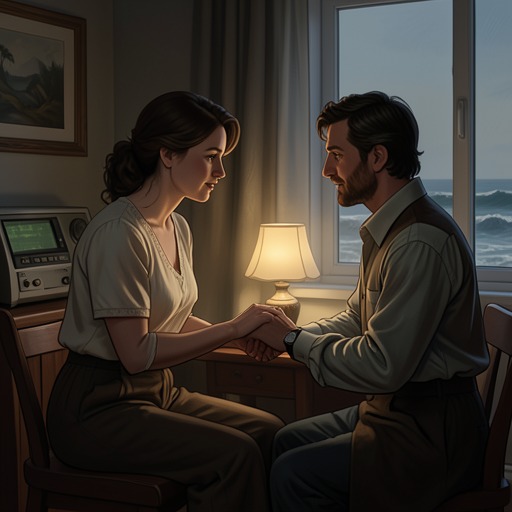
The Narrow Road to the Deep NorthDorrigo Evans and Ella Lansbury’s marriage is shaped from its beginning by a gap between the life Ella believes they share and the one Dorrigo feels himself living. He returns from war unable to recover his former attachment to her, yet yields to the public expectation that their old engagement must become a marriage. Ella offers enduring affection and practical care; Dorrigo, burdened by guilt and emotional numbness, increasingly meets that devotion with distance, betrayal, and anger. Their relationship becomes one of the clearest forms of his postwar submission to circumstance: he fulfills the expected role of husband while remaining unable to inhabit it wholeheartedly.
Wartime Engagement and Unequal Expectations
Dorrigo had proposed to Ella in 1941, during what he remembered as his last leave with her before embarking overseas. The proposal was not the beginning of a secure mutual commitment in his own mind. Ella had repeatedly asked why he had not proposed, and Dorrigo recalls using the question as a route to sexual intimacy, seeking relief both from her questioning and from his thoughts of Amy Mulvaney. The memory leaves him ashamed, made worse by the suspicion that Ella may have understood what was happening. Being with Ella did not give him the oblivion he sought: she reminded him more painfully of Amy.
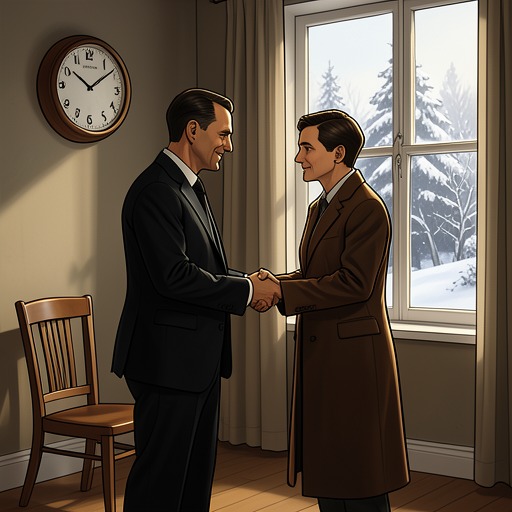
When Dorrigo returned to Sydney in the autumn of 1948, after seven years apart, he was horrified and impressed to see Ella waiting for him. He had spent nineteen months working across Southeast Asia on military matters including repatriation, war graves, and postwar reconstruction, delaying his return until he could no longer avoid choosing between an army career and civilian life. The war’s end had not ended his inward allegiance to wartime danger and upheaval. Facing civilian life, he resolved to approach it as another obstacle, with charm and daring, and tried to treat the follies of the past as things time would wash away.
The reunion exposes how little that resolve can repair. Ella’s conventional greeting carries, as Dorrigo reads it, joy, relief, love, and the vindication of fidelity. He feels outside those emotions. Even after recognizing her voice and kissing her, he cannot remember her name; her lips seem dry and disappointing, and the name returns to him only eventually. His estrangement is not simply an abstract reluctance to return to domestic life: it appears in the basic failure to recognize the woman who has waited for him.
Marriage by Momentum
Ella tells Dorrigo not to say anything false, and he answers that he is entirely false. Her embrace and the unquestioning assumptions of the people around them then make the old engagement feel less like a choice than an arrangement already settled. To those around Ella and Dorrigo, their marriage is the obvious conclusion to a wartime engagement. To Dorrigo, the intervening years have contained several lives, while Ella seems to have devoted hers to an idea of him that he scarcely recognizes.
He does feel flashes of anger and defiance, but exhaustion and the prospect of choosing for himself weigh more heavily. Dorrigo regards his mind as a prison camp of horrors and does not want to give those thoughts additional weight. He therefore yields to the apparent sobriety of the people around him, hoping their confidence might draw him toward a better life. In a reversal central to their relationship, the prospect that frightens him most becomes the course he follows: three weeks later, in an alcoholic haze and in a new suit chosen by Ella, he marries her at Saint Paul’s Cathedral.
The wedding does not resolve the uncertainty that preceded it. Dorrigo again loses his sense of his own name in Ella’s presence before remembering Alwyn. Looking at her in lace and orange blossom, he can find nothing attractive in her. At the reception, he does not voice his wish to deny the identity and commitment being assigned to him. Instead, he tells a story of a love that survived seven years apart, casting Ella as Penelope and himself as a returned Ulysses. The applause and laughter accompany a public account of fidelity that conflicts with his private preoccupation and doubt.
Infidelity, Duty, and Emotional Distance
For the rest of his life, Dorrigo yields to circumstance and expectation, eventually calling those pressures duty. The more guilty he feels about his marriage, and later about his failures as a husband and father, the more urgently he tries to do what is good in public life. In private, he treats himself as the bad element and acts against the bond he has publicly affirmed: a month after the honeymoon, he sleeps with Ella’s best friend, Joan Newstead, at a shack in Sorrento while everyone else has conveniently gone elsewhere. The affair makes the distance between the wedding story and his conduct concrete, while his use of duty as a guiding principle does not repair the harm within the marriage.
In later years, Dorrigo carries a deep, inaccessible turbulence that he experiences as a void made up of unfinished things. He drinks heavily, from wine at lunch and whisky in his morning tea to spirits before and after dinner. His moods become less predictable, and he hurts Ella with words, indifference, and anger. After her father’s funeral, he shouts at her for no good reason. His distress does not become an honest separation: he wants to love her and fears that he does love her, but believes it is not the way a husband should love his wife. He wants to make her recognize that he is not for her, as if her recognition might force a release from his own inward sleep. Instead, her hurt, tears, and sadness deepen his sense of hibernation.
Ella’s Care and the Marriage’s Imbalance
Ella cannot imagine living without loving. Having been loved by her parents and having loved them in return, she experiences love as something central to her nature, seeking people on whom she can lavish it. She listens to Dorrigo’s hospital problems, grieves with him when he loses a patient, and sympathizes with his disputes with bureaucrats and surgeons. Her care is attentive and sustained, extending into the professional frustrations that occupy his working life.
As she grows older, Ella is admired for her composure, style, compassion, and easygoing manner. Her confidence in Dorrigo is so complete that she repeats his opinions as if they were her own, including his complaints about bureaucrats and surgeons. That solidarity does not make him feel understood. He is frustrated by her repetition even as it demonstrates how closely she has attached herself to his outlook. He increasingly fixes on the slight upturn of her nose, noticing it more often until, at times in the morning or when he returns from work, he can see little else.
Their marriage thus persists through a sharp asymmetry: Ella continues to offer belief, sympathy, and love, while Dorrigo experiences her affection as both a source of guilt and an unwelcome reminder of his inability to respond as he thinks a husband should. The evidence presents no corresponding turn toward reconciliation. Instead, the relationship’s recurring pattern is her effort to sustain him and his retreat into drinking, anger, and emotional absence—a private failure set against the public duty by which he tries to define himself.