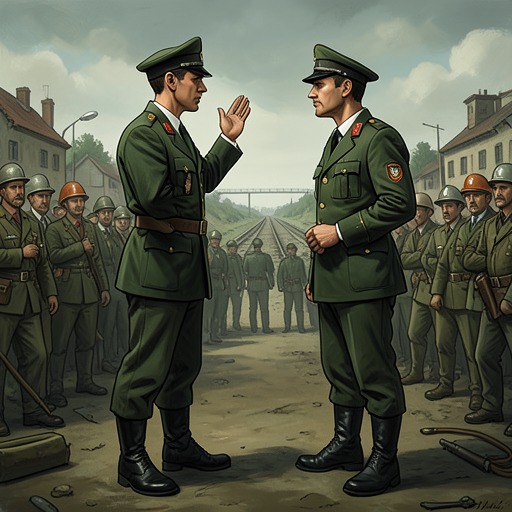
Dorrigo asks Nakamura to let the POWs rest
The Narrow Road to the Deep NorthDorrigo Evans asks Major Nakamura to let the prisoners of war rest after the Speedo has run for thirty-seven consecutive days. The appeal is made during an evening of cards and whisky, but its stakes reach beyond the social gathering: Dorrigo argues that a day’s rest would help preserve the men and make the railway work more sustainable, while Nakamura answers from an imperial outlook in which their deaths can serve the Emperor. The exchange brings practical negotiation and incompatible ideas of human responsibility into the same conversation, without establishing that Dorrigo secures the rest he seeks.
The moment for an appeal
The request follows a card game in which Major Nakamura wins the final hand. He is known to be poor at cards, and both his junior officers and the Australian prisoners understand that it is better for him not to lose. The game therefore unfolds under an unspoken accommodation: its result is not simply a matter of skill, but of the hierarchy governing the room. Nakamura thanks the Australian colonel and major through Lieutenant Fukuhara, then stands, stumbles backward, nearly falls, and recovers. Despite the near fall, he appears unusually ebullient.
The whisky Nakamura has supplied has also affected the Australian officers. Dorrigo Evans rises carefully and judges that the time has come to speak. He has held back throughout the evening, aware that he must take up his position as the Big Fella. The timing matters: he makes the appeal after the formal social exchange, but before the gathering has fully broken up, when he can address Nakamura directly and still present the request as a matter of shared practical interest.
A case for rest within the railway’s terms
Dorrigo begins with a concrete measure of the men’s labor: the Speedo has continued without stopping for thirty-seven days. Rather than frame his request as a rejection of the railway or a direct challenge to Nakamura’s authority, he argues that the Emperor’s wishes are best served by making use of the prisoners’ resources wisely. In his account, rest is not opposed to construction; it would help the work proceed by conserving the men’s energy and, beyond that, preserving the men themselves.
That argument joins operational prudence to concern for the prisoners. Dorrigo does not conceal the destructive conditions behind an abstract complaint: his case rests on the length of the continuous work and the predictable cost of exhausting the labor force. Yet he chooses language that meets the commander within the stated purpose of the railway. By presenting rest as a means to build it more effectively, he attempts to make protection of the men legible even within a system organized around their labor.
Nakamura’s answer
Dorrigo expects Nakamura to react with anger or violence, but Nakamura laughs as Lieutenant Fukuhara translates the appeal. He makes a brief aside and starts to leave. Fukuhara then conveys Nakamura’s view that the prisoners are fortunate because dying for the Emperor will redeem their honor. The answer does not address Dorrigo’s proposed day of rest on its practical merits; it recasts the prisoners’ possible deaths as service and honor.
Nakamura turns back and continues. Through Fukuhara, he acknowledges that war is cruel, but presents war as an expression of human beings and their conduct. He distinguishes the railway, which may kill people, from his own role, which he describes as making the railway rather than making human beings. The distinction separates the project from its human consequences even as Nakamura recognizes that those consequences exist. He further contrasts Dorrigo’s description of the work as unfreedom and cruelty with his own language of spirit, nation, Emperor, and destiny, and treats progress as possible without freedom. His reply thus answers a request about a day’s rest with a broader defense of the system’s purpose and terms.
An unresolved negotiation
The scene ends without recording a decision about the prisoners’ rest. Dorrigo bows after Nakamura’s statement, and Squizzy Taylor, identified as a major and Dorrigo’s second-in-command, bows as well. The gestures close the exchange formally, but do not demonstrate agreement: no permission, revised work schedule, or subsequent rest is established in the evidence for this episode.
The appeal’s importance lies in the contrast between its measured proposal and the scale of Nakamura’s justification. Dorrigo seeks a limited interval in which the prisoners might recover, and supports it by appealing to the railway’s own needs. Nakamura answers by treating death as an honorable outcome and freedom as unnecessary to progress. The scene therefore shows both the narrow opening available to Dorrigo as a commander trying to protect the men and the ideological barrier his practical argument encounters. Whether the appeal changes their conditions remains unanswered.