Evans's Unit Transferred to the Death Railway
The Narrow Road to the Deep NorthThe transfer of Evans’s J Force to the Death Railway was the point at which a dispersed group of Australian prisoners became a railway work force. After surrender in Java, the men were moved through Changi and onward to Siam; there, they were directed to clear the route and establish a camp. Their journey carried them from one form of confinement into a project whose military purpose depended on forced labor and whose construction would cost many lives.
Strategic Background
The railway arose from Japan’s worsening military position in 1943. The Allies were supplying Chiang Kai-shek’s Nationalist army in China through Burma, while American control of the seas made maritime supply difficult for Japan. Japanese leaders sought a land route to supply their forces in Burma and support further ambitions in India, but the Empire lacked the machinery, money, and time to build a railway by ordinary means. Its plans instead depended on the labor of prisoners and other enslaved people.
The proposed route was marked on the ground by surveyors’ pegs laid by Imperial Japanese Army engineers. It was planned as a 415-kilometre line running from north of Bangkok through to Burma. At first, it existed as a set of plans and orders; the transfer of prisoners made the projected route a work site. The wider scale was immense: of 22,000 Australian prisoners, most of whom had surrendered at the fall of Singapore, 9,000 would be sent to work on the railway.
From Java Through Changi
Before reaching the railway, the men had endured six months after surrender in Java. They were then transported to the coast and sent toward Siam in a group of about a thousand, crowded into the hull of a deteriorated vessel for three days on the way to Singapore. From there they marched to Changi Gaol. The contrast with the established camp was sharp: its barracks, lawns, gardens, and well-equipped appearance stood against the condition of Dorrigo Evans’s men, who were emaciated, in mixed Australian and Dutch uniforms, and often without shoes.
The Australian commander at Changi had labelled them Java Scum. Dorrigo Evans asked Brigadier Crowbar Callaghan, who commanded the Australian prisoners there, to provide clothing, boots, and provisions. Callaghan refused. He also tried, unsuccessfully, to remove Dorrigo Evans from command because Evans had challenged his refusal to open the stores. This dispute matters to the transfer’s circumstances: the men departed Changi without receiving the supplies Evans had sought, while remaining under his command.
The men played a football match against Changi’s leading side and lost by eight goals. Two weeks later they left in the same rags in which they had arrived. A proposed escape by Wat Cooney, who had suggested hiding in crates bound for a ship to Sydney, came to nothing; he left with the rest. Their official designation became Evans’ J Force, marking them as a unit even as the transfer carried them away from the comparatively orderly camp and toward railway labor.
The Journey to the Work Site
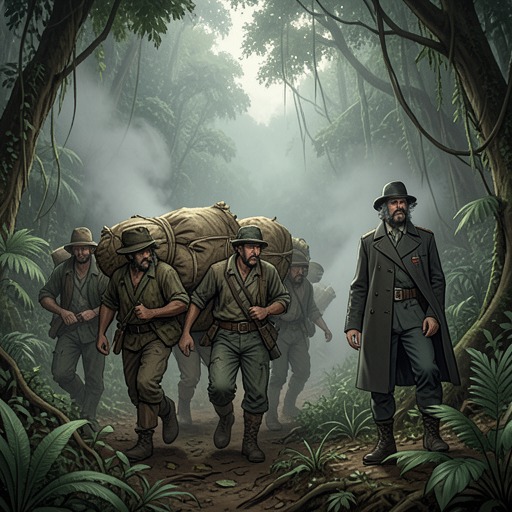
The unit was packed into closed steel rice wagons, with twenty-seven men in each and insufficient room even to sit. The train travelled for five days, covering about a thousand miles. The men took turns sitting and slept in cramped arrangements; there was no food during the journey, and three men died before it ended. At Ban Pong, about forty miles from Bangkok, the prisoners were transferred to trucks, with thirty men crowded into each vehicle.
The road carried them through jungle and deep dust to Tarsau, where they arrived late in the evening. After sleeping on the ground, they continued in the trucks at dawn along a rough track into the mountains. At its end, they marched until late afternoon and stopped at a clearing beside a river. The river offered a brief interval for swimming after the confined train and truck journey. That pause did not change the direction of events: the next morning, guards led the prisoners three and a half miles through the jungle toward the planned line.
The Railway Becomes Labor
At the work site, a Japanese officer told the prisoners that their labor would help the Emperor’s railway and presented their status as prisoners as something their work could redeem. He pointed toward the surveyors’ pegs, which soon disappeared into the jungle. The military language of honor thus accompanied the immediate reality of a work assignment: the men were given blunt axes and rope and ordered to fell, grub, and clear a kilometre of giant teak trees along the proposed route.
The clearing was only the first task. After completing it in three days, the prisoners were told to build their own camp some distance away. They cut and burned bamboo, trees, and lower growth, levelled the ground, and hauled large clumps of bamboo together by rope. The railway’s engineering plans therefore translated directly into labor demands: the marked route required not only clearing but also the construction of the place where its workers would be held.
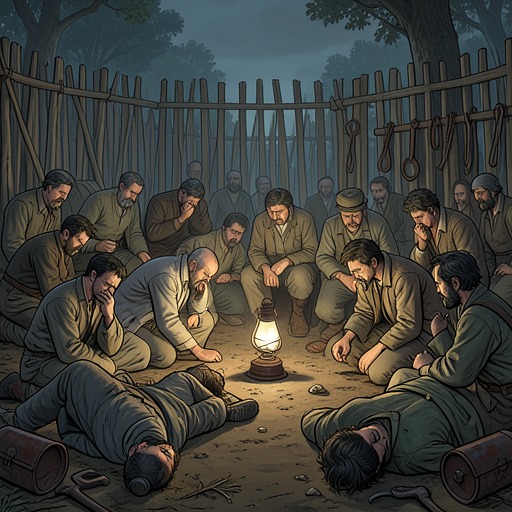
The initial work took place before the later escalation known as the Speedo. As the dry season gave way to monsoon conditions and food dwindled, the Speedo removed rest days, raised quotas, lengthened shifts, and sent prisoners to work day and night. The transfer was consequently the start of a process that shifted from difficult clearing to an increasingly punishing labor regime. In later negotiations, Colonel Kota stated that the work was to be completed even if most prisoners died, or even if everybody died. The railway’s demands were treated as overriding the lives of the people made to build it.
Consequences and Significance
The unit’s transfer belongs to a much larger history than its own movement. The railway was completed, and on 25 October 1943 locomotive C 5631 travelled its length with Japanese and Thai dignitaries aboard. The work force included Allied prisoners as well as hundreds of thousands of Asian laborers; estimates of Asian laborer deaths vary widely, and the total is unknown. Among the Australians sent to the railway, one in three would die. The event thus marks both the beginning of Evans’ J Force’s labor on the line and the entry of its members into a system whose scale exceeded any one unit’s experience.
The railway’s later history reverses the permanence its planners sought. After the war, its remaining workers were freed; the route was abandoned, dismantled, or taken apart, and its embankments, bridges, and cuttings gradually gave way. The line that had organized prisoners’ labor did not endure as its makers intended. Its eventual disappearance contrasts with the enduring difficulty of accounting for the dead: the railway’s material traces could be removed, while the names and numbers of many who built it remained unrecorded or uncertain.