Fish
The Narrow Road to the Deep NorthThe Fish in Nikitaris’s Fish Shop recur as more than scenery: Darky Gardiner sees their confinement as kin to the prisoners’ own, and his former comrades eventually turn that comparison into an act of release. The fish move through the story from an image held in memory to living creatures carried out of a locked shop and returned to open water. The rescue is impulsive and imperfect, but it gives physical form to a fellow-feeling that had survived the railway camp and the war.
The Fish in Darky Gardiner’s Memory
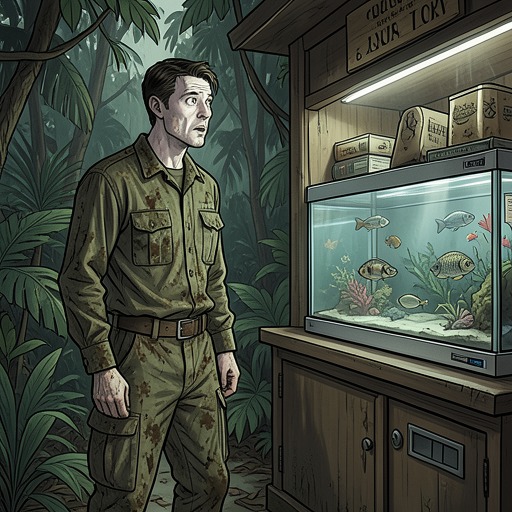
Before the war, Darky Gardiner remembers the fish tank at Nikitaris’s Fish Shop as part of an ordinary visit with his girlfriend. In the jungle, however, he cannot stop thinking about the fish swimming there. He calls their confinement unnatural and understands them as prisoners of war too. His imagined remedy is practical and absolute: when he gets back, he will get the fish out of the tank and put them in the sea, whatever it takes.
The idea reaches his companions through Shugs’s account of Darky speaking while seriously ill. Shugs cannot tell whether Darky is fully aware of the camp or lost in a remembered scene from before the war; even the images he offers are possibilities rather than certainties. That uncertainty matters. The fish occupy Darky’s mind alongside fragments of home, but the account does not make his mental state transparent or reduce the remembered shop to a simple escape. The fish are both the particular animals he once saw and the focus of a promise that persists under imprisonment.
A Memory Shared in the Camp
Squizzy Taylor tells Darky to stop exciting himself and points out that he is ill and needs hospital care. The camp has little medicine and little food, so Shugs can offer rest as the immediate practical measure, not the treatments he names. Against this deprivation, Darky’s recollection shifts from the fish to a remembered meal at the shop: two couta, battered scallops, and bread with butter. The food is not a solution to the men’s present hunger; it is a precise fragment of a life beyond the camp.
Darky repeats the meal, and Squizzy, Shugs, and Darky laugh together in the mud. The episode binds the fish to more than Darky’s solitary wish: his remembered world becomes something his comrades can hear, repeat, and share. The laughter does not remove their circumstances, but it briefly makes room for companionship inside them. In this earlier telling, freeing the fish remains a future intention; the story’s later action will give the intention a consequence beyond the camp.
The Break-In and Release
After the war, the former prisoners walk through an almost empty Elizabeth Street to Nikitaris’s Fish Shop. The shop is shut, its interior dark, while the illuminated tank at the front contains several fish: flatheads, a trumpeter, silver trevally, and a leatherjacket. The return does not match the scene imagined in the camps. Darky’s girlfriend is not there, and the men find no bustling shop or welcoming meal—only the tank and its circling inhabitants behind glass.
Jimmy Bigelow is acutely aware of feeling empty and unable to summon emotion simply by wishing for it. He picks up a rock, turns it in his palm, and throws it through the shop window. The action changes the men’s stillness into a collective breach: the others begin throwing rocks too, and the window gives way. Gallipoli von Kessler improvises with a chip fryer, using it to lift the fish from the tank. After a few mishaps, the group has gathered them in two mop buckets.
They carry the buckets to Constitution Dock, taking care not to spill the water as they walk. At the edge of the dock, Sheephead Morton tips one bucket, and the fish drop into the water; the men release the fish from the other bucket as well. Darky’s remembered intention has become the group’s deed, though Darky is not present in this scene. The rescue is not a return to the exact sea from which the shop’s fish came: the text places their release in the harbour at the dock. What matters in the scene is the shift from looking through glass to carrying the fish out and letting them go.
Aftermath and Significance
The next night, the men retell the break-in at the Hope and Anchor with enthusiasm, but their excitement is accompanied by growing shame. Jimmy says they should visit the shop and pay for the broken window. When they return, the lights are on and the window has already been replaced, though it has not yet been painted. The account thus keeps the release from becoming an uncomplicated triumph: the men have acted on Darky’s old wish, but they have also damaged someone else’s property, and Jimmy insists on taking responsibility for that cost.
The fish’s significance rests on the gap between metaphor and action. Darky’s comparison makes the tank’s confinement legible to men who have themselves been held against their will; the later escape from the tank gives that recognition a concrete, if rough-handed, expression. Yet the fish are not only symbols for the prisoners. They are actual animals whose movement from the shop to the dock is the purpose of the men’s expedition. Their release connects an intimate memory from before the war with the former prisoners’ uneasy return to ordinary life, where solidarity, impulsive damage, and responsibility to others exist together.