Forgetting faces
The Narrow Road to the Deep NorthForgetting faces is a recurring wound in Dorrigo Evans’s memory: long after war, he cannot fully recover the faces of the people he loved and lost, even as he tries to honor the dead by writing about them. The failure is not simple forgetfulness. It separates remembered details from the human presence they once belonged to, leaving Dorrigo with names, gestures, and images where recognition should be. The novel makes that gap central to the difficulty of mourning and to the limits of his later attempts at remembrance.
The Failure of Recognition
The image is established amid a fire. With the flames behind him, Dorrigo thinks of a woman he loved, including the red camellia in her hair, but cannot summon her face however hard he tries. The remembered details remain precise enough to suggest intimacy, while the person they should complete remains unavailable. The contrast makes the loss more than an absence from the present: even memory cannot return the face to him. The novel’s framing account identifies his earlier love affair with Amy Mulvaney as a force that continues to haunt him, placing this failure within a history of attachment that time has not resolved.
The same inability reaches beyond romantic memory to the men who died in the camp. In an intimate conversation, Dorrigo tells the woman beside him that he cannot remember Darky Gardiner’s face. The admission is not presented as a lack of affection or concern: Darky’s name comes readily, and Dorrigo later thinks about the pointlessness of his death. What fails is his ability to make the remembered man visible to himself. The distinction between knowing who Darky was and being able to see his face gives the loss its particular force.
Darky Gardiner and the Railway Sky
Dorrigo’s failure to picture Darky becomes especially painful when he tries to write an account of Darky’s beating. The attempt brings back the sky during the Speedo, the forced labor on the Line, rather than the face he wants to remember. Darky’s death and the conditions surrounding it return as an impersonal landscape; the person disappears behind the setting in which men died. Dorrigo wants to recover Darky not only as a name but through his singing and the sly split smile he remembers. Yet those fragments do not overcome the image of the dirty, moving sky that seems to flee the place of suffering.
The recollection also preserves Darky’s way of thinking about chance. He had spoken of every throw as a first one, an idea Dorrigo remembers as beautiful. The thought offers no explanation for why Darky died, and Dorrigo’s own reflection insists that there was no point to the death. The remembered phrase and the failed face therefore coexist without reconciling one another: Dorrigo retains something of Darky’s voice and outlook, but cannot turn those remnants into a complete, recoverable presence. The failure of memory is sharpened by the knowledge that the man mattered.
Memory, Fame, and the Work of Writing
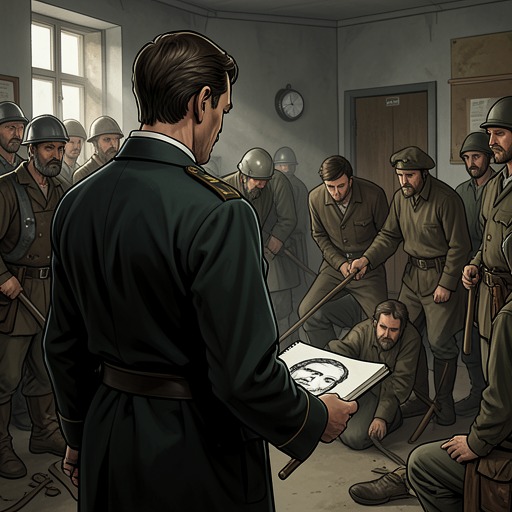
At seventy-seven, Dorrigo is writing a foreword for a book of sketches and illustrations by Guy Hendricks, a prisoner of war who died on the Line. During the war, Dorrigo carried and hid Hendricks’s sketchbook for the rest of the conflict. The task places remembrance before him in a concrete form: another man’s images have survived, and Dorrigo has been asked to introduce them. He hopes to correct the record by focusing on those who have been forgotten rather than on himself. Yet he fears that even an act intended as humility may increase his own standing, leaving him caught between the wish to restore others to memory and the public attention attached to his name.
That tension is expressed in the contrast between Dorrigo’s public visibility and his private inability to see the faces of the dead. His face is everywhere, while theirs remain inaccessible to him. The problem is therefore not only whether he can write about the past, but whether writing can serve the people it seeks to remember without making him its center. Hendricks’s surviving sketchbook offers a record made by a dead prisoner; Dorrigo’s foreword is a later attempt to frame that record and acknowledge those whom fame has obscured. Neither task guarantees that the lost can be restored.
The Meaning of the Missing Faces
The recurring failure joins Dorrigo’s private attachments to his responsibilities as a survivor. He cannot recall the face of the woman he loved, and he cannot summon Darky’s face even while remembering Darky’s death, singing, and characteristic smile. These are different losses, but both expose the distance between retaining fragments and recovering a person. The novel does not resolve that distance by presenting memory as a complete archive. Instead, it allows a name, a remembered phrase, or an image of the sky to remain where a face should be.
Forgetting faces also complicates remembrance as a moral act. Dorrigo wants the dead to receive attention rather than have their stories eclipsed by his own, yet the very people he wants to honor are those he struggles to picture. His inability does not cancel his care; it makes the limits of care visible. Memory can preserve the fact of a death, the injustice surrounding it, and particular details of a life without restoring the person whole. In this way, the missing faces become an image of both grief’s persistence and its irreducible incompleteness.